Once you understand how helicopters work.
And the cleverness of the swashplate.
And how steering linkages elegantly compensate for gyroscopic precession.
And how the rotors will autorotate in an emergency.
You never want to get into one of those flying bolt buckets again.
"One fleck could ruin this entire assembly..."
This segment from "How It's Made" shows the lengths taken to keep a lens completely clean during its production.
@HumanMilitia@BingoBertie@HannahRHON@mattrife And Thatcher wasn't worth her wait in shit and also developed dementia which was probably attributed to that famous ability to not sleep
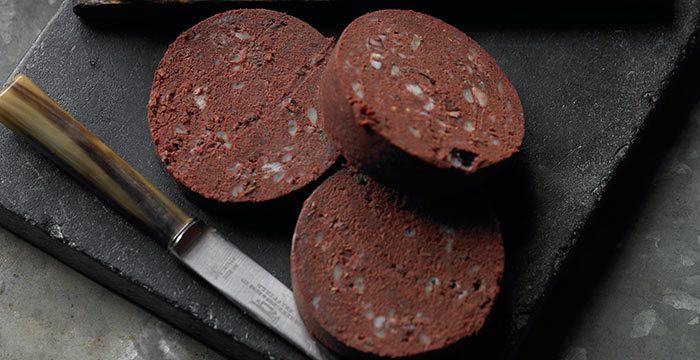
Black pudding is one of the very few offal foods in Britain that survived the 20th-century collapse of traditional cooking.
When the British kitchen turned against liver, kidney, heart, tongue, tripe, sweetbreads, faggots, and trotters, black pudding somehow got through. The generation that grew up in the 1970s rejecting their grandmothers' offal made an unspoken exception for the thick black disc on the breakfast plate. It survived by stowing away inside the Full English, carried through the century by the cultural weight of a breakfast format no government campaign has managed to dismantle.
The recipe has not changed in six hundred years. Fresh pig's blood, pinhead oatmeal, beef suet, onion, salt, pepper. Stuffed into a natural casing, coiled into a ring, simmered until it sets. Stornoway defends its version under PGI. Bury uses pearl barley and eats it boiled with mustard. Every butcher from Morecambe to Fraserburgh has a recipe his father handed him.
A ring from a decent butcher costs about £5. Per 100 grams it delivers substantial heme iron in the form the human gut actually absorbs, substantial B12, complete protein, and the specific lipid profile of real rendered suet.
Approximately 20% of British women of childbearing age are anaemic. The NHS response is ferrous sulphate tablets at £4 a month, which cause nausea, constipation, and dark stools, and must be taken for six months to correct a deficiency that two slices of black pudding a week would correct in a fortnight.
Faggots went. Brains went. Tripe went. Sweetbreads went. Black pudding stayed.
It stayed because the British breakfast refused to let it go.
Eat it. Support the butcher who makes it properly. That is what kept it here in the first place.
£32,000 a year. Graduate job. What it actually comes to:
Gross: £2,667 a month.
Income tax: £324
National insurance: £225
Student loan Plan 2: £35
Pension (4% auto-enrol): £107
Take home: £1,976.
Rent in any UK city worth living in: £1,200.
Council tax, gas, electric, water, internet: £420.
Train or petrol to get to work: £250.
Bills alone eat £1,870 of it. Leaves you £106 a month for food, clothes, socialising and any kind of life.
This is what a 'good graduate job' looks like in 2026 after 3 years at uni and £50K of student debt. How did we let them sell this to us?
@blurrybonez@1ssve Such as what? What's one thing they make with a full automation process? Bearing in mind we have had automation to help and aid us in manufacturing since the victorian era
@blurrybonez@1ssve Said no one who has ever actually worked in manufacturing/assembly. AI can do a lot, it's far off making technical components, assembling, testing and rolling into production than it seems a lot of people think
@blurrybonez@1ssve So no more 'things' then? No cars? No vehicles at all, no construction, no surgical equipment, no hydraulic controls, no sub sea equipment, no tools, no bottles, no lenses, no microchips, no clothes, just too expensive?
Nobody has ever given a full-throated sales pitch for a tin of sardines. That is a market gap.
Allow me.
The tin is food-grade steel, lined, sealed, oxygen removed. The environment inside is more controlled than most restaurant kitchens you have eaten in happily and without incident.
No preservatives. Canning is heat and the absence of oxygen. Just the fish, suspended exactly as they were the day the boat came in.
The omega-3s survive it. Studies comparing fresh to tinned show no meaningful difference in EPA and DHA. The fish was caught, canned within hours, and the fatty acids went nowhere.
The bones are edible. They have been sitting in olive oil long enough to become soft, and they are the calcium delivery mechanism the sardine built for itself. You eat them. That is the intended use.
What the tin actually contains: EPA and DHA in immediately usable form. Selenium, iodine, B12, CoQ10, vitamin D, calcium, complete protein with every essential amino acid.
Your protein shake has twenty-three ingredients. The sardine grew its own nutrition in the North Atlantic and asked for nothing.
A food humans have eaten since before written history now apparently requires a defence.
Buy the tin.