Love the Desert Southwest, hiking, animals, nature, wildlife and all aspects of aviation! An avid photographer, focused mostly on desert life and aviation. 🌵✈
BRANIFF IS YOUR WAY TO DALLAS - Braniff International Boeing 727-27C Quick Change Passenger Cargo Trijet is departing Dallas Love Field in July 1970. The Braniff jet is painted in the 1967 Alexander Girard/Harper and George Orange Solid Color Scheme.
Braniff Airways Foundation
Copyright 1926 2025
Photos: Braniff Airways, Incorporated, Copyright
Braniff International Heritage Archives
Now Associated with The University of Texas at Dallas System
Braniff Airways Space Sciences Endowment
BRANIFF EOTPP 707 JET SYDNEY TO DALLAS - Braniff International Boeing 707-138B Intercontinental Jet registered as N108BN is being readied for its new owner, Braniff International, at the Qantas Airways hangar at Sydney, Australia. Braniff purchased four long-range Series -138Bs in 1969, for domestic backup and charter work. Ship N108BN is painted in the 1967 Alexander Girard/Harper and George New Dark Blue Solid Color Scheme.
Braniff Airways Foundation
Copyright 1926 2025
Photos: Braniff Airways, Incorporated, Copyright
Braniff International Heritage Archives
Now Associated with The University of Texas at Dallas System
Braniff Airways Space Sciences Endowment
COLORFUL BRANIFF BAC ONE-11 REVEAL - Braniff International BAC One-11 Fastback Jet is parked on the Airside Ramp at the Braniff International Operations and Maintenance Base at Dallas Love Field in the summer of 1965 for an EOTPP photoshoot. This jet features the Orange Solid Color Scheme peel-off paint that was used for this photoshoot and for management review of the new Alexander Girard Solid Color Scheme. The Braniff flight attendant is wearing the 1965 Emilio Pucci Terminal Greeting Two Piece Suit in Pucci Pink with Velveteen Hat.
Braniff Airways Foundation
Copyright 1926 2025
Photos: Braniff Airways, Incorporated, Copyright
Braniff International Heritage Archives
Now Associated with The University of Texas at Dallas System
Braniff Airways Space Sciences Endowment
BRANIFF LET OUR WORLD EXPAND YOURS MIAMI - Braniff International Boeing 727-227 registered as N434BN is taxiing at Miami International Airport, Florida, on March 30, 1981. The big jetliner is painted in the 1971 High Wide and Handsome Glenn Geddis/Harper and George Blue over Light Blue Two Tone Color Scheme.
Braniff Airways Foundation
Copyright 1926 2025
Photos: Photographer Bob Garrard, Copyright
Braniff International Heritage Archives
Now Associated with The University of Texas at Dallas System
Braniff Airways Space Sciences Endowment
BRANIFF INTRODUCED NEW EOTPP COLORS IN 1967 - Braniff International Boeing 707-138B registered as N105BN is taxiing at Dallas Love Field in 1970. Ship N105BN is painted in the updated 1967 Alexander Girard/Harper and George Red Solid Color Scheme with White Wings, Engines and Vertical Tail with Alexander Girard Sky Font and BI Tail Logo in Black.
Braniff Airways Foundation
Copyright 1926 2025
Photos: Braniff Airways, Incorporated, Copyright
Braniff International Heritage Archives
Now Associated with The University of Texas at Dallas System
Braniff Airways Space Sciences Endowment
BRANIFF BOUTIQUE BLACK FRIDAY
SALE BEGINS 8PM TONIGHT THANKSGIVING DAY!!!!!!!!
10-percent off site wide through next Sunday at midnight!!!!
Use code BNDC8JET at checkout.
https://t.co/F1cKdDSdv4
Braniff International
Braniff Airways Foundation
https://t.co/TrTJfqBdTe
https://t.co/F1cKdDSdv4
https://t.co/djWRGOiXHl
SAME BRANIFF EOTPP PHOTOSHOOT AS ABOVE NEW ANGLE - Color and style everywhere you looked was the mantra during Braniff's epochal End of the Plain Plane Era. Flight Attendants, known as Hostesses as the time, are serving the new desert delicacies designed by Braniff's new Executive Chef Mr. Willy Rossel, in their new 1965 Emilio Pucci Serving Dresses in Pucci Pink and Periwinkle Blue and Pink and Turquoise.
Braniff Airways Foundation
Copyright 1926 2025
Photos: Braniff Airways, Incorporated, Copyright
Braniff International Heritage Archives
Now Associated with The University of Texas at Dallas System
Braniff Airways Space Sciences Endowment
SAME BRANIFF EOTPP PHOTOSHOOT BUT RED BOEING INTERIOR - We have moved from one Boeing 720 to another featuring the Alexander Girard Red Interior. Note the models are well-known in Braniff photoshoots.
Braniff Airways Foundation
Copyright 1926 2025\
Photos: Braniff Airways, Incorporated, Copyright
Braniff International Heritage Archives
Now Associated with The University of Texas at Dallas System
Braniff Airways Space Sciences Endowment
BRANIFF EOTPP TRANSITION PERIOD QUICK REFERENCE - With the arrival of Harding L. Lawrence in April 1965, Braniff began its transition into the EOTPP era. However, while the new looks and designs were being created, it was necessary to immediately clean up Braniff's older staid El Dorado look, which had served the company well but was not dated.
The EOTPP Transition Period began on May 1, 1965, and continued until October 1, 1965, when the first Alexander Girard System Timetable was released with the new schedules. During this Transition Period, a new Red and Blue Scheme was introduced only for printed items that included a simple new Braniff International font, which officially introduced the new company name.
This unique Quick Reference Timetable for the MSP STL market dated August 1, 1965, includes a BAC One-11 Fastback Jet in the old El Dorado Scheme along with the new BI Logo and font.
Braniff Airways Foundation
Copyright 1926 2025
Photos: Braniff Airways, Incorporated, Copyright
Braniff International Heritage Archives
Now Associated with The University of Texas at Dallas System
Braniff Airways Space Sciences Endowment
BRANIFF EL DORADO SALUTES BRANIFF EOTPP - On Sunday, February 12, 1961, Braniff International Airways first new Boeing 720-027 Super Jet was delivered to the carrier at its Dallas Love Field Operations and Maintenance Base. The big new jetliner, registered as N7076 and painted in the 1959 Red and Blue El Dorado Super Jet Color Scheme, was flown from Boeing’s Renton, Washington, Narrow Body Plant, to Dallas Love Field. In 1965, Braniff’s first 720 would become a key part of a very important era in the development of Braniff Airways.
Prior to the unveiling of the End of the Plain Plane Campaign to the public on November 6, 1965, N7076 was painted first in the 1965 Alexander Girard Periwinkle Blue or Lavender Solid Color Scheme but after a month it was repainted in the Dark Blue Color Scheme. The aircraft was the first of nine 720 jets that were either purchased or leased from 1961 until 1972.
In 1965, Alexander Girard designed eight Solid Color Scheme hues for Braniff International's jet-powered aircraft. One of the most beautiful and dramatic colors selected for application was Periwinkle Blue, which was a Lavender color. Although short lived, it became the most memorable of all the original End of the Plain Plane colors. Braniff did, however, use purple extensively in its advertising and promotion until 1971.
Periwinkle Blue presented a light but striking purple tone on the single Braniff aircraft fuselage that received the color. The lavender scheme was accented by the white painted wings and tail surfaces, engines and attaching pylons. A bold anti-glare screen in flat black was applied over the radome and around the cockpit window glasses coupled with the black Alexander Girard Sky Font Braniff International titles along the fuselage length and Alexander Girard BI Logo on the tail created a truly memorable and striking airliner.
The Periwinkle Blue or Lavender Solid Color Scheme was first applied to Braniff's Boeing 720-027 four-engine jetliner registered as N7076 during the summer of 1965. It was one of the first two aircraft painted in the new Solid Color Scheme, the other a BAC One-11 Twinjet registered as N1544. Ship N7076 was the premier aircraft on display during the November 6, 1965, presentation of the new Braniff look to the public and press. However, the 720 was repainted in the Dark Blue Solid Color Scheme after it was discovered that the colors of black and purple signified death and sorrow in Latin America. As a result, the Periwinkle color was discontinued and replaced by Dark Blue.
The Lavender 720 became a media star as it played a central role in a July 1965 photographic expose for a Braniff advertisement that premiered in LIFE Magazine for a special three-part full-color second page layout in the December 24, 1965, holiday edition. Photographers from LIFE Magazine as well as those hired by Jack Tinker and Partners, the masterminds of the End of the Plain Plane Campaign, captured the historic moment in Braniff's history on a very hot Texas day in July.
The right wing of the 720 was photographed in the hot sun with fifty Braniff employees and a South American family deployed along the top of the wing, which was protected with a white fabric covering. The group modeled the various new pieces of public contact items designed by Alexander Girard and the customer service uniforms created by Haute Couturier Emilio Pucci especially for the new look. The wing was so heavily loaded that it had to be supported out at the very end with a support which was not visible in the LIFE advertising shot.
Airline seats, artwork and pilots and hostesses modeling the new Pucci creations were lined up on the wing and placed perfectly to create a unique photo session. A washable white powder coating was sprayed on the North Hangar ramp of the Braniff Operations and Maintenance Base and around and under the Lavender 720 to add to the beauty of the photograph and to give the appearance of a white background that served to enhance the brilliant colors of not only the aircraft but the people and equipment on the 720's wing.
A television commercial featuring actor Paul Richards as narrator was also produced along with several other photographic sessions featuring the beautiful 720. Mr. Richards stated the catchphrase CHA CHA CHA in the commercial, which became a new Braniff moniker. A later shoot was staged for a November 1965 LIFE Magazine feature called Wild Hue Yonder that featured a special rollout session with the brilliantly painted Braniff ground equipment arranged around the 720 and once again modeled on the white tarmac covering. The fall 1965 photography sessions with the Boeing 720 are some of the most memorable elements of the End of the Plain Plane Campaign.
Mary Wells, an ad executive from Jack Tinker and Partners, was the driving force behind the End of the Plain Plane campaign along with her associates Stu Green and Dick Rich. Mrs. Wells wanted to take the aircraft out and park it at the end of Runway 13L at Dallas Love Field, but Air Traffic Control was not amenable to closing the runway for a photographic exercise, regardless of how historical it might become. As a result, she enlisted the help of Braniff's Charles "Charley" Woods in Maintenance. Mr. Wood's, a 2025 Braniff Airways Foundation Hall of Fame Inductee told Ms. Wells that they had plenty of ramp space at the Operations and Maintenance Base to park the aircraft and conduct the photoshoot.
Mr. Woods ordered Braniff's maintenance department to mix up five 55-gallon drums of a white powder mixture. He then instructed five men to take mops and spread the powder over the majority of the surface of the North Ramp. Once the powder was placed on the ramp, the aircraft was moved into place along with the people and equipment for the photo shoot. Mrs. Wells was elated and when the photo was presented to Braniff's management at a meeting in the conference room at 7701, Mr. Woods was on her right and Braniff President Harding L. Lawrence was on her left. She introduced Mr. Woods and told the managers that it was because of him and Mr. Lawrence that she had been successful with the new campaign.
The original paint that Braniff used in painting the Alexander Girard Solid Scheme Color Scheme was a Type A-850 gloss enamel weighing in at 9.5 pounds per gallon. The paint was produced by Andrew Brown Company of Los Angeles, California. Braniff technicians reported that they used the hot spray technique to apply the paint because it enabled a 30-percent reduction of the amount of paint required to cover a painted surface that was required by conventional spray techniques. This not only saved in paint materials but also reduced added weight to the aircraft.
Braniff conducted a study in 1965, that posed this question: Would painting Braniff aircraft in the solid colors, which resulted in added weight from the paint, be more costly than operating with just a bare metal fuselage? The answer was no because the costs of keeping a base fuselage clean and polished were about equal to the cost of the added paint weight to the aircraft. Most aircraft of the time featured a fully painted fuselage, which weighed the same as the solid color paints. The painted wing surfaces on jet aircraft were already painted with a flat gray paint and Braniff would be replacing that paint with the Solid Color Scheme White paint.
Another study determined that there was no additional cost by painting Braniff's aircraft in the new solid color schemes. In fact, the upkeep on the solid schemes would be less than the highly detailed and intricate design of the 1959 El Dorado Super Jet Color Scheme. Braniff paid approximately $18,000.00 USD per paint job, which was required every 18 months to keep the fleet looking new and presentable. Braniff "paint critics" seemed to ignore that fact that the El Dorado Color Scheme featured a near full fuselage of paint.
Less than a year before the first Boeing 720 was delivered to Braniff, on March 10, 1960, Braniff International Airways ordered three Boeing 720-027 aircraft with an option for a fourth lightweight derivative of the highly successful Boeing 707. The new Boeing medium range airliners were scheduled to be used on the company's domestic US routes.
Braniff's purchase price for the three new aircraft was $15,500,000 USD, and would be paid for by internally generated funds. The price included three Boeing 720s plus spare engines and parts, a flight simulator, training and training aids, and the necessary ground and shop equipment to service the new aircraft.
The new Boeing 720's were ordered with the same seating capacity as the long-haul Boeing 707-227 aircraft, which seated 50 in First Class and 56 in Coach Class for a total of 106 passengers. However, the 720 did not feature the First Class Lounge that was installed on the Series -227 aircraft. The 720 was also eight feet shorter than its bigger Boeing sister ship but looked very similar in style and look. The general cabin layout and decorations were the same, which allowed for cross scheduling of the entire 707 fleet on the domestic system.
Boeing 720 aircraft were constructed out of much lighter weight materials and featured a lower fuel capacity than the 707. The new Braniff Boeing was powered by four Pratt and Whitney JT3C-7 turbojet engines that were much lighter than conventional aircraft engines. Water injection, which had been required on earlier turbojet engines, was not required with the 720 Pratt and Whitney engines. A 720 could quickly be identified by the fresh air intakes for the turbo compressors. On regular 707s the intakes were installed on the four engine forward pylons but on the 720 only the two inboard engines featured the turbo compressor feeds.
Boeing 707-227 aircraft were initially delivered with a 40-inch shorter vertical stabilizer than the 720 was delivered with. A small vestigial type or ventral fin was fitted to the bottom of the fuselage directly below the vertical tail and elevator surfaces which gave the aircraft superb vertical yaw control. The new fin also reduced the possibility of having too high of a rotation angle on takeoff as well as providing improved lateral control during periods of assymetric thrust. Braniff's Boeing 707-227 aircraft that were delivered in 1959 and 1960 also received the increased height vertical tail and a full sized ventral fin in 1961.
Braniff had taken an option for a fourth Boeing 720, which was exercised in March 1961. The first Boeing 720 entered service with Braniff on April 30, 1961 and replaced the venerable Lockheed L-188 Electra II Jet Powered aircraft on the Minneapolis/St Paul to Mexico City route with intermediate stops in Kansas City, Dallas and San Antonio International Airport. Additional 720 service was inaugurated on June 15, 1961, between Houston and Denver with an intermediate stop at Dallas Love Field.
One additional Boeing 720 was purchased new from Boeing in 1963. A used aircraft was also purchased from Aer Lingus of Ireland in 1964 and two aircraft also leased from the Irish carrier during 1965 and 1966. These two aircraft featured the 1965 Alexander Girard Solid Color Scheme but with only the upper half of each fuselage was painted in Lemon Yellow and Dark Blue. A third Boeing 720-022 would be leased from United Airlines from June to December 1973. The aircraft was fitted with an all First Class configuration and exclusively operated on the hourly Dallas Love Field to Houston service.
Registration numbers on the first three and the fourth optioned Boeing 720s were N7076, 7077, 7078, and N7079 respectively. The fifth new 720 from Boeing was registered as N7080 and the used Aer Lingus aircraft was registered as N7081. All six of these aircraft were initially delivered to Braniff in the Red White and Blue El Dorado Color Scheme. The two leased Aer Lingus 720's were registered as N7082 and N7083 and the leased United Airlines Houston First Class 720 carried N7224U FAA number and was painted in the 1971 Glenn Geddis/Harper and George Blue over Light Blue Two Tone Color Scheme.
The Boeing 720 fleet served Braniff for the next twelve years before they were retired and replaced by Boeing 727 Trijets. Ships N7076 through N7080 were sold to American Aviation Services or Aeroamerica, a US Supplemental Carrier based in Seattle, Washington, that was founded in 1973. N7081 was sold to Pacific Northern Airlines in June 1966.
Ship N7076 flew for Braniff over twelve years before being sold to AM Aviation Services. The aircraft was sold to AM Services on September 25, 1973, and was reregistered as N736T. The other four non-leased 720s were also disposed of in 1973, to AM Services. AM Services was a charter outfit owned by Joel Eisenberg of Seattle, Washington.
Photo: Braniff International Boeing 720-027 is taxiing by the North Ramp at the Braniff Operations and Maintenance Base at Dallas Love Field in the summer of 1965. This 720 is painted in the Blue and Red El Dorado Super Jet Color Scheme while a special removable 1965 Alexander Girard Orange Solid Color Scheme paint was applied, for management review and a photoshoot, on company BAC One-11 Fastback Jet registered as N1544.
Braniff Airways Foundation
Copyright 1926 2025
Photos: Braniff Airways, Incorporated, Copyright
Braniff International Heritage Archives
Now Associated with The University of Texas at Dallas System
Braniff Airways Space Sciences Endowment
To our dedicated Braniff employees, cherished retirees, beloved customers and loyal fans
As the holiday season begins, we pause to express our sincere gratitude. This is a time to reflect on the colorful, dedicated history of Braniff, especially during this season, which historically brought out the best in our team as we successfully served a record number of passengers year after year.
We are thankful for your enduring legacy and your continued connection to the "America's Most Colorful Carrier."
From our family to yours, we wish you a warm, restful, and joyful Thanksgiving filled with wonderful memories.
Happy Thanksgiving Eve!
Sincerely,
Ben, Collin, Gus, Jody, Jessica, Romlee, Donna, Eliz, Deb S., David M., Deborah N., Nelda, Rudy, David S., Tynia, Claudia, Hassan, Carlos, Lindy, Terry C, Terri, Katharyn, Kathy, Penny, Tim, Slater and Paul
Braniff International
TO THIS DAY BRANIFF PHOTOSHOOTS ARE CONSTANT - A rare glimpse of the striking new Alexander Girard EOTPP Blue Interior of a Braniff International Boeing 720-027, during a photoshoot in the summer of 1965. The flight attendant with the company mandated beehive is wearing the 1965 Emilio Pucci Lavender/Periwinkle Blue Evening Lounge Top that is normally worn with matching culotte. She appears to be changing from the Puccino Serving Dress to the Lounge Suit.
Braniff Airways Foundation
Copyright 1926 2025
Photos: Braniff Airways, Incorporated, Copyright
Braniff International Heritage Archives
Now Associated with The University of Texas at Dallas System
Braniff Airways Space Sciences Endowment
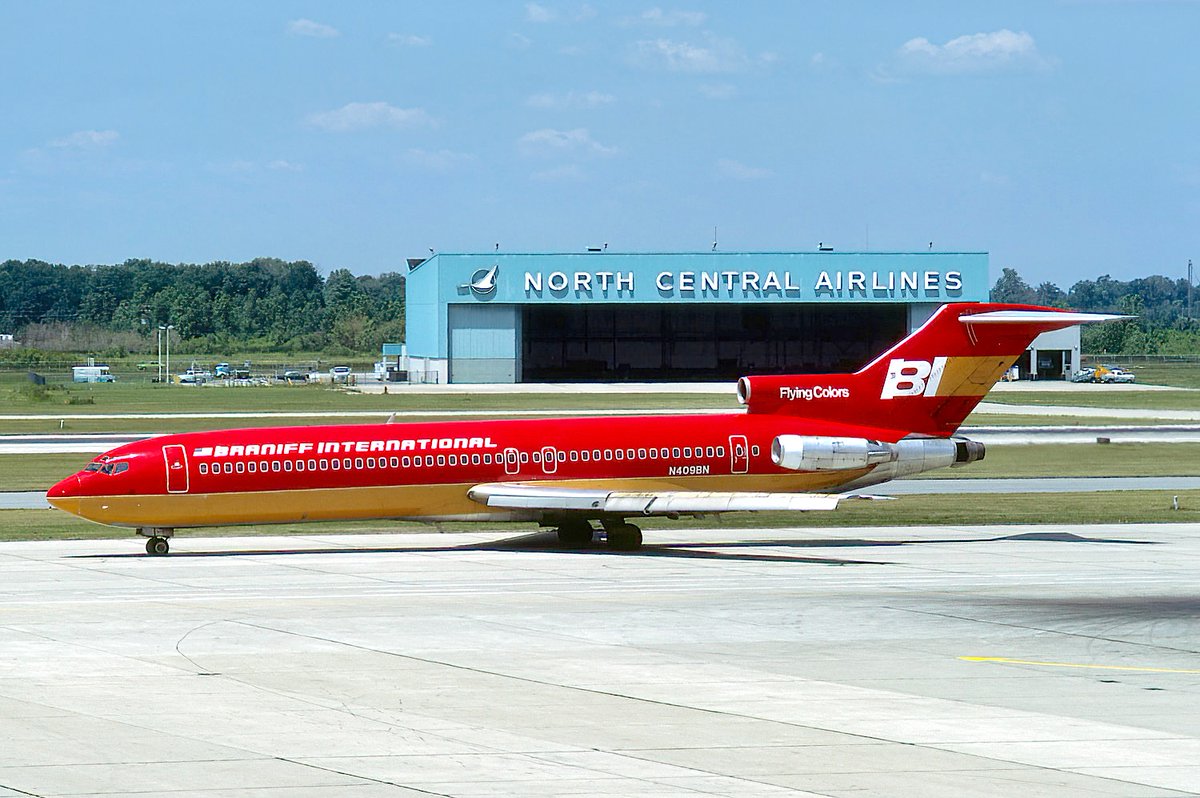
MINNEAPOLIS BRANIFF YOUR FIRST STEP TO EVERYWHERE - Braniff International Boeing 727-214 registered as N409BN is taxiing at Minneapolis/St. Paul Wold Chamberlain International Airport, Minnesota, in June 1977. The big jetliner is painted in the 1971 High Wide and Handsome Glenn Geddis/Harper and George Red over Tan/Aztec Gold Two Tone Color Scheme.
Braniff Airways Foundation
Copyright 1926 2025
Photos: Photographer Bob Garrard, Copyright
Braniff International Heritage Archives
Now Associated with The University of Texas at Dallas System
Braniff Airways Space Sciences Endowment
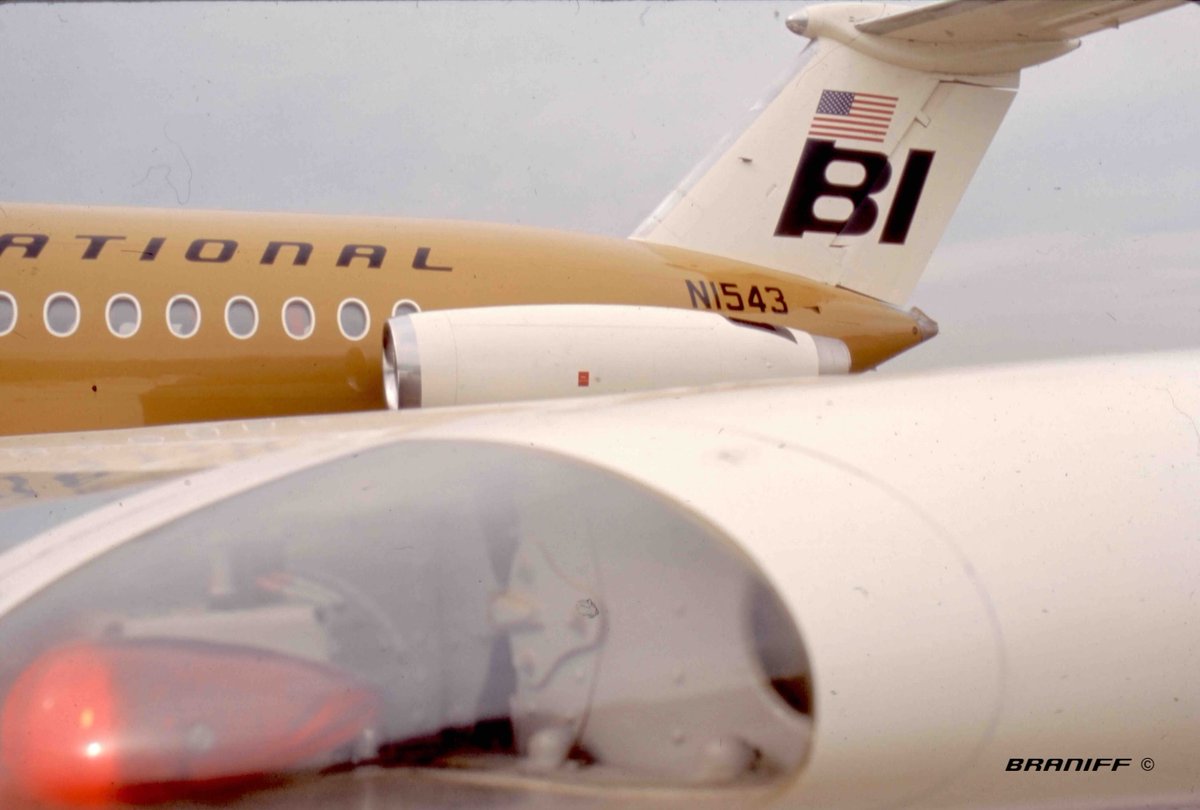
FLASH FLASH BRANIFF BAC JET PHOTOSHOOT - A key part of the EOTPP Campaign was a significant number of photoshoots were scheduled to ensure that an array of photographs of Braniff's newly painted colorful jets would be circulated in the news media and public in general. Each aircraft type was the subject of a multi-day photoshoot to ensure that it was captured in every angle and light. The new BAC One-11 was the first jet-powered aircraft to receive the new color scheme even though it was an orange peel-off coating. Ship N1543 is being photographed at Dallas Love Field in the fall of 1965.
Braniff Airways Foundation
Copyright 1926 2025
Photos: Braniff Airways, Incorporated, Copyright
Braniff International Heritage Archives
Now Associated with The University of Texas at Dallas System
Braniff Airways Space Sciences Endowment
BRANIFF CONVAIR 440 METROPOLITAN N3437 - Braniff International Airways Convair 440-32 Metropolitan registered as N3437 is parked on the ramp at Tulsa International Airport in October 1963. This aircraft was the sixth and final Convair 440 delivered to the Dallas-based carrier. Ship N3437 is painted in the 1956 Red and Blue El Dorado Color Scheme and remained in that color until retirement. The aircraft was delivered new to Braniff on December 2, 1957, and flew for the carrier for the next nine years. The big Convairliner held the distinction of being the only Braniff 440 outfitted with the elongated radar dome rather than the Chamberlain Nipple-Dome installed on the other aircraft when the 340/440 fleet underwent a radar upgrade in 1962.
On October 5, 1966, the aircraft was sold to Allegheny Airlines, which quickly had the aircraft converted to turboprop power. Two 3750 Shaft Horsepower Allison 501-D-13 turboprop engines were fitted to the aircraft and it was designated as a Convair 580, which was a Convair sales and promotion designation rather than an actual aircraft model. Allegheny reregistered the aircraft as N5819 and it entered scheduled service on December 30, 1966.
Allegheny flew the aircraft for the next eleven years before selling it to Plymouth Leasing Corporation of Ypsilanti, Michigan, in 1977. On April 22, 1977, the aircraft was leased to Evergreen International Airlines, a cargo carrier based at McMinnville, Oregon. Evergreen flew the aircraft until 1980, and then returned it to Plymouth Leasing and then stored at Ypsilanti, Michigan.
In 1981, Ship N3437 was broken up at Ypsilanti Willow Run Airport. Plymouth Leasing Corporation of Ypsilanti, Michigan, was the last registered owner/operator of the aircraft. The Convair's FAA registration was canceled on August 10, 1982.
Braniff Airways Foundation
Copyright 1926 2025
Photos: Braniff Airways, Incorporated, Copyright
Braniff International Heritage Archives
Now Associated with The University of Texas at Dallas System
Braniff Airways Space Sciences Endowment
LATIN AMERICA SAID NO TO BRANIFF'S BIG PURPLE JET - Braniff International Boeing 720-027 registered as N7076 is taxiing at Dallas Love Field during the summer of 1965. The big jet is painted in the 1965 Alexander Girard Lavender Periwinkle Blue Solid Color Scheme with White Wings, Engines and Pylons and Vertical Tail and Girard Sky Font Script and BI Tail Logo in Black. This early End of the Plain Plane color was short-lived since it was discovered that the purple and black combination were symbols of death and sorrow in Latin America.
Braniff Airways Foundation
Copyright 1926 2025
Photos: Braniff Airways, Incorporated, Copyright
Braniff International Heritage Archives
Now Associated with The University of Texas at Dallas System
Braniff Airways Space Sciences Endowment
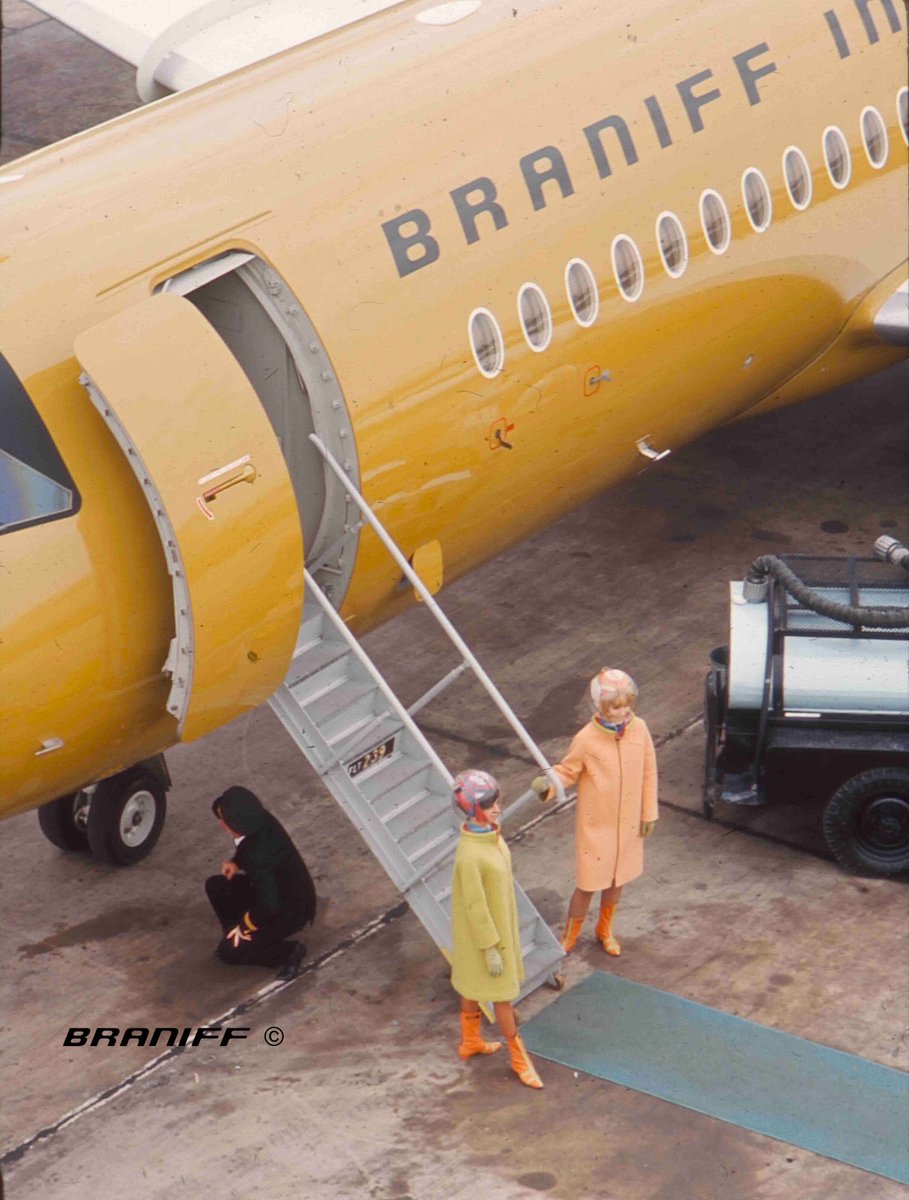
BRANIFF EOTPP FEATURED MANY PHOTOSHOOTS - Braniff International flight attendants, dubbed hostesses at the time, are modeling, in the fall of 1965, the new 1965 Emilio Pucci Gemini IV Hostess Uniform Collection designed exclusively for the Dallas-based Airline. Another star of EOTPP was the Alexander Girard Solid Color Scheme including this Ochre Color Scheme painted on a Braniff BAC One-11 Fastback Jet.
Braniff Airways Foundation
Copyright 1926 2025
Photos: Braniff Airways, Incorporated, Copyright
Braniff International Heritage Archives
Now Associated with The University of Texas at Dallas System
Braniff Airways Space Sciences Endowment
THE AIRCRAFT INTERIOR IN THE LAST BRANIFF POST - The aircraft interior depicted in the last post was a mockup for the proposed Boeing 2707 supersonic airliner. Braniff officials traveled to Boeing in Seattle, Washington, to view the mockup, which today is still available for viewing at The Museum of Flight's Restoration Center in Everett, Washington, at Paine Field.
Braniff commissioned this painting of the proposed Boeing 2707. The artist painted the big Boeing in the 1965 Alexander Girard Orange Solid Color Scheme.
The final design included a second set of wings that folded into the main wings. These smaller wings were deployed for low speed operations during takeoff and landing. The original painting of the 2707 is currently housed in the Braniff International Heritage Archives.
Braniff Airways Foundation
Copyright 1926 2025
Photos: Braniff Airways, Incorporated, Copyright
Braniff International Heritage Archives
Now Associated with The University of Texas at Dallas System
Braniff Airways Space Sciences Endowment
SERVING UP PUCCI BRANIFF STYLE - Braniff's EOTPP best take a moment for a photograph in their 1965 Emilio Pucci Puccino Serving Dresses in Pucci Pink and Yellow, in 1966.
Can you name this aircraft???
Braniff Airways Foundation
Copyright 1926 2025
Photos: Braniff Airways, Incorporated, Copyright
Braniff International Heritage Archives
Now Associated with The University of Texas at Dallas System
Braniff Airways Space Sciences Endowment
BRANIFF HOUSTON EVERYWHERE USA - Braniff International Boeing 727-227 registered as N451BN is taxiing at Houston Intercontinental Airport, Texas, on December 1, 1979. Ship N451BN is painted in the 1971 Glenn Geddis/Harper and George High Wide and Handsome Orange over Mustard/Ochre Two Tone Color Scheme.
Braniff Airways Foundation
Copyright 1926 2025
Photos: Photographer LRS747, Copyright
Braniff International Heritage Archives
Now Associated with The University of Texas at Dallas System
Braniff Airways Space Sciences Endowment