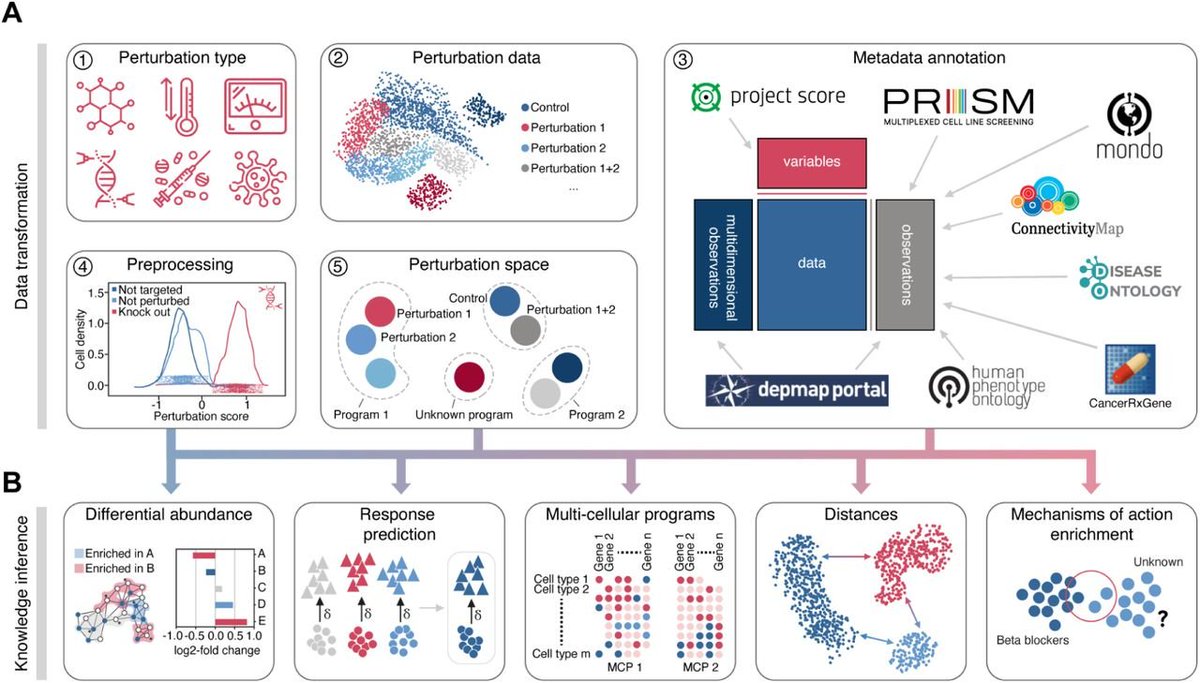
Check out scPerturb, out now in Nature Methods!
Among other things: new datasets in our database, and a lot more information per dataset (e.g. mean No. of counts, cells per perturbation) in the interactive data table. You can find it on our website, link in thread!
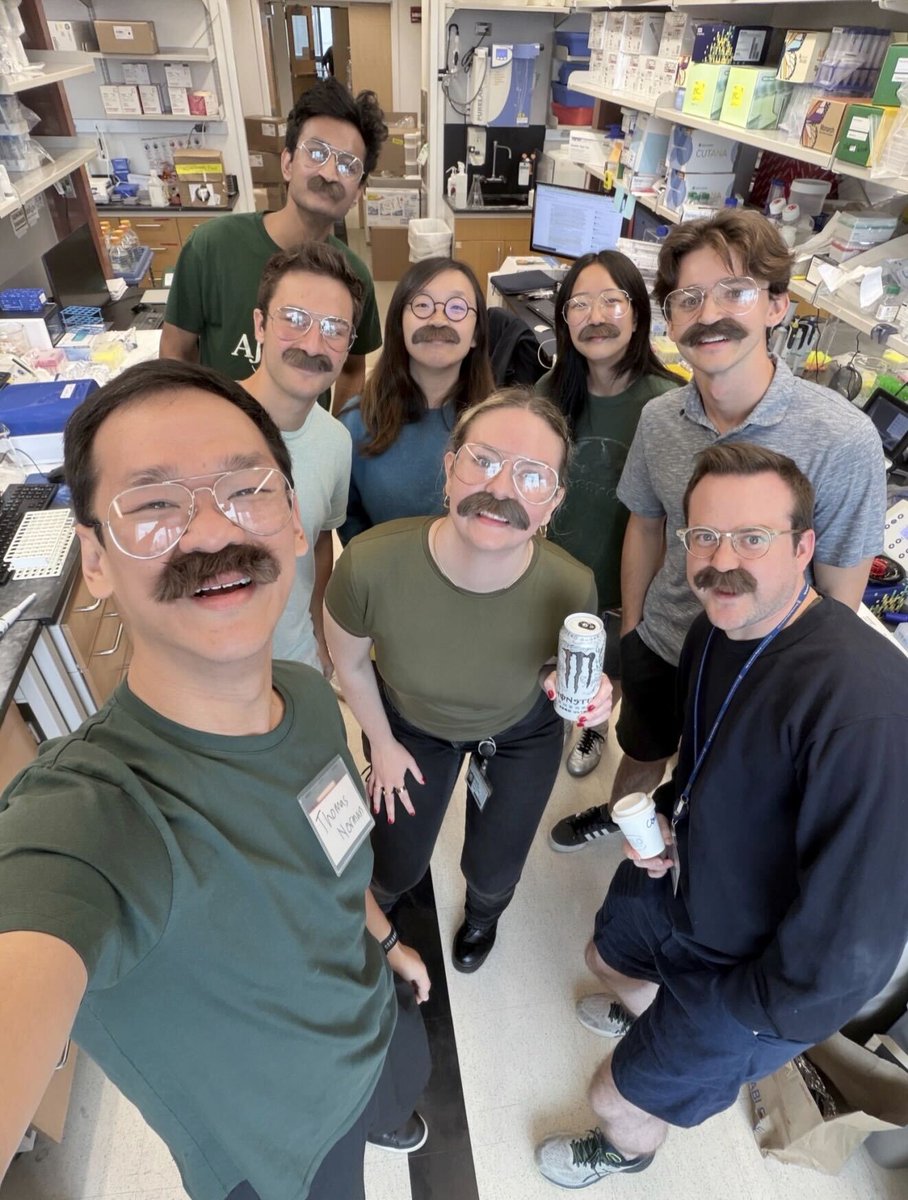
My lab at MSKCC in New York is hiring for two positions. Join us at the frontier of functional genomics, studying fibroblast state transitions, combinatorial genetics, and ECM in disease. Please share with anyone who might be a good fit! (Mustache not required.)
🧵 Excited to share our latest work: scPCA — a flexible factorization model for single-cell data that integrates both cellular heterogeneity and experimental condition effects! 🚀 Let's dive in! (1/9)
I'm stoked to announce our new end-to-end framework for perturbation analysis! Our scverse advisory committee highlighted that a maintained and well-documented framework for perturbation analysis is missing. Pertpy is our attempt to satisfy this request
https://t.co/eaNB41HuOt
Are you developing or benchmarking methods for single-cell perturbation data?
I've written a very simple example pipeline in snakemake that auto downloads all (/selected) datasets from scperturb and applies your custom script to each of them in parallel: https://t.co/AQstyJgh9T
Check out datavzrd, super useful tool for making tables pretty for showing on the web. I used it to make a simple metadata table for a database, see here: https://t.co/qC7VLwp22w
#datavzrd, our tool for rendering modern interactive, visual, server-free, tabular scientific HTML reports with zero/low-code (https://t.co/rFK2ZLcCkA), now has a tutorial (1-2h): https://t.co/ziOQIB54jQ.
Out now: "Single-cell-resolved interspecies comparison shows a shared inflammatory axis and a dominant neutrophil-endothelial program in severe COVID-19"
https://t.co/ye4OsdLU1b
(Graphics: Polygraph Design)
(1/7)
Congratulations to CompCancer graduate @Speidli for the publication in Cell Reports, covered by German newspaper @Tagesspiegel: Warum Covid-19 mal schwer und mal mild verläuft: Immunzellen, die sich nicht deaktivieren lassen https://t.co/7OM97IgYmS
Check out scPerturb, out now in Nature Methods!
Among other things: new datasets in our database, and a lot more information per dataset (e.g. mean No. of counts, cells per perturbation) in the interactive data table. You can find it on our website, link in thread!
@aksbioinfo@the_tessallator Good question! We think of the E-distance as a way to measure signal-to-noise ratio. Cells labeled as perturbed but actually having escaped perturbation (as expected in e.g. cas9 screens) might "water down" this ratio. So running mixscape to remove them would be advisable.
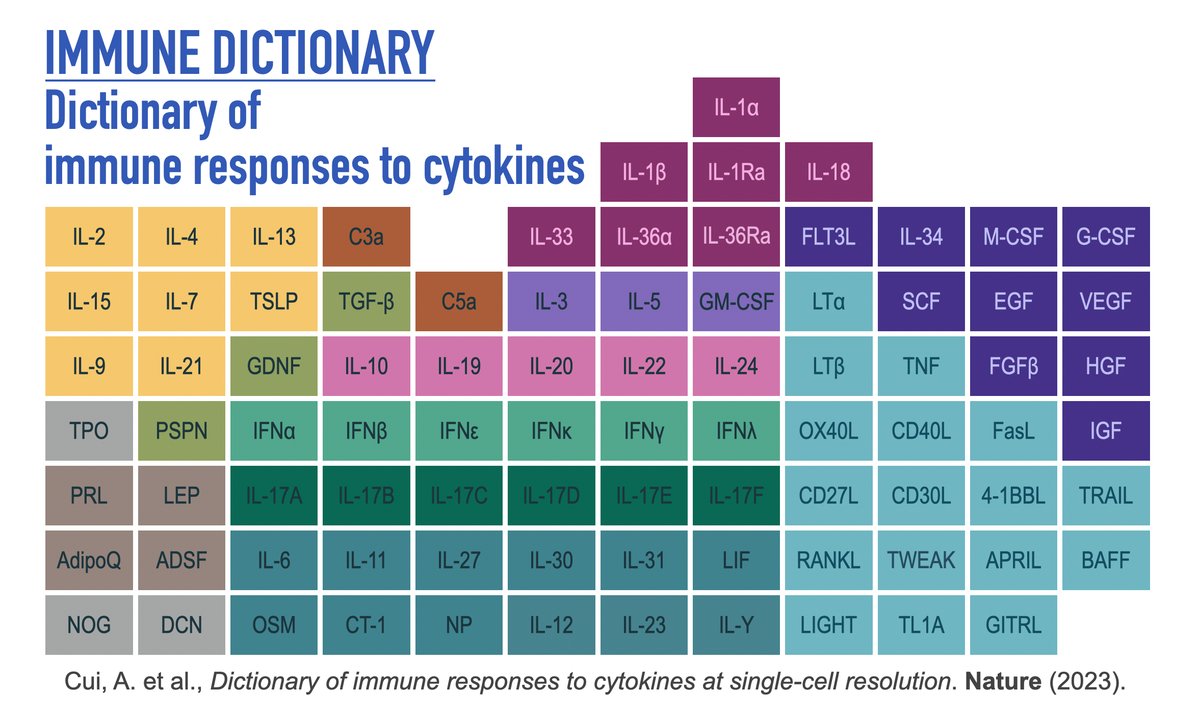
✨#ImmuneDictionary✨is out today in @Nature!
Paper https://t.co/XY47lyphjU
Software https://t.co/duoWWcBmTj
We created scRNA-seq dictionary of 17+ immune cell types responding to 86 cytokines in vivo, discovered the immune system is far more complex than previously known 1/
Very unique data with mutliple doses and time points after infection. We had lots of opportunity for data analysis. And go check out the amazing diffusion map we got for the endothelials!
What drives severe COVID-19? In our new preprint, we explore this question using and interspecies comparison of lung single-cell RNA-seq data – summary in the thread below, lead by @SPeidli and Samantha Praktiknjo! … (1/7)
For our 3rd competition for #NeurIPS2023, we’re asking: can you predict a new algorithm for how cells respond to a drug treatment? Learning how #singlecells respond to perturbations will help support more efficient drug design.
See more on Kaggle: https://t.co/8nttiznF6l
The US is notorious for it's mass shootings, but its immigration policies (or lack thereof) set a new standard for the art of shooting yourself in the foot with a bazooka.
Advice to graduate students from countries the US doesn't like: just go to Europe.
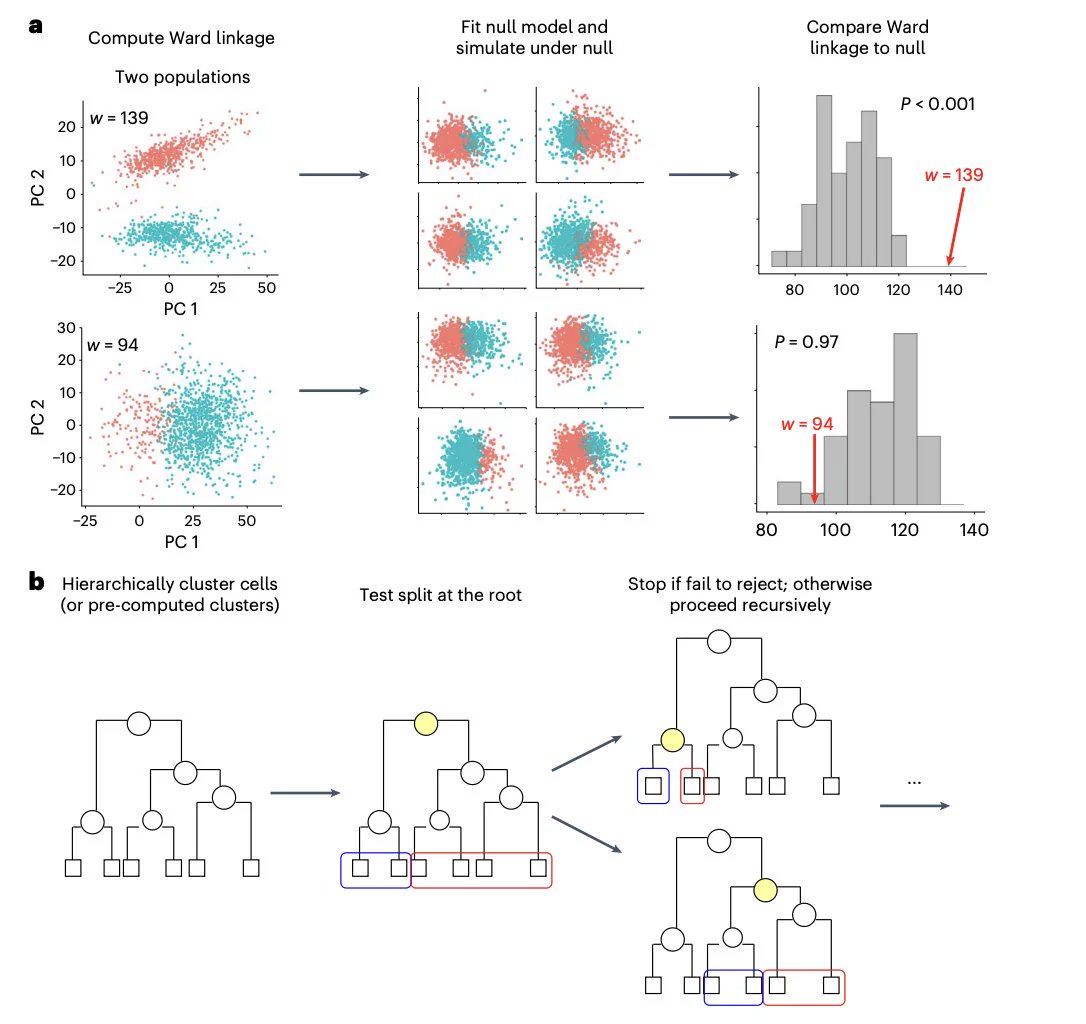
Cluster analysis is the first thing most PhD students do when working with scRNAseq data because it's simple and part of scanpy/seurat's tutorials. But often enough data does not actually allow clustering because it is too homogeneous (e.g. cell lines)!
Clustering algorithms report clusters even when none exist. In single-cell RNA-Seq pipelines, novel cell types are often identified by clustering algorithms. Expanding on Kimes et al.'s work, we introduce significance analysis for single-cell RNA-Seq data: https://t.co/ut1kPjKVCM
@Karl_Lauterbach Da kriegt man richtige Marie-Antoinette vibes, wenn ein Minister sowas tweetet.
Eigentlich geht es bei dem Streik auch weniger ums Geld dachte ich...