🗞️Weekly Solar Geoengineering Bulletin (02-08 November 2026)🗞️
🔗Read the full newsletter here:
https://t.co/eGAir1cxUp
𝗧𝗢𝗣 𝗛𝗜𝗚𝗛𝗟𝗜𝗚𝗛𝗧𝗦
𝗥𝗲𝘀𝗲𝗮𝗿𝗰𝗵 𝗣𝗮𝗽𝗲𝗿: Impacts of potential solar radiation modification: a systematic review of the literature through May 2024 (Springer Nature Link)
𝗠𝗼𝗻𝘁𝗵𝗹𝘆 𝗦𝗥𝗠 𝗕𝗿𝗶𝗲𝗳: Monthly Solar Geoengineering Updates (October’2026) (Solar Geoengineering Updates)
𝗥𝗲𝗽𝗼𝗿𝘁: Planetary Power: Geoengineering and the New Geopolitics of Climate Intervention (Carnegie Endowment)
𝗧𝗼𝗼𝗹: Climate Decisions: New Horizons (Center for Future Generations)
𝗡𝗲𝘄𝘀: As the world approaches 1.5°C, climate experts urge governments to fund research into stabilising Earth’s systems (CCAG)
𝗝𝗼𝗯 𝗢𝗽𝗽𝗼𝗿𝘁𝘂𝗻𝗶𝘁𝘆: Director of Operations and Finance (The Alliance for Just Deliberation on Solar Geoengineering)
𝗬𝗼𝘂𝗧𝘂𝗯𝗲 𝗩𝗶𝗱𝗲𝗼: Big Ideas to Cool the Planet 4: Marine Cloud Brightening (Centre for Climate Repair)
🚨🗞️Read on for source links & more updates, including new research papers, web posts, job opportunities, podcasts, videos, upcoming events, and more:
https://t.co/eGAir1cxUp
🗓️You can also subscribe to the Solar Geoengineering Events Calendar for timely reminders about upcoming events, job listings, funding deadlines, and more:
https://t.co/FtHCBXDu2L
Climate Decisions: New Horizons
It is the year 2036. You’re a head of state forced to negotiate a world grappling with powerful technologies that are able to alter the earth’s climate. Which path will you choose?
https://t.co/SzLcI8gPWA
A weird take. Talk about stratospheric geoengineering while literally admitting that the trails are not in the stratosphere, but blame geoengineering anyway.
The pivot is almost complete.
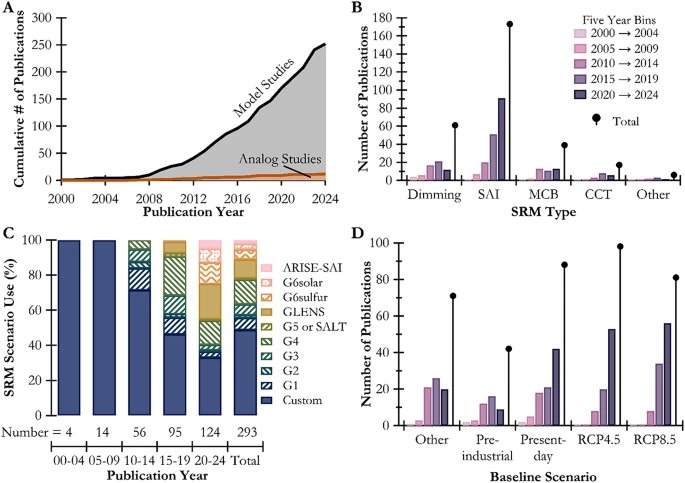
Systematic review of 289 peer-reviewed studies published through May 2024 examines how research has assessed the potential impacts of solar radiation modification (SRM) on human and natural systems.
Only 9% of the studies addressed human systems and 25% examined ecosystems, while 97% of primary research relied on global models. Consequently, the literature focuses largely on variables readily produced by these models, including global mean temperature, precipitation, sea ice and primary production.
Research examining human and ecosystem impacts more often used linked modelling frameworks incorporating regional climate projections. By comparison, empirical research drawing on SRM analogues, such as volcanic eruptions, was rare and declining in relative frequency.
The authors call for a more integrated research approach combining global climate models, regional-scale modelling and analogue studies to improve understanding of SRM's potential consequences for people and ecosystems.
https://t.co/RoAdYLQ6cF
How do you 10x the stabilization field as quickly as possible? Everyone I talk to has a different opinion, and I actually think they’re all correct.
🧵👇
$354,720 of Cooling Credits cools Earth enough to save one life before 2100. Every part of that number can be checked.
$1 per Cooling Credit × 4,434 tons of CO2 × 80 years.
Worth sitting with at year end.
@claydumas@paulgambill@chrismtolles I think it's likely we'll start with a less efficient SRM using existing aircraft once it becomes bloody obvious that James Hansen was spot-on.
Then research as we go, finding more efficient and better ways of doing it.
Basically buying time for buying time as we buy time.
Sucess of Solar will not save us from Climate Chaos. CDR and SRM in scale will need drastic changes in how we use surplus in a declining resources world. Just do not see that we end hording of digits on bank accounts for slowing down the climate chaos.
The Global Risk and Stabilization Summit has published post-event survey findings based on 85 responses from attendees at its October 2026 Reykjavík meeting.
Nearly two-thirds had joined the field within the past five years, while respondents identified public and political support, pathways to testing, and governance as its biggest gaps.
Participants also called for greater involvement of policymakers, critics and Global South representatives, alongside stronger collaboration and funding.
https://t.co/lLiETY4XSt
I wouldn’t agree with the “nor necessary” part. I’m of course in favor of figuring out how to do SAI safely, but stabilization interventions are merely response options that buy us more time for large scale decarbonization and CDR to finish the job.
There is a maximum amount of SAI we could do before causing too much damage to the ozone layer so we plausibly can’t expect to cool by more than 1, maaaaybe 1.5 degrees C. And if we keep up the current pace of emissions (as the new Rhodium report this week suggests) then we’re pushing more GHGs into the atmosphere and masking more and more of the warming (while also not dealing with the ocean acidification issues) without a long term off-ramp. I agree that net zero is nowhere near sufficient (even turning off all emissions forever starting tomorrow is not sufficient!) but a future Earth without massive decarb+CDR is not one people will enjoy living on. Stabilization is a temporary measure to buy time, not the full solution.
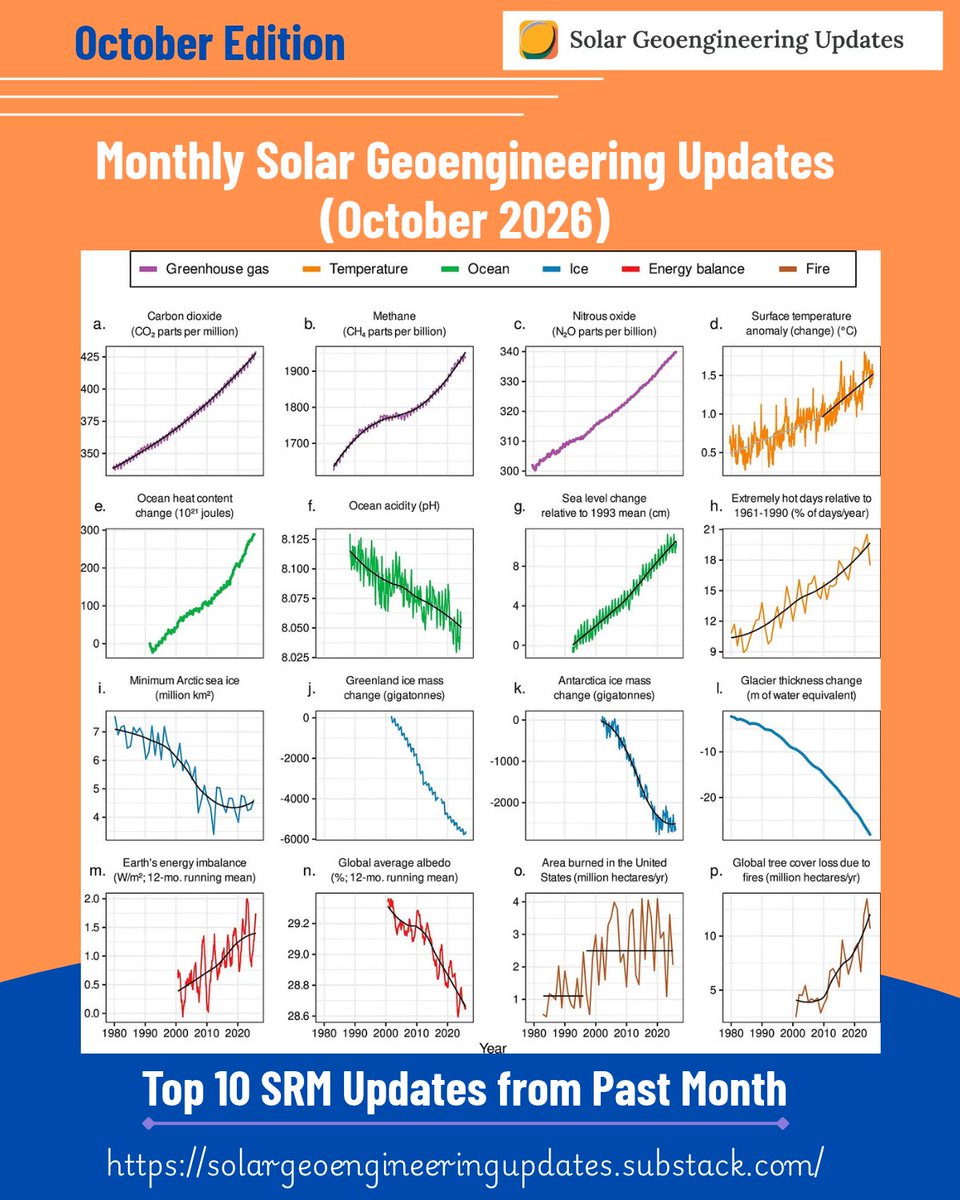
🚨🗞️Monthly Solar Geoengineering Updates (October 2026)🗞️🚨
From war-gamed scenarios exposing SAI conflict risks to new Arctic intervention assessments, $1.2M in SRM funding & a survey of 6 space-based sunshade designs, here are Oct's key headlines
🔗Full newsletter here: https://t.co/IuyYyRwRMV
Top 10 SRM Updates from October 2026:
1️⃣Centre for Future Generations (CFG) exercise involving 35 participants found that strategic distrust, sovereignty disputes & disinformation could undermine int'l cooperation, raising the risk of an SRM arms race & geopolitical conflict.
2️⃣Foresight report developed by Centre for Future Generations (CFG) with input from more than 250 stakeholders outlines 4 scenarios for 2036, ranging from int'l restrictions on large-scale SAI testing to commercial development & geopolitical competition.
3️⃣UArctic (University of the Arctic) has opened its climate intervention assessments for public review, with feedback due by 4 Dec.
4️⃣Giving Green Fund awarded $1.2M to 4 SRM organisations. The Alliance for Just Deliberation on Solar Geoengineering (DSG) received $300,000, Climate Hub $375,000, The Degrees Initiative $300,000 & Environmental Defense Fund $241,762.
5️⃣Simulations based on the proposed CAIRT mission indicate that high-resolution infrared observations could detect SO₂ injections within hours to days, quantify release rates of several 100t/d & track the evolution of sulphate aerosol plumes.
6️⃣Publications from Giving Green, Middle Path Initiative, Ifri - Institut français des relations internationales, France’s Defence Climate Observatory & The Arctic Institute examine SRM research funding, geopolitical risks, inclusive governance & safeguards for Arctic climate interventions.
7️⃣Planetary Sunshade Institute 2026 survey examines the engineering feasibility & climate implications of space-based sunshades, estimating that development remains 20-40yrs away & calling for $30M in research funding over 5yrs.
8️⃣Reflect Orbital tested powerful lights in a demonstration of its plan to launch 50,000 mirror-equipped satellites within a decade, directing sunlight onto Earth at night. The proposal has raised concerns over wildlife, sleep, light pollution & astronomy, while its potential to redirect additional sunlight towards Earth highlights possible implications for climate intervention.
9️⃣Centre for Climate Repair announced to award £1,000 to undergraduate & postgraduate students to propose projects involving GGR & SRM. Applications close 11 Dec.
🔟The inaugural Global Risk & Stabilization Summit brought together participants from 6 continents to discuss climate risks & stabilisation research, with calls to expand the research community & increase participation from low- & middle-income countries.
📰We covered all this & more in our October 2026 SRM roundup. Read here:
https://t.co/IuyYyRwRMV
Mixed-phase cloud thinning (MCT) has been proposed as a regional climate intervention method to offset Arctic warming by reducing the longwave cloud radiative effect of high-latitude winter clouds. While initial studies suggested that MCT could achieve meaningful Arctic cooling using idealized MCT scenarios with prescribed ice-nucleating particle (INP) concentrations, the radiative impact of a more realistic, prognostic seeding aerosol has remained largely unexplored so far. Here 5 we evaluate the viability of MCT using prognostic mineral dust in a global climate model. We conducted a set of 16 sensitivity experiments in the Arctic during the boreal winter (Nov-Feb), varying the dust injection altitude and the seeding rate relative to a control simulation. Mineral dust seeding triggers glaciation of mixed-phase regime clouds, producing a net negative top-of-atmosphere radiative effect, that strengthens with seeding rate, driven by a competition between a positive longwave effect arising from aerosol-radiation interactions (LW ARI), a negative shortwave effect arising from aerosol-radiation interactions (SW ARI), and effects from aerosol-cloud interactions (ACI). Lower seeding altitudes retain more of the seeded dust within the target region and activate a larger fraction of it into cloud droplets, yet produce weaker cloud glaciation and thinning than high-altitude injections. Overall, these results indicate that MCT can produce a meaningful negative top-of-atmosphere radiative forcing over the target region, consistent with the surface-cooling potential suggested by earlier studies, but that both injection altitude and rate influence its efficacy and its side effects.
https://t.co/zhTZlJhmlk
Historical volcanic eruptions may have temporarily slowed Arctic warming by injecting sulfate aerosols into the stratosphere, according to an analysis combining CMIP6 simulations, HadCRUT5 temperature records and MERRA-2 aerosol data.
The study examines the effects of Agung (1963), El Chichón (1982) and Pinatubo (1991), finding that each produced approximately 4–5 years of Arctic cooling.
Without these eruptions, Arctic surface air temperature anomalies could have been up to 0.5°C higher, while observed volcanic cooling ranged from −0.07°C to −0.4°C. The Arctic response was stronger than the Antarctic response, which was moderated by oceanic and atmospheric processes.
The findings also highlight faster warming of Arctic minimum temperatures compared with maximum temperatures. Overall, the research illustrates how volcanic sulfate aerosols can temporarily interrupt polar warming, offering insights relevant to discussions of stratospheric aerosol intervention.
https://t.co/hta4YmOHVz
Using fully coupled CESM2.1.3 simulations, a new research examines how greenhouse warming and stratospheric aerosol intervention (#SAI) affect Indian Summer Monsoon low-pressure systems (LPSs), which contribute over half of seasonal rainfall.
Under doubled CO₂, global warming weakens monsoon circulation and reduces LPS frequency by 9–14%, despite a 6% increase in all-India rainfall.
Fewer systems nevertheless produce stronger rainfall and more intense extreme events across central and northern India.
Uniform SAI restores global temperature to within 0.03 K of the control climate and partially recovers monsoon circulation, LPS frequency and distribution.
However, it suppresses atmospheric moisture and reduces all-India rainfall by 3.82% relative to the control, while weakening LPS rainfall and extremes.
The findings highlight a trade-off: SAI can partly restore monsoon dynamics while offsetting the rainfall intensification associated with greenhouse warming.
https://t.co/o8VSu2a7KZ
"Geoengineering is becoming a geopolitical question as much as a climate one.
The way states and the private sector pursue these technologies, assess risks, and drive research increasingly appears focused on gaining a strategic edge.
In a field where governance in lagging behind, Europe should keep track of the geopolitical implications if it is to develop effective regulatory frameworks," per new report by Carnegie Europe.
https://t.co/8EOYWLvUq4