Author of The Fassa Tails Kid Books | Joy coach | Host of the Let There Be Joy Podcast — helping families find real-world connection in a tech-influenced world.
Your kid just finished the book. Now they want more.
Every Fassa Tails book comes with a 40-page activity workbook — designed to get kids off screens and into something real. Creativity, heart skills, hands-on play. Ages 4–8. 🐾
https://t.co/Q8oiPj4uPN
Jesus actually gave sight to the blind.
Jesus actually walked on water.
Jesus actually fed the 5000.
Jesus actually raised the dead back to life.
Jesus actually did everything written in the gospels.
Fred Rogers met with a child psychologist every week for 22 years to build his show. She shaped everything: every script, prop, and song. The whole point was to give a child's nervous system time to slow down. In 1984, a single regulatory decision ended all of it.
The psychologist was Dr. Margaret McFarland, who co-founded the Arsenal Family and Children's Center alongside Benjamin Spock and Erik Erikson. She and Rogers understood that the prefrontal cortex in children, the part of the brain that controls impulse, emotion, and attention, takes decades to fully develop. At the start of every episode, Rogers tied his sneakers and changed his sweater while children settled in. Those pauses were intentional, designed to help a child's nervous system shift into a calmer, more focused state.
What ended it had nothing to do with child development science. In 1984, Reagan's FCC chairman Mark Fowler abolished the advertising limits that had protected children's programming from commercial pressure. Toy companies moved within months. Between 1984 and 1985, cartoons tied to toy lines increased by 300%, from a handful of shows to more than 40 animated series. In almost every case, the toy was designed first. The cartoon was built to sell it.
Researchers later put numbers to what parents were already noticing. A 2011 study in Pediatrics from the University of Virginia tested 60 four-year-olds across three groups: one watching SpongeBob, which cuts scene every 11 seconds; one watching a slow PBS show, which cuts scene every 34 seconds; and one drawing. Nine minutes later, all three took tests on attention, impulse control, short-term memory, and problem-solving. The SpongeBob group scored significantly worse across every measure.
In the 1970s, children began watching television around age 4. Research from pediatrician Dimitri Christakis found that by 2009, the average age of first screen exposure had dropped to 4 months, as the content got faster and the audience got younger. Researchers separately found that each additional hour of daily screen time at ages 1 or 3 raised the risk of attention problems at age 7 by 9%.
As someone who’s been singing the National Anthem at rodeo events for over 20 years, I’ll just say….
There’s a way it was intended to be sung, without your own spin. This was 💯the way! Bravo!
"God is so real. He's so much realer than you can ever ask, think, or imagine."
That's how New York pastor and basketball coach Matt Sierra described the moment Christian artist Forrest Frank surprised him with a trip to see the Knicks in the NBA Finals after asking fans online who he should bring along during his NYC tour stop.
Followers quickly rallied behind Sierra, who serves young people through ministry, basketball, and community outreach in New York City, making him one of the most recommended names.
What started as a simple social media question turned into a night Sierra says he'll never forget, as seen in a video Frank later shared with fans.
The moment is resonating across social media, with many praising Frank for using his platform to encourage others and create meaningful experiences that reflect his faith.
I keep getting asked why I'm so angry and so focused about repeat-offender crime.
This photo right here… this is why.
I grew up in a country where childhood felt free.
Not perfect, but free.
We hopped on our bikes after breakfast and didn't come home until the streetlights flicked on.
No phones.
Just a bunch of kids pedaling through the neighborhood... cutting through yards, racing down hills, stopping at a friend's house because you saw their bike was in the grass out front and knew they were home so you knocked on the door and got hit with a water-balloon.
That's the start of a life-long friendship.
We went to public pools with a diving board and a high dive (they tore those down)
We played soccer in the front yard with whoever happened to be outside... sometimes they were kids you knew from school, but often times they were kids you only knew because you saw them every summer riding past your house.
It was normal for my parents to assume their kids would ALWAYS come home in one piece and my parents NEVER knew where we were growing up.
That's the America I knew, and the one I grew up in.
My kids are not growing up in that America.
I don't get to just be the parent yelling, "Be home by dinner!" I have to be the parent running risk calculations in my head. Because all of us parents know the public spaces aren't safe anymore.
There's no headline for "OH LOOK AT THAT! Another neighborhood kept their kids indoors today and gave them iPads!"
But go ahead and talk to ANY parent you know… it’s happening.
We all know it's happening.
It's the slow, quiet theft of my kids' childhood... and your kids childhood.
A childhood we ALL once had and one they will never know.
It wrecks me just thinking about it... I hate it for them.
So when I talk about repeat offenders... when I post the screenshots of their 50+ arrests every single day…
Please understand something…
It's because I want my kids, and your kids, to have what we had.
I want the biggest concern at a park to be a skinned knee.
Not a st*bbing.
I want streets where the sound of bicycles and laughter is louder than that of sirens.
This is why I won't shut up about it.
I'm not asking for a perfect world.
I'm asking for the radical idea that childhood should be safe enough to look like this picture again.
And honestly, I just don’t think it’s all that radical of an ask…
My older brother was born with cerebral palsy.
My mother almost died giving birth to him.
Half his body doesn’t work. He can’t even grasp a fork with one hand. He wears out shoes every few months from dragging one leg.
And yet I will never forget the night my younger brother spiraled into depression, seriously questioning whether life was still worth living. It was my older brother, through tears and sobbing, who pleaded with him to see the good still waiting.
I remember how he described the little joys of life in ways I had never considered. He noticed beauty I had walked right past. Through his eyes, life felt richer and fuller.
I am grateful for his perspective every day and infinitely grateful he is alive.
Because in a body that fights him at every turn, he still chose to become the light for someone else. And that choice didn’t just save my brother.
He taught us what it really means to live.
He’s living proof that everyBODY, no matter how broken, deserves the chance to love this life and find its quiet joys.
If any content you consume leaves you feeling at odds with your family, with your husband, with your role as a mother, with your children then block it all. Don’t let this stuff poison your spirit
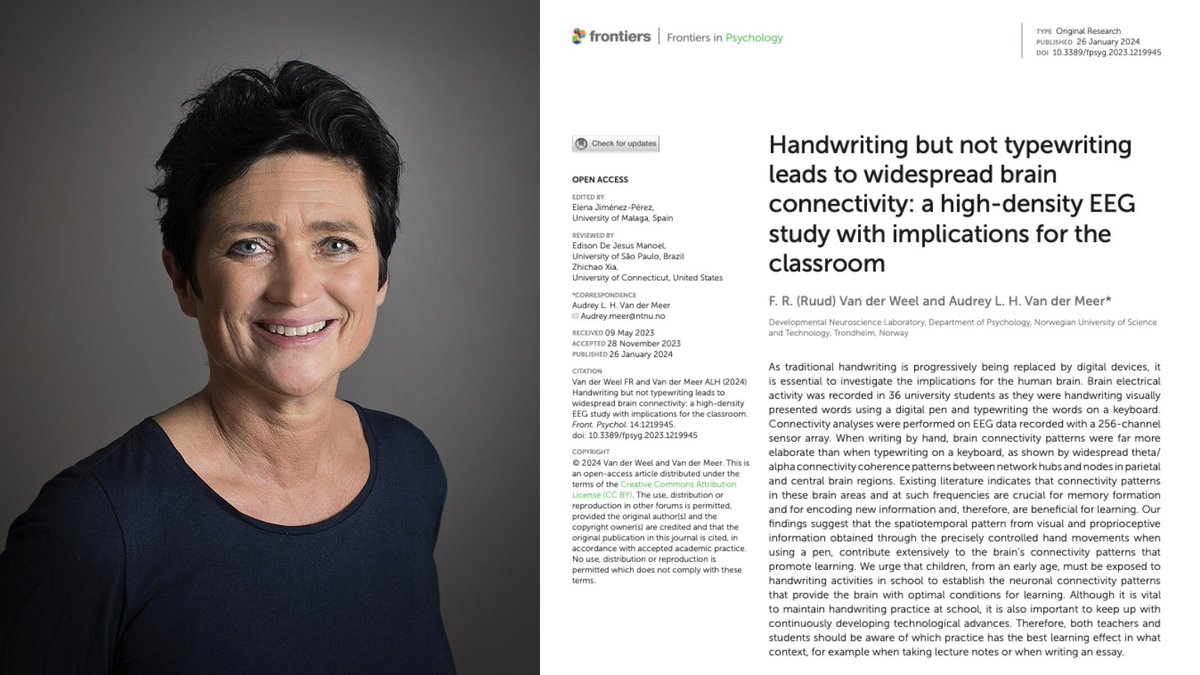
A Norwegian neuroscientist spent 20 years proving that the act of writing by hand changes the human brain in ways typing physically cannot, and almost nobody outside her field has read the paper.
Her name is Audrey van der Meer.
She runs a brain research lab in Trondheim, and the paper that closed the argument was published in 2024 in a journal called Frontiers in Psychology. The finding is brutal enough that it should have changed every classroom on Earth.
The experiment was simple. She recruited 36 university students and put each one in a cap with 256 sensors pressed against their scalp to record brain activity. Words flashed on a screen one at a time.
Sometimes the students wrote the word by hand on a touchscreen using a digital pen, and sometimes they typed the same word on a keyboard. Every neural response was recorded for the full five seconds the word stayed on screen.
Then her team looked at the part of the data most researchers had ignored for years, which is how different parts of the brain were communicating with each other during the task.
When the students wrote by hand, the brain lit up everywhere at once.
The regions responsible for memory, sensory integration, and the encoding of new information were all firing together in a coordinated pattern that spread across the entire cortex. The whole network was awake and connected.
When the same students typed the same word, that pattern collapsed almost completely.
Most of the brain went quiet, and the connections between regions that had been alive seconds earlier were nowhere to be found on the EEG.
Same word, same brain, same person, and two completely different neurological events.
The reason turned out to be something nobody had really paid attention to before her work. Writing by hand is not one motion but a sequence of thousands of tiny micro-movements coordinated with your eyes in real time, where each letter is a different shape that requires the brain to solve a slightly different spatial problem.
Your fingers, wrist, vision, and the parts of your brain that track position in space are all working together to produce one letter, then the next, then the next.
Typing throws all of that away. Every key on a keyboard requires the exact same finger motion regardless of which letter you are pressing, which means the brain has almost nothing to integrate and almost no problem to solve.
Van der Meer said it plainly in her interviews.
Pressing the same key with the same finger over and over does not stimulate the brain in any meaningful way, and she pointed out something that should scare every parent who handed their kid an iPad.
Children who learn to read and write on tablets often cannot tell letters like b and d apart, because they have never physically felt with their bodies what it takes to actually produce those letters on a page.
A decade before her, two researchers at Princeton ran the same fight using a completely different method and ended up at the same answer. Pam Mueller and Daniel Oppenheimer tested 327 students across three experiments, where half took notes on laptops with the internet disabled and half took notes by hand, before testing everyone on what they actually understood from the lectures they had watched.
The handwriting group won by a wide margin on every question that required real understanding rather than surface recall.
The reason was hiding in the transcripts of what the two groups had actually written down.
The laptop students typed almost word for word, capturing more total content but processing almost none of it as they went, while the handwriting students physically could not write fast enough to transcribe a lecture in real time, which forced them to listen carefully, decide what actually mattered, and put it in their own words on the page.
That single act of choosing what to keep was the learning itself, and the keyboard had quietly skipped the choosing and skipped the learning along with it.
Two studies. Two countries. Same answer.
Handwriting makes the brain work. Typing lets it coast.
Every note you have ever typed instead of written went into your brain through a thinner pipe. Every meeting, every book highlight, every idea you captured on your phone instead of on paper was processed at half depth.
You did not forget those things because your memory is bad. You forgot them because typing never woke the part of the brain that would have made them stick.
The fix is the thing your grandmother already knew.
Pick up a pen. Write the thing down. The slower road is the faster one.
🚨WOW!!!
Tim Sparks has confirmed he purchased 80 PIZZA HUTS and brought back EVERYTHING that made them iconic!
Pac-Man is back.
Salad bar is back.
Red cups are back.
Booths for families.
"I want to rebuild places for families to connect and put their phones down..."
This teacher had her 2nd grade class write on their hand what they want to be when they grow up?
I have to say, I was pleasantly surprised to see some hopeful, future police officers. A valiant career. 💯
The very last little girl who wrote “mom” at the end, that got me- that is a beautiful choice. 🥹
They haven’t the slightest idea of the hardships ahead of them …. I hope and pray they all make it through and achieve their dreams and much more.
Always loved that song. ���️
Do you remember what you wanted to grow up to be when you were that age?
A submissive woman actually controls a man.
Most people are too low IQ to understand this. Especially modern women.
Masculine men don't submit to loud women.
Not to arrogance. Not to masculine energy. Not to women constantly trying to dominate everything.
That kills attraction fast.
But a feminine woman? A peaceful woman? A woman who knows how to soften a man instead of fighting him?
She can influence him deeper than any "boss bitch" ever could.
Submission was never weakness.
It was psychological leverage.
Soft power. Quiet power. Ancient feminine intelligence.
Women abandoned it because modern culture trained them to hate femininity.
A man will sacrifice for peace.
He will move mountains for the woman who makes life feel lighter.
But he becomes emotionally cold toward women who treat relationships like warfare.
Modern women think power comes from attitude, arguments, and acting emotionally untouchable.
Wrong.
That only works on weak men.
The loud girl gets attention.
The submissive, feminine girl get commitment, protection, investment, and a ring.
There are levels to female intelligence.
Masculine men don't respond to control.
They respond to loyalty, peace, grace, and genuine respect.
That is what makes a powerful man emotionally fold.
A submissive woman rarely has to beg.
The man gives willingly.
Because peace makes a man generous naturally.
Pressure makes him distant.
Modern women were told acting like men would make them powerful.
Now many are single, angry, combative, and confused why their relationships keep failing.
The married woman doesn't control him loudly.
She controls his heart quietly.
Effortlessly. Gracefully. Without force.
A true feminine woman doesn't lose power through submission.
She multiplies it.
Arthur Brooks: "There shouldn't be a classroom in America from kindergarten to PhD where you're allowed to use your personal devices"
"We're rewiring their brains to become lonely and depressed."
“As soon as devices were introduced into classrooms around 2010 scores have been falling in reading, in math, basically around the world.”
“We have over a decade of research showing this experiment was a fail... Having students on devices harms their learning.”