The photosynthesis process gets reversed at night. In the morning photosynthesis happens and the plant produces O₂ after it gets CO₂. However, at night the plant takes back O₂ and produces CO₂.
China's desertification control technology continues to reach new heights! 🚀
While earlier generations achieved remarkable success with straw checkerboard barriers, today's innovators are embracing high-tech materials—using biodegradable PLA fiber sandbags. 🌱
These bags decompose naturally once plants take root, serving not only as sand barriers but also as nurturing beds for greenery. They return to nature, leaving a legacy of green oases.
To every dedicated worker braving the harsh conditions: your sweat is turning deserts into verdant landscapes. 💪🌍
The violence of Oklahoma’s tornado season on full display with this powerful EF-4 twister in southern skies—raw force, relentless winds, and destruction in motion 🌪️
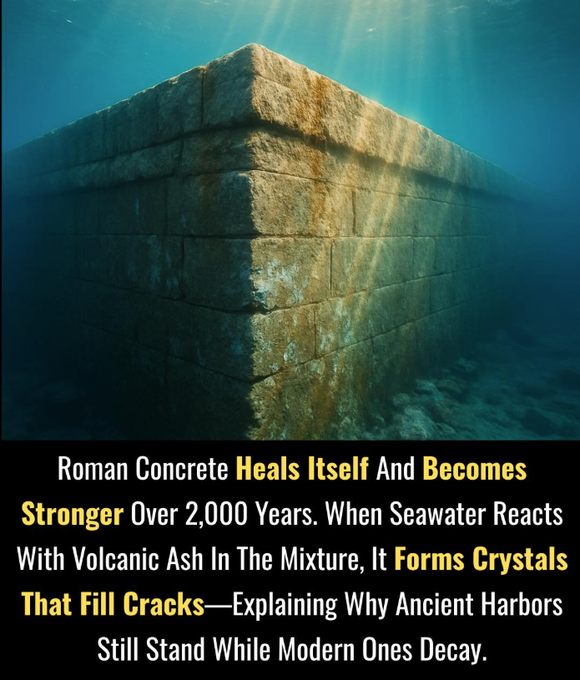
Two thousand years ago, Roman engineers discovered a secret that modern science is only beginning to understand: a concrete that gets stronger with time.
Their legendary “marine concrete” was made by mixing volcanic ash, lime, and seawater — a combination that allowed structures like harbor piers and breakwaters to not only survive millennia of ocean waves but actually strengthen underwater.
Modern research has revealed the secret ingredient: a rare chemical reaction that produces aluminum tobermorite, a mineral that forms and expands over time, sealing cracks and reinforcing the material.
While modern cement crumbles in decades, Roman concrete endures for centuries. Engineers today are studying these ancient formulas to design self-healing, eco-friendly concretes that could revolutionize the building industry and drastically cut CO₂ emissions.
Scientists in Iceland are drilling 2 kilometers deep into the molten heart of a volcano.
Iceland’s Krafla Magma Testbed (KMT) is set to embark on a historic mission — drilling directly into a magma chamber .
Building on a serendipitous 2009 accident where drillers unexpectedly struck molten rock at 2,100 meters, this international collaboration aims to peer into the heart of a volcano. By placing sensors directly in the 1,000°C fluid, researchers hope to move beyond surface-level observations and finally master the science of volcanic forecasting, potentially saving lives by predicting eruptions with unprecedented accuracy.
Beyond scientific discovery, the project represents a massive leap for renewable energy.
Using specialized heat-resistant alloys to withstand extreme pressures and corrosive gases, the KMT aims to harness "supercritical" steam from the magma's edge. This process could produce up to ten times more electricity than traditional geothermal wells, providing a near-limitless supply of high-density clean power. While the engineering challenges of operating at 900°C are immense, the reward is a dual revolution: a deeper understanding of our planet’s subterranean forces and a new frontier for global energy security.
source: BBC News. (2024). Iceland to drill into magma to create world-first observatory. British Broadcasting Corporation.
From the surface of the Moon, Earth appears as a bright and beautiful sphere our home floating in the vast darkness of space. Every ocean, continent, and form exists on that distant blue world. The contrast between the Moon's silent, grey landscape and Earth's vibrant colors makes this view truly powerful. It reminds us how special and unique our planet is. Standing on another world and looking back at Earth changes perspective everything we know is contained in that small glowing sphere.
A distant view... but still home
Twin Tornadoes 🌪️🌪️ Storm chaser @AaronRigsbyOSC captured quite the sight on Sunday as two tornadoes spun from the same storm over Osage County, Oklahoma.
Mount Bokty, Kazakhstan 🇰🇿
The distinct “layered cake” appearance results from colored chalk and clay bands that have been exposed and sharpened over time.
Qinzhou, Guangxi, China is experiencing extreme rainfall that has caused flooding today.
273 mm in 8 hours, three times the extreme storm threshold.
160 mm in 1 hour, nearing world-record intensity.
Previous April records for the region have been broken.
As temperature decreases, the kinetic energy of molecules decreases.
This is a visualization of the transformation of water into ice, seen at molecular level.
[🎞️ CSIRO’s Data61]