I developed Bambi, a wearable device designed solely for counting steps.
I made this because the wearables on the market are simply not accurate enough. Bambi is 99.5% accurate (tested on 5,000 continuous steps).
https://t.co/0fXpVEnsEr
The Campaign map for General Command will be procedurally generated. This is the initial implementation which includes Mountains (black), Forests (green), cities/farms/churches/garrisons, and roads.
Currently thinking about how to generate rivers ...
https://t.co/fC9HcRmaIu
Crash physics, but without using Godot’s physics engine. This is actually just stacking Tweens based on position when area3Ds overlap.
So this more like dynamic crash animation than crash physics.
Made my Godot + AI project for reinforcement learning open source: https://t.co/5pSGAKAp8D
Modern video games don't have enemy AI agents that use reinforcement learning in them because it is hard. This project makes the parallelization and observation/action batching easier.
Working on a new solitaire game, but in the meantime just released an app for practicing punctuation on classic literature. Feel free to message me if you want a free key: https://t.co/w39C6QVIJW
Design based on a certain shape is a lifesaver for artist's block! I just pick a few shapes, find some references, and boom! Designs start flowing. After a few, the creativity explodes! ✨🤯
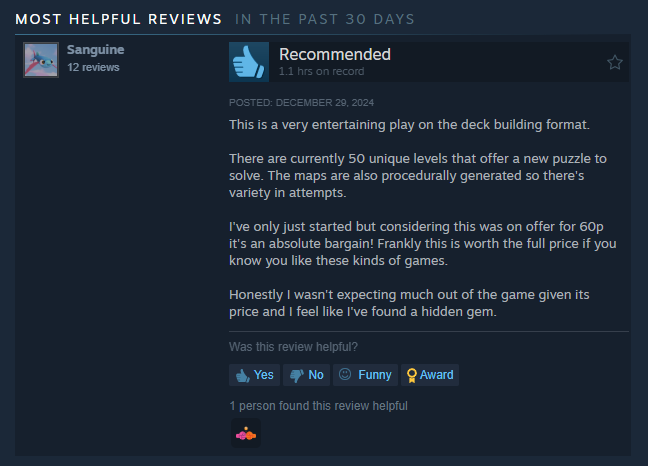
A goal for Tower Knight was to get 10 reviews by the end of 2024. It didn't reach that goal, but this latest review goes a long way for me. Thanks Sanguine -- whoever you are.
Tower Knight is still on sale for the next 24 hours: https://t.co/2HlnajSEYz
@ukasz38626871 What is MARL? This uses a SAC method, and has similar inputs to Open AI's hide and seek game, but it does not know about the enemy xy coordinate (the agents infer the enemy position based on their own lines of sight)
After more than 1.5 million simulations the agents learned to:
- Hide at the center wall and peek
- Search for the other agent
- Change directions to evade/cutoff
All of this was learned with a simple +100 vs -1 reward. Next is to test a +-1 reward system
#GODOT#Pytorch
Red trained first and learned to explore until it found Green, then move toward it.
Green trained second and learned to move toward open space w/o Red. Green has a bias to move counterclockwise.
Multiple training batches for each agent might help correct each other’s biases
2 AI agents that were trained with competing reward functions. The Red agent got +100 when it catches the green agent (else -1). The Green agent got -100 when it was caught (else +1).
Both agents get the same input but Red was trained first ... (continued)
#GODOT#PyTorch
I have stopped working on the 1700's war game I was developing. After creating the core battle system, it is not clear to me that this game should be my next release.
I might revisit this in the future. In the meantime, it is fee on itch. #IndieGameDev
https://t.co/sNmxiLwu0a
This is fascinating because the only positive signal (+1) was for the move that reached the target. All other moves scored -1.
That means this didn't learn by fitting a continuous reward function. Every move is the result of the continuous topology created from discrete rewards
An AI agent that learned to find a hidden target.
Red knows its own position, rotation, and sweeps its field of view to get the distance to walls (beige lines) and the target (blue lines) + its last 10 observations.
This is at 5k epochs, 100simulations/epoch
#GODOT + @PyTorch