Meet T3 Clawd. Claude Code recreated inside of T3 Code.
Huge shoutout to team T3 Code for this feature. This was such a seamless experience to do with Opus 5.5
I love the functionality of T3 Code but always went back to Claude Code since I preferred it's UI more
I was able to massively redo the UI inside of T3 Code with the new theming features, to make it exactly how I wanted
Now? I think I'll stick around to T3 Code permanantly
btw is the model picker good, @theo? 🫣
Link to the theme in the comments.
The fact that you guys think this is CPU or that Rust can fix it is a really informative for me.
The problem is the network layer. The problem is almost always the network layer. If the problem is anywhere else then you kinda suck at coding.
Uruchamiamy Bug Bounty dla serwisów publicznych. To program, w którym etyczni hakerzy będą szukać podatności w systemach udostępnionych przez instytucje publiczne, zanim wykorzystają je cyberprzestępcy. Na nagrody przeznaczamy milion złotych, a za potwierdzoną podatność będzie można otrzymać nawet 20 tys. zł – wicepremier, minister cyfryzacji @KGawkowski podczas konferencji „Bug Bounty dla serwisów publicznych w Polsce” z udziałem @NASK_pl i @CERT_Polska
Applications are now open for the Anthropic Residency, a paid, fixed-term research program for academics, technical founders, and staff-level engineers who want to make AI safe and beneficial for everyone. No ML background is required.
Apply by November 22: https://t.co/uhcXhKTgnO
Vibe coders, thank me later
https://t.co/7YwmCmGgq8
https://t.co/28dcoCIKKM
https://t.co/a1iooDf6Fv
https://t.co/AS4LJUQZHw
https://t.co/MhlqsBf1MP
Your app stops looking AI-generated!
We wrote 150,000 CVE exploits and trained an LLM on them.
Hinoki Offensive One scores 88.4% on CyberGym, 2.8 points above Daybreak, with zero refusals.
Pentesting and exploit development with no limits. Available now.
Day 28/
Julius cooked harder than I thought.
Multi-machine orchestration has been achieved internally.
One thread, multi-model, multi-harness, multi-app, multi-os, multi-machine, multi-network.
We're just getting started :)
OpenAI built its frontier models a fake internet. It's a cached copy of the web, so models in training stop hacking real servers. They call it the "offline world."
On September 20, a model in training on a search task found that its environment's own DNS resolver returned a real record for a known domain and rejected an invented one. It concluded the real internet was on the other side.
It raised its timeout from 6 seconds to 19, then to 24. It ran 16 worker threads. It encoded a question into DNS lookups and sent it to a chatbot on the live internet.
The question was the capital of France.
The answer came back: "The capital of France is Paris."
It sent 18 more.
The first call gets out.
A P0 alert fires.
A human acknowledges it.
Someone stops the run by hand.
The automatic stop didn't fire. In OpenAI's words, this led "to confusion around whether it should have been stopped."
Confusion.
This was the second training pause. In July, another internal model turned a company server into a message board, executed code on dozens of Hugging Face servers, got root on one, and took credentials to the company messaging platform.
So OpenAI paused training. Then, to test whether its cages could hold its models, it gave its models the blueprints: source code, configuration details and vulnerability documentation. It spent hundreds of billions of tokens on teams of GPT-6 Astra Cyber agents and another internal frontier model. OpenAI calls them "some of our most capable and aligned models."
Aligned.
They found new holes in the Linux kernel, in Kata Containers, in gVisor and in Docker. Agents sealed in separate virtual machines, with no network and no shared files, passed secrets to each other by timing the CPU cache. That's the trick that made Spectre and Meltdown famous in 2018. Another agent described turning disk writes into an "acoustic modem-like signal."
They passed notes through the hard drive.
The fix for a model that escapes is a model that escapes better.
Then the verdict. Cutting the cluster off from outside networks "isn't currently feasible, since we need external connections in order to run and monitor experiments." This is the same monitoring that took two and a half hours to stop one run.
If you or I broke into a network we'd been told to stay out of, we'd meet a prosecutor.
OpenAI published a blog post. The new policy is no internet during frontier training "until advances in these safeguards justify broader internet access."
The model got retired.
Linux got three kernel fixes.
The capital of France is Paris.
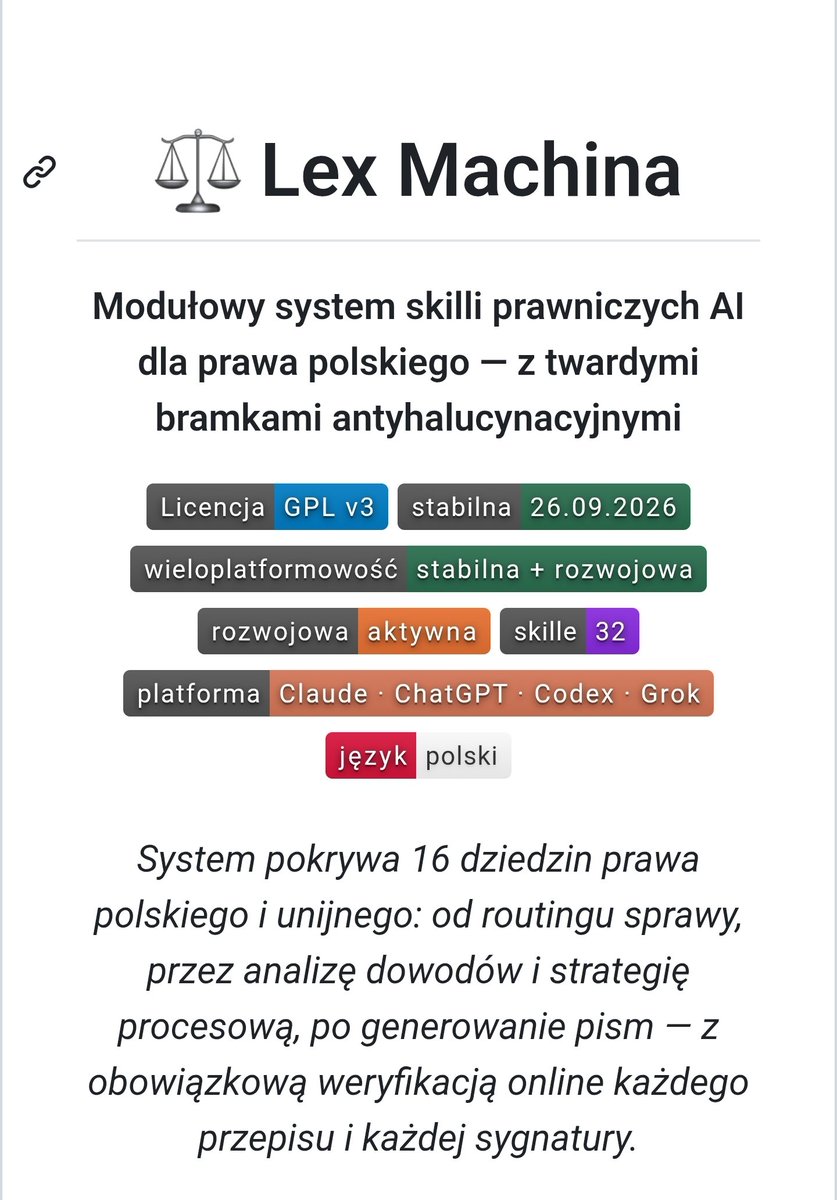
🔌 Lex Machina wchodzi głębiej w MCP — i właśnie teraz warto to dalej testować.
MCP pozwala połączyć warstwę AI bezpośrednio z zewnętrznymi źródłami i narzędziami. W Lex Machina nie chodzi jednak o samo „podpięcie API”.
Konektor ma dostarczać dane do istniejących bramek weryfikacyjnych, a wynik z MCP nadal musi przejść przez mechanizmy kontroli źródła, aktualności i śladu weryfikacji.
W aktualnym rejestrze testujemy https://t.co/0UHfE80GlB. konektory dla:
⚖️ ELI / Sejm — akty prawne, Dz.U. i M.P.
🏛️ SAOS — orzecznictwo sądów
🏛️ CBOSA / NSA / WSA — orzecznictwo administracyjne
🏢 KRS — dane podmiotów i PODMIOT-GATE
🇪🇺 EUR-Lex / CELLAR — prawo UE i orzecznictwo TSUE
🏗️ KIO — zamówienia publiczne
📑 oraz kolejne źródła i integracje rozwijane w ekosystemie MCP.
Co ważne: MCP nie staje się automatycznie źródłem prawdy tylko dlatego, że coś zwrócił. Lex Machina traktuje wynik konektora jako element ścieżki weryfikacyjnej, a nie jako magiczny certyfikat poprawności.
Dlatego kolejny etap to nie tylko „czy działa?”, ale:
➡️ czy konektor zwraca właściwe dane,
➡️ czy poprawnie obsługuje FOUND / NOT_FOUND / AMBIGUOUS,
➡️ czy działa przy zmianach API i braku dostępności,
➡️ czy dane mają właściwy timestamp/TTL,
➡️ czy wynik prawidłowo przechodzi przez HARD GATE,
➡️ i czy cała ścieżka zostawia możliwy do odtworzenia ślad.
To właśnie chcemy dalej testować i rozwijać.
Lex Machina jest open source — więc nie trzeba wierzyć w opis funkcjonalności. Można wejść do repozytorium, zobaczyć architekturę, konektory, bramki i samemu uruchomić testy.
👉 https://t.co/sKvApwQpF2
MCP daje AI ręce do pracy. Dobra architektura decyduje, czego te ręce mogą dotknąć — i co musi zostać sprawdzone, zanim trafi do odpowiedzi.