A Visual Guide to Currency Control in Rialo
Diving into the architecture of the Rialo project.
Specifically, let's look at their Currency Control mechanisms. The system relies on four distinct pillars to ensure stability, security, and compliance.
Here is a breakdown of how the ecosystem works 👇#Rialo #DeFi
Smart Contracts:
At its core, Rialo moves away from manual intervention and relies on programmatic enforcement.
What it does: Automates conditions like collateral requirements and time-locks via code.
The Goal: Transparent governance where the rules are baked into the protocol itself.
Regulatory Compliance:
Rialo integrates a "Gatekeeper" system to bridge the gap between DeFi and traditional finance.
What it does: Enforces adherence to KYC (Know Your Customer) and AML (Anti-Money Laundering) laws.
The Goal: To prevent illicit activity and ensure that only authorized users access the network.
Exchange Rate Peg:
To function as a reliable currency, combating volatility is key.
What it does: Maintains value against a reserve asset through automated supply adjustments (minting/burning).
The Goal: To keep the value stable and predictable, avoiding the wild swings seen in unpegged assets.
Transaction Limits:
Network health requires flow management.
What it does: Places caps on daily movements of funds.
The Goal: To manage capital flow, prevent systemic risk, and stop network congestion before it happens.
💡 The Big Picture:
By combining Smart Contracts, Compliance, Pegs, and Limits, Rialo aims to build a currency that is both secure and stable.
@RialoHQ@itachee_x
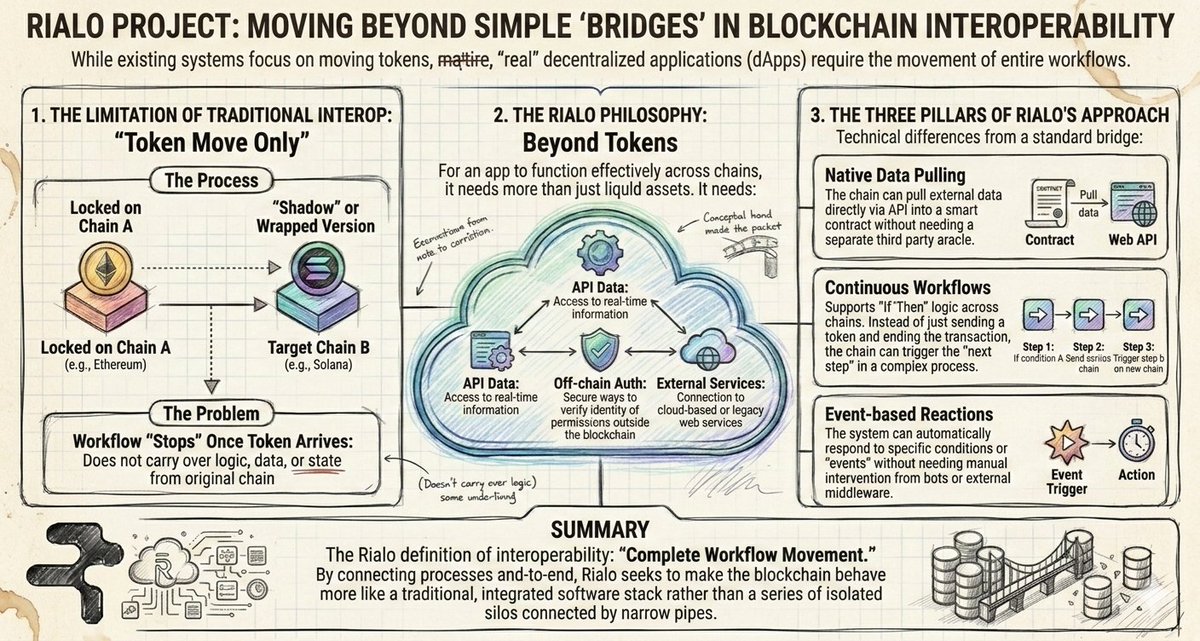
Rialo and why it’s shifting the paradigm of how blockchains talk to each other.
The "Token Bridge" Problem
Most current interoperability is just a digital pawn shop. You lock a token on Ethereum and get a "wrapped" version on Solana.
The issue? Once the token arrives, the logic stops. The data and "state" from the original chain don't follow it. It’s a delivery service that loses the instructions.
Moving Beyond Assets
Rialo’s philosophy is different. For a dapp (decentralized app) to truly work across chains, it needs more than just liquid money. It needs:
Real-time API data
Off-chain authentication (Identity)
Cloud/Legacy connections
It’s not about moving tokens; it’s about moving workflows.
Pillar 1: Native Data Pulling 📥
Traditional bridges need a third-party "oracle" to tell them what’s happening elsewhere. Rialo allows a chain to pull external data directly into a smart contract via API. Less middleman, more speed.
Pillar 2: Continuous Workflows
Imagine a domino effect across chains.
Instead of sending a token and ending the transaction, Rialo supports "If/Then" logic that spans networks.
Step 1: Condition met on Chain A.
Step 2: Trigger action on Chain B.
Step 3: Finalize on Chain C.
Pillar 3: Event-Based Reactions
No more manual bots or middleware required to "kick" a contract into gear. The system is designed to automatically respond to specific events or triggers. It’s "set it and forget it" for cross-chain automation.
The Big Picture: Integrated Software
Right now, blockchains are isolated silos connected by narrow pipes. Rialo’s goal is to turn the entire ecosystem into one integrated software stack.
Complete workflow movement means the blockchain finally behaves like the modern internet.
@RialoHQ@itachee_x