Are we at peacetime or wartime in US healthcare?
Do we need peacetime leaders or wartime leaders?
Read my new essay in @Forbes.
https://t.co/odUIOTcfBx
I had a roommate in college who frequently reminded us, “A friend in need is a friend indeed.”
I used to laugh. I’m not sure I fully understood what he meant.
These days, I think about that line often as people come and go—sometimes arriving with an ask, sometimes with a specific need, and then vanishing once the moment has passed.
It used to bother me.
If I’m honest, it still does.
The unexpected ebb and flow of people is one of life’s bitter pills.
But its converse is also one of life’s great gifts: the people who enter your life wanting nothing, needing nothing—and choose to stay awhile.
And then there is the harder truth.
I, too, am sometimes the friend in need. I have appeared in the lives of others with a request, received their help, and then allowed myself to drift away.
It is easy to notice who disappears from our lives.
Harder to reckon with the lives from which we have disappeared.
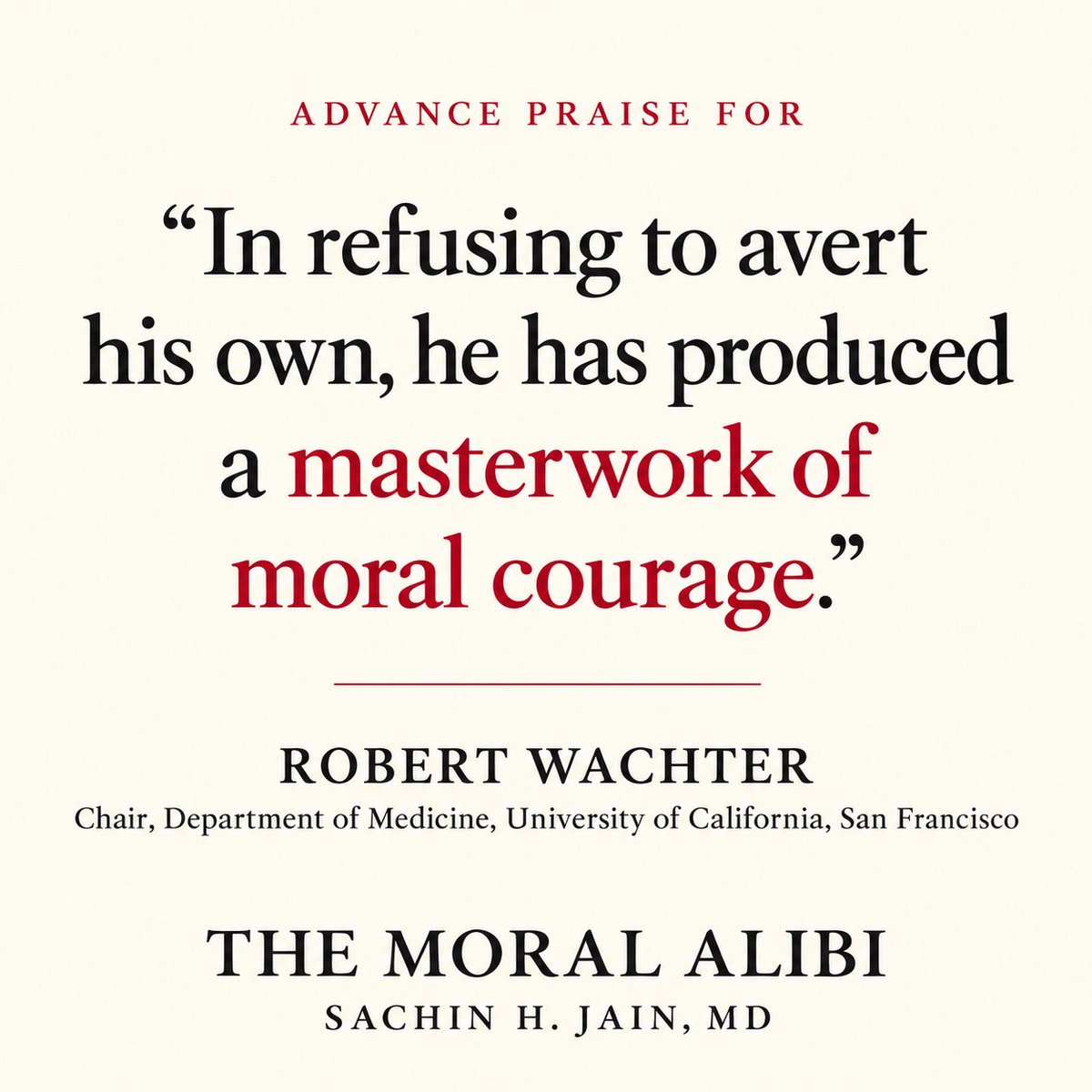
I am grateful to the legendary @Bob_Wachter of @UCSF for spending some time with an advance copy of “The Moral Alibi.”
I appreciate his comments:
“We have come to accept a healthcare system that underperforms with stunning regularity. Jain argues, persuasively, that this is less the product of bad people than of good people averting their eyes. In refusing to avert his own, he has produced a masterwork of moral courage.”
Learn more about the book and preorder it at its website:
https://t.co/idCzoGoecZ
SCAN and @Walmart are announcing a strategic collaboration to launch a co-branded Medicare Advantage plan in two states, with the plan expected to be available to more than two million Medicare enrollees.
“Walmart has been helping customers navigate Medicare choices for more than a decade,” said @pravenenath, group director for consumer health and data solutions at Walmart U.S. “What makes this collaboration unique is Walmart’s role in customers’ everyday lives. Because customers regularly turn to Walmart for groceries and other everyday essentials, we have an opportunity for those who choose to participate, to use insights from their shopping experiences to make nutrition guidance more relevant and actionable. Combined with Walmart’s breadth across food, pharmacy, vision and other health and wellness services, and SCAN’s deep Medicare expertise, we can create a more connected experience that helps older adults take action on their health goals as part of their everyday routines.”
To learn more about this collaboration, visit: https://t.co/HpYiLbbn5W
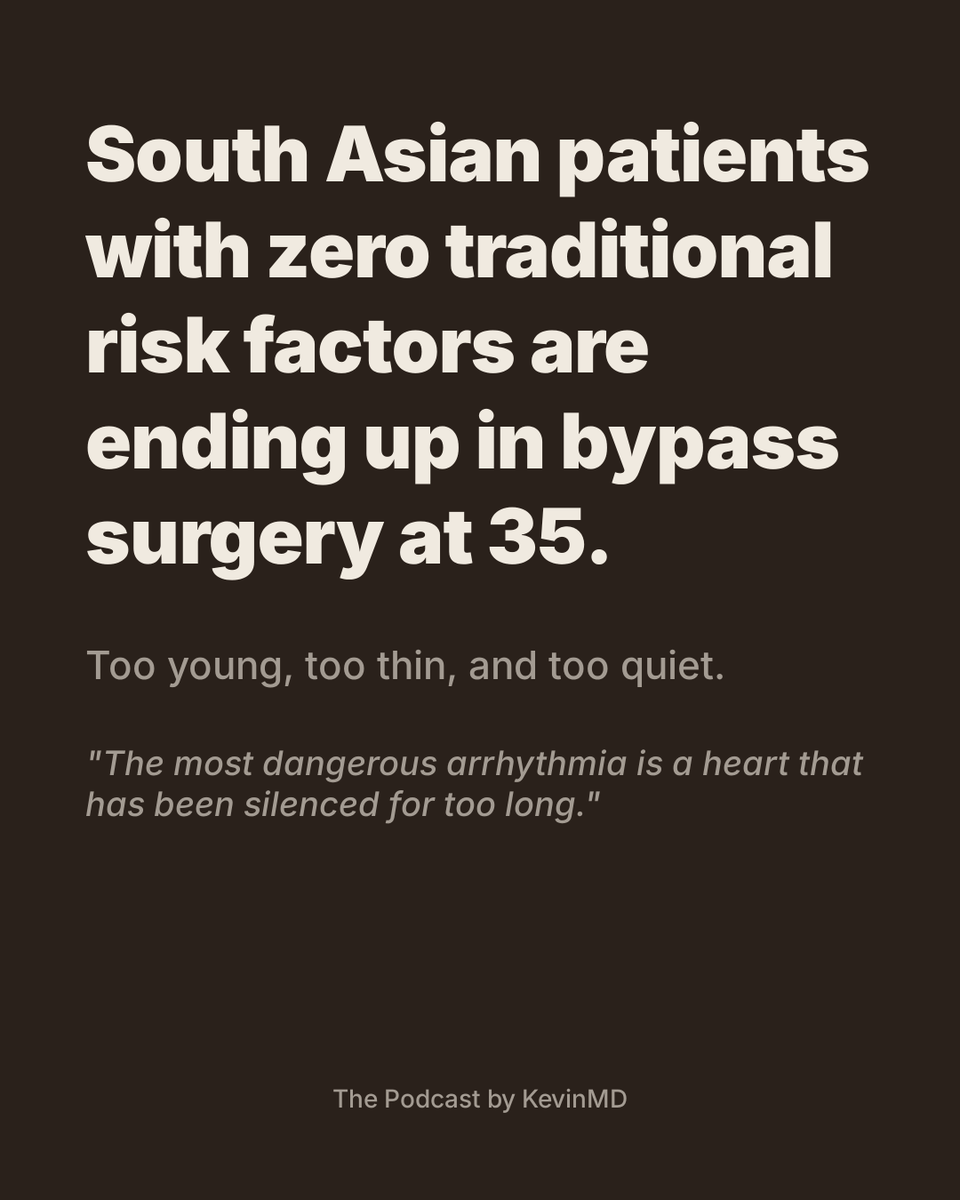
The 10-year cardiac risk calculator often fails South Asian patients, and a cardiologist in the Bronx is watching people around 35 or 40 with no traditional risk factors end up in bypass surgery.
Monzur Morshed is board-certified, originally from Bangladesh, and has treated immigrants and working-class men in New York for decades. Here is what he screens for instead.
Start with what the standard panel misses. South Asians carry insulin resistance and central obesity even at a normal BMI. In his words, thin on the outside but fat on the inside. The lipid pattern is low HDL, high triglycerides, and a "normal" LDL, so he reads the ratios rather than the LDL alone. High-sensitivity CRP runs high. And lipoprotein(a), which is almost 90 percent genetically determined, drives early atherosclerosis and probably won't respond much to atorvastatin or rosuvastatin.
His pathway:
1. Run the lipid panel and plug it into the ASCVD calculator like you would for anyone.
2. If the result is borderline, 5 to 7.5 percent, a typical patient without a family history can manage with diet and lifestyle. For a South Asian patient at the same number, order a lipoprotein(a). Once in a lifetime is enough to know their status.
3. If it is elevated, get a coronary calcium score. Zero, 1 to 100, or over 100 tells him whether to start a statin or order more.
4. Add apolipoprotein B and the LDL-to-HDL ratio, since LDL alone can look fine while HDL is also low.
The other half of his screening happens in the conversation. He asks about the stress. Immigrant families worry constantly about deportation. There are divorces, jobs that never became good jobs, and a society that doesn't acknowledge them as much as it should. The cortisol stays in the system, and eventually the chronic inflammatory system kicks in and the atherosclerosis comes early and aggressive.
One of his patients, an educated man with no obvious risk factors, was terrified his wife was going to leave him. He was so afraid to talk that Morshed had to dig for it. He presented with what looked like an acute heart attack. In the cath lab, the coronary vessels were normal. Takotsubo cardiomyopathy, stress-related, symptoms exactly like a heart attack.
Family history is often blank for a reason. Sudden cardiac death is common back in Bangladesh, and most people never made it to a hospital, so nobody knows the cause.
On statin hesitancy, his answer is practical. Muscle aches, when they happen, are usually proximal and can be temporary. Lower the dose, take a holiday, or switch. For patients who won't take a pill, there are injections every 1 or 2 weeks, and inclisiran every 3 or 6 months. After a cardiac event or a stent, the LDL target is under 55.
His take-home for clinicians: "Do not wait for symptoms. Many South Asians with severe disease are asymptomatic."
Listen to the full conversation on The Podcast by KevinMD. Link in the replies.
What is your trigger for ordering a lipoprotein(a)?
#Cardiology #ThePodcastbyKevinMD
Why did I write The Moral Alibi?
In this new interview with @pminemyer at @FierceHealth, I discuss why healthcare needs a moral renewal—and why The Moral Alibi is also a self-indictment.
As I told Paige, many of us entered healthcare and started our careers with a sincere desire to help people.
Over time, we can become co-opted by its culture of quiet complicity.
Read the Fierce Healthcare interview:
https://t.co/4MgjK02vyD
Learn more about The Moral Alibi:
https://t.co/YEpvKJnEvd
The US Department of Homeland Security just posted this on its official account.
It's a racist and hateful message targeting Sikh Americans. And it's going to make all of us less safe.
Before it became a day of infamy, September 11 was my father’s birthday.
On the eve of what would have been his 80th birthday, I reflect on the lessons his example taught me about the business of healthcare.
https://t.co/U7ilfBOIbb
Robert Putnam, Malkin Research Professor at Harvard University, and author of the classic tome “Bowling Alone,” offers advance praise for my new book, “The Moral Alibi.”
Learn more about the book at
https://t.co/f657y8KMrZ
and order your pre-order copy wherever books are sold!
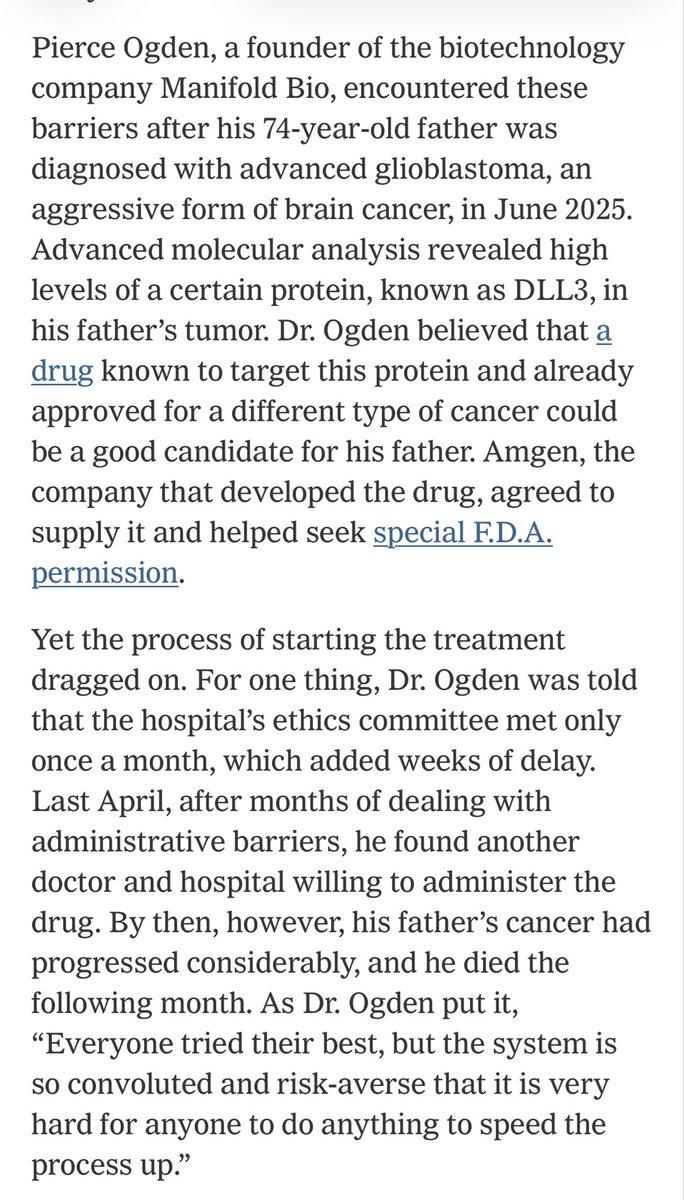
Man can’t get the drug for brain cancer that might save his life in time because the ethics board at his hospital only meets once a month.
Is anyone checking the ethics board for whether stuff like this is behaving ethically?
I’m thrilled to announce that Wiley is publishing my forthcoming new book, The Moral Alibi.
For most of my career, I believed I have working to make American healthcare better.
I worked in government, academia, pharma, care delivery, and health insurance.
In every role, I saw good people working hard inside institutions that routinely failed the people they were supposed to serve.
I also learned how easily we explain those failures away.
The regulations made us do it.
The economics and incentives have left us no choice.
The system is too complicated.
Someone else owns the problem.
These explanations are often true.
They are also alibis that absolve of us of our own responsibility to make things better.
My new book, “The Moral Alibi: How Healthcare Learned to Look Away—and How We Learn to See Again,” is not just another critique of American healthcare.
It is also a self-indictment and a confession.
The book comes out February 16, 2027
Today, I’m launching the book’s website, where I’ll share more about the ideas behind it and the conversation I hope it provokes.
I hope you’ll take a look and pre-order your copy today.
https://t.co/f657y8KMrZ
An innovative emergency medicine organization @YourSollis will give you 24/7 access to a private emergency room.
In the world of high deductible health plans and low first dollar coverage, its $4000 minimum annual price tag doesn’t seem crazy.
It might even be reasonable.
But what does its existence say about the state of medicine in the US today?
I dig in with Brad Olson, the company’s CEO and some recently released data on US ER access times.
Take a read:
https://t.co/EnYEb43K0x
❓Question of the day: What if #MedicareAdvantage members could choose to lock in their coverage for three years in exchange for gaining richer benefits, more stability, and in turn, better long-term health outcomes? In their latest @JAMAHealthForum article, SCAN CEO @sacjai, Dr. @DhruvKhullar, and Dr. Amelia M. Bond share their ideas around a voluntary three-year enrollment option, and how an alternative timeline could provide beneficiaries access to enhanced benefits and stability, while encouraging health plans to invest more in long-term prevention and chronic care.
Read their viewpoint here: https://t.co/ixQ1JCssYX
"Traditional Medicare is not a social safety net. It’s really a rich person’s Medicare program."
On the latest Good Medicine, Dr. Sachin Jain (@sacjai) breaks down the math of American healthcare, showing how traditional #Medicare can cost a senior couple $12,000 a year in premiums (although avg income is ~$54,000), making it entirely cost-prohibitive for the average retiree.
Enter Medicare Advantage. Despite its flaws and well-documented corporate arbitrage, it has become the actual safety net for low-income seniors who need comprehensive care, like dental and vision, without bankrupting themselves.
Catch the full conversation of Good Medicine where you get your podcasts, and share your thoughts on Roon: https://t.co/hLj3Httycq
"...what we're trying to do with Costco is create a higher degree of transparency and reliability around the benefits... and actually bring people to use their benefits at a store they already love and shop at."
SCAN CEO @sacjai shares details around SCAN and @Costco's partnership with @YahooFinance’s @joshuahlipton.
📺 View the full clip here: https://t.co/NDyGWOs5zI
⭐ The growing number of legal disputes over #MedicareAdvantage Star Ratings signals a need to restructure the Stars program. As SCAN CEO @sacjai and Chief Legal Officer Renee Delphin-Rodriguez explain in their @Health_Affairs piece, the current system’s complexity and instability not only affect health plans, but also have real consequences for members who rely on these ratings for quality care.
Read their observations and guidance here: https://t.co/rvZqv4pO0r
@Costco and @SCANHealthPlan are partnering to develop jointly branded Medicare Advantage and Medicare Supplement products designed to make Medicare simpler, more accessible and better connected to everyday health needs.
By combining Costco’s trusted reputation for quality and value with SCAN’s nearly 50 years of experience serving older adults, we aim to create a more intuitive experience for choosing coverage and accessing services such as pharmacy, vision and hearing care.
Specific benefits, markets and timing remain subject to regulatory approval. I joined @YahooFinance’s @joshuahlipton to discuss the partnership and the opportunity ahead.
Watch the conversation:
https://t.co/iNFgsJIyUE