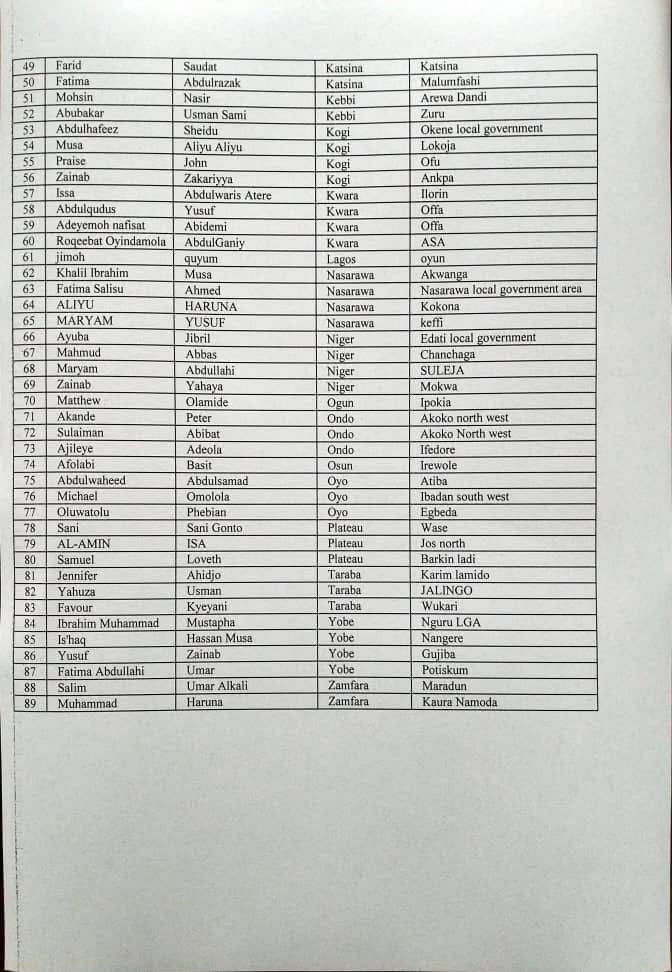
We are delighted to congratulate all successful applicants from the first phase of the Kwankwasiyya Development Foundation scholarship scheme at the Mewar International University Nigeria.
This is part of our ongoing commitment to providing quality education and creating opportunities for talented students across Nigeria.
All successful applicants listed below will be contacted and invited to the next phase, which includes an interview and document authentication. Upon successful completion, scholarship award letters will be issued.
For further information or enquiries, please contact:
• Mr. Ahmad: 0810 804 0392 (Call/WhatsApp)
• Mr. Lukman: 0703 578 9587 (Call/WhatsApp)
- RMK
Let me tell you something, my friend.
The North’s problem is real. Nobody serious should deny it. The poverty is real. The out-of-school children are real. The insecurity is real. The failure of leadership is real.
But if you want to understand the North, you cannot start the story from “they have had presidents.”
That is too shallow for a region with this much history, geography, trauma, religion, power politics, colonial distortion, elite failure, and security pressure.
The North did not wake up one morning and decide to hate education. There is a history behind that suspicion.
When the British entered Northern Nigeria, they met an already established Islamic political order. There were emirates, courts, scholars, taxation systems, trade routes, Islamic schools, judges, administrators, and a ruling class that already had its own idea of civilization.
Then colonial rule came with Western education, missionary activity, new courts, new administrative structures, and new incentives.
In many parts of the South, Western education entered through mission schools and became a ladder into the colonial economy. In much of the Muslim North, it carried a different meaning. It was not just “school.” It was seen by many as a vehicle for Christian influence, colonial loyalty, cultural erosion, and the weakening of existing Islamic authority.
That stigma did not come from the sky. It came from conquest, mistrust, and the way Western education arrived.
This is why the North’s education problem cannot be reduced to stupidity or laziness. It began partly as a defensive reaction to a real historical threat.
But here is the hard truth: the suspicion has outlived the threat.
A reaction that may have made sense under colonial pressure became destructive when the modern state began rewarding literacy, science, bureaucracy, technology, engineering, and formal administration.
At some point, protecting identity became indistinguishable from trapping children outside the future.
That is where Northern leadership failed badly.
The old Northern elite understood the danger earlier than people admit. Sir Ahmadu Bello did not sit down and say, “Let the North remain backward.” His Northernization agenda was a deliberate attempt to produce Northern teachers, administrators, civil servants, professionals, and political leadership quickly enough to prevent the region from being swallowed inside a new Nigerian state dominated by the already Western-educated South.
That agenda had flaws, but it worked in one important sense: it created a Northern administrative class.
The problem is that later leaders inherited the power but not the developmental seriousness.
They inherited the slogans, the emirates, the titles, the political machinery, and the federal access, but not the discipline of mass education, industrial policy, rural development, teacher training, agricultural modernization, and serious security planning.
So yes, the North has produced presidents.
But producing presidents is not the same as producing development.
Power without developmental discipline becomes distribution. It becomes appointments, contracts, pilgrim boards, federal slots, elite bargaining, and recycled patronage.
And geography also matters.
The North is not sitting beside the Atlantic like Lagos or Port Harcourt. It is tied to the Sahel. It shares long and porous borders with Niger, Chad, Cameroon, and Benin. When Libya collapsed, when weapons spread across the Sahel, when jihadist networks expanded, when climate stress hit pastoral routes, when Lake Chad communities were weakened, when Niger and Mali became unstable, the North inherited those shocks directly.
A farmer in Zamfara, a trader in Maiduguri, a herder around Sokoto, or a community in Katsina is not dealing only with “Nigerian leadership failure.” They are living inside a regional security crisis.
That does not excuse bad leadership. It explains why lazy comparisons are weak.
The North also suffered from the Nigerian resource curse in a particular way. Once oil money became the centre of the Nigerian state, productive regional economies were weakened. Groundnut pyramids, cotton, hides and skins, textiles, agriculture, local industry, and regional planning lost importance. Politics became a struggle for federal allocation instead of a competition to build productive capacity.
The North had land. It had people. It had agriculture. It had trade routes. But the oil state taught every region to look toward Abuja.
That destroyed initiative everywhere, but it damaged the North deeply because its strongest assets required long-term planning: irrigation, agro-processing, education, rural roads, livestock systems, border trade, and security coordination.
Now, after saying all that, responsibility must be accepted.
Northern leaders failed their own people.
They allowed almajiri children to become political decoration instead of a national emergency. They allowed banditry to grow from local criminality into a parallel economy. They allowed schools to decay. They allowed girls’ education to become negotiable. They allowed clerics and politicians to play games with reform. They used poverty as an election structure. They built loyalty through dependence.
That part is true.
But the answer is not to mock the North. The answer is to study what worked before and update it.
Ahmadu Bello’s Northernization agenda can be reimagined for the 21st century.
Not as ethnic exclusion or nostalgia. But as a serious regional human-capital project.
Mass teacher training. Boarding schools in secure zones. Integrated Qur’anic and formal education. Technical colleges tied to agriculture, energy, construction, mining, and logistics. Girls’ education backed by stipends and community negotiation. Agro-industrial clusters around Kano, Kaduna, Katsina, Sokoto, Bauchi, Gombe, Niger, and Borno. Livestock modernization instead of pretending open grazing can survive modern population pressure. Border security tied to trade, not just soldiers and checkpoints.
Other societies have faced versions of this problem.
Bangladesh attacked female education with stipends, community-level incentives, and a clear national push. Indonesia did not abolish its Islamic schools; it integrated many of them into a modern education pathway. Malaysia used state policy to expand opportunities for historically disadvantaged Malay communities, though with its own flaws. China took poor inland regions seriously through infrastructure, rural industry, technical training, and state coordination.
The lesson is simple: you do not fix historic backwardness by insults. You fix it with policy, discipline, and elite seriousness.
So yes, my friend, criticize Northern leadership. I do it too.
But do not flatten a whole region into “they had presidents and still failed.”
That is lazy analysis.
The North’s crisis is a product of bad leadership, colonial disruption, educational mistrust, Sahelian geography, oil-state laziness, elite capture, and security collapse.
And the way forward is also clear.
The North must stop hiding behind history.
The South must stop pretending history does not matter.
And Nigeria must understand that if the North remains broken, the country will not be stable, no matter how much one region mocks another online.
No matter how much you hate Kwankwaso & try to criticize in Kano, you’ll still see an evidence of his good deeds around you. Whether in human form or infrastructure.
Jagora is a living legend..
“Let’s try to register a new party in case the government creates chaos in the coalition,you can’t create chaos in a new party. that’s why we have that plan in place.decamping to ADC is a temporary solution”.
El-Rufa’i Dec, 2025.
I beg you in the name of God. Do not just sit and be scrolling through twitter forming fine boy and find girl.
Get your PVCs and prepare to vote. This is a life and death situation. We need to get this fuckers out
Had Tinubu allowed PDP, LP and NNPP to thrive without placing and financing moles to fight them, there wouldn’t have been Atiku, Obi and Kwankwaso sitting under one roof today.
As a Hausa proverb wisely cautions, when digging a trap, do not make it so deep that if you fall into it, you cannot climb out.
Northern Gov Forum should create SPV led by seasoned finance bro (like Shamsudeen Usman) Pool N20B (billion/state, 2 from Kano😀) Augment w private investment
and endowments from dem Dangote, Danjuma, BUA
This what Youths deserve, enough of Grinding machine empowerments🤧
I wish myself and few of my well to do brothers can open a “Shark Tank” in the North to help Youths in Business. Find potentials, invest in their business, co-own and see where it goes.
I firmly believe that this initiative is feasible. It has the potential to mitigate numerous challenges in the North, create job opportunities, and reduce the reliance on government assistance.
Please note that “North” encompasses all individuals, those who reside in the region regardless of their tribe, religion, or ethnicity. However, the business ventures must be domiciled in the North.
We can build a lot of lives… No one will do it for us, but us.
Ya Rabb, we thank You for this additional day and night in Ramadan.
Make this addition a source of khair for us Ya Rabb.
If we had any deficiency in our ibada during this blessed month, grant us the ability to rectify it and accept it from us Ya Rabb.
Help us to remember the purpose of Ramadan and of our creation.
Rabbanaa taqabbal minnaa innaka antas Samī'ul Alīm
She resigned from serving the highest office in the world due to her basic human conscience. In Nigeria, hunger has made them believe their hands are tired just because of a small SA appointment.
How did “we”, as a society,fail him? We aren’t government.We don’t have government’s resources.We don’t control the armed forces or intelligence apparatus. If anything, you should boldly call on the government to rise up,as stipulated in section 14, 2(b) of the 1999 constitution.