The Pan-African market is drowning in noise. General news, political gossip, and PR fluff. When we scan the market for our weekly Dispatches, we kill 95% of the stories we see. We hunt the Signal. 👇🧵
The macroeconomic architecture of African mining is undergoing a profound structural realignment as resource nationalism shifts from a theoretical policy risk to the definitive operating baseline. For mining executives and capital allocators navigating 2026, the strategic thesis is absolute: sovereigns that mandate and command local processing margins will dictate the market, while operators who fail to integrate these domestic value-add requirements will be systematically priced out. Aggressive regulatory pivots, such as the Democratic Republic of Congo’s concentrate export ban and Mali’s recent gold levies, are not isolated incidents; they are merely the opening acts of a continent-wide mandate to internalize supply chain wealth. Navigating these jurisdictions now requires sophisticated capital structures that align foreign direct investment directly with sovereign industrialization goals.
Subscribe to The Monday Dispatch to track the macro trends reshaping continental capital pipelines. 👇
#Macro #ResourceNationalism #CriticalMinerals #Mining #BatteryMetals #SovereignRisk #TheMacroBrief
Qatar's sovereign wealth fund is transforming a remote, pristine stretch of Egypt's Mediterranean coast into a year-round urban city with a $29.7 billion price tag.
The project, being developed by Qatari Diar, the real estate arm of the Qatar Investment Authority, will turn Alam El-Roum about 480 kilometers northwest of Cairo into a self-contained metropolitan center. The master plan includes 7.2 kilometers of private beachfront, 22 kilometers of artificial lakes, an 18-hole international golf course, a 50-berth marina, more than 3,500 hotel rooms across four hotels, luxury residences, sports facilities, retail businesses and educational institutions.
The first phase, estimated at EGP220 billion ($4.5 billion), is expected to create nearly 30,000 direct and indirect jobs. Qatari Diar CEO Sheikh Hamad bin Talal Al-Thani described the project as "an integrated urban city at a world-class level, operating throughout the year and not a tourist resort". The water features are designed to be swimmable, with 85% of the land allocated to open areas.
The agreement, negotiated with Egypt's New Urban Communities Authority, reflects increased Gulf confidence in Cairo's economy at a time when the government is seeking external finance to confront debt and a budget gap. It also marks Qatar's first substantial investment in Egypt since pledging $7.5 billion earlier in 2025.
This is what a sovereign wealth bet on African tourism infrastructure looks like.
Subscribe to The Monday Dispatch to track the macro trends reshaping continental capital pipelines. 👇
#Macro #CapitalMarkets #RealEstate #Hospitality #TheMacroBrief
Martell, the oldest of the great cognac houses, has launched Swift Academy a pan-African talent development platform designed to identify, develop and connect the next generation of African music creatives and professionals.
The platform will roll out across the continent over the next 12 months, beginning with its maiden edition in Kenya, aiming to support 100 emerging creatives within its first year. Curated by Africa House, the academy draws on its pan-African network and cultural expertise to create pathways for emerging talent to access mentorship, industry relationships and opportunities across markets.
The timing is strategic. Sub-Saharan Africa's recorded music market reached $120 million in 2025, following more than 15% year-on-year growth for two consecutive years. Yet many emerging creatives face limited access to professional networks, development opportunities and the infrastructure required to turn skills into sustained careers. Swift Academy is designed to close that gap.
Lanre Odutola, Head of Culture & Partnerships at Martell: "At Martell, we believe in celebrating progress, championing collective success and supporting creators as they pursue excellence on their own terms."
Jade Kelly Wilson, Co-founder of Africa House: "Swift Academy reflects what Africa House was created to do: connect the talent that already exists across the continent with the ecosystems and opportunities that allow it to grow."
Applications for the Kenya edition open on 17 August 2026.
Subscribe to The Monday Dispatch to track the macro trends reshaping continental capital pipelines. 👇
#Macro #CreativeEconomy #CapitalMarkets #AfricanMusic #TheSafariBrief
A new digital labour market is quietly reshaping how attention is manufactured across social media and it's paying real money.
Clipping is the practice of paying editors to chop long-form content podcasts, livestreams, TV shows, movies into short clips and distributing them across platforms. The goal: flood feeds, buy reach, and manufacture virality.
The economics are already substantial. In Nigeria, clippers charge between ₦30,000 and ₦200,000 per post. Elite clippers command guaranteed retainers of $500 to $1,500 a month, with performance-based pay of $1 to $4 per 1,000 views. One streamer spent $1.4 million over five weeks paying 303 clippers to flood social media with highlights.
The model has a dark side. The clipping economy can incentivize creators to manufacture inflammatory moments and stretch the truth to drive engagement. And the arbitrage may not last platforms could eventually automate native clipping, making the current $15,000-monthly clip economy a temporary tactic rather than a durable business model.
Clipping is the distribution engine of the creator economy in Africa. The question for allocators tracking digital infrastructure is whether this is a structural shift in content distribution or a fleeting arbitrage.
Subscribe to The Monday Dispatch to track the macro trends reshaping continental capital pipelines. 👇
#Macro #CreatorEconomy #DigitalCapital #LaborArbitrage #TheSafariBrief
Madagascar has ended a 25-year monopoly on oil imports by private companies as the tanker Sunda 1 docked at Toamasina with a diesel shipment for the state power company Jirama.
The arrival marks the first government-led fuel procurement in a quarter-century, backed by new legislation that allows the Malagasy government to control fuel importation. Private firms remain involved in logistics and parallel shipments, but the government now coordinates storage and distribution.
Energy Minister Radonirina Lucas Rabearimanga described the move as "bringing an end to the monopoly that previously existed". The fuel will stabilize the national grid for several months.
The trigger was the October unrest. Severe power outages crippled daily life and business, leading to deadly civil unrest and a coup. Madagascar is now taking direct control of its energy security.
Subscribe to The Monday Dispatch to track the macro trends reshaping continental capital pipelines. 👇
#Macro #CapitalMarkets #EnergySecurity #Madagascar #OilAndGas #TheSafariBrief
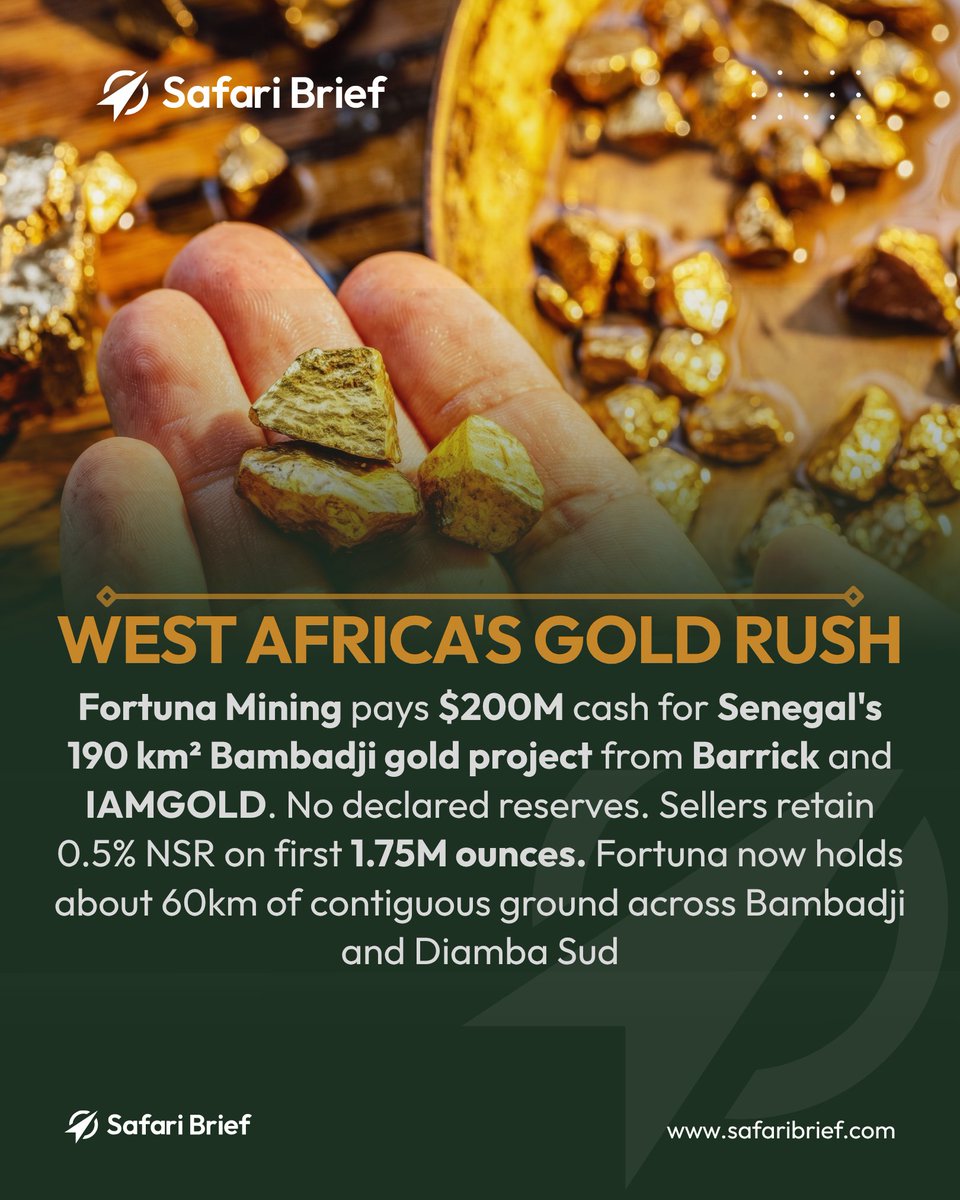
Fortuna Mining has agreed to pay $200 million in cash for the Bambadji gold exploration project in Senegal acquiring 190 square kilometres from Barrick and IAMGOLD.
The deal consolidates Fortuna's position in Senegal's emerging gold district. Bambadji sits adjacent to Fortuna's Diamba Sud project, giving the company approximately 60 kilometres of contiguous, potentially gold-bearing ground across the two assets. The acquisition was funded from Fortuna's treasury, with $130.35 million going to Barrick and $69.65 million to IAMGOLD.
The market is watching closely. Bambadji is an advanced exploration project with no declared mineral resource. Fortuna is betting that its exploration team can convert the prime drill-defined targets into a mineable resource. The sellers have retained a 0.5% net smelter return royalty on the first 1.75 million ounces produced from Bambadji Nord a signal that Barrick and IAMGOLD see upside they're willing to keep a stake in.
Fortuna plans to spend approximately $8 million on exploration in 2026, with drilling expected to begin in the third quarter. The question now is whether the drill bit validates the price tag.
Subscribe to The Monday Dispatch to track the macro trends reshaping continental capital pipelines. 👇
#Macro #CapitalMarkets #Gold #Mining #WestAfrica #TheSafariBrief
The architecture of global capital is shifting. Africa’s top 10 new greenfield megaprojects are aggressively targeting energy, chemicals, and critical industrial corridors.
The structural reality: Global and regional capital is deploying surgically to secure supply chains. Gulf liquidity leads with a $5B chemicals project in Ghana backed by Qatar and a $4B oil/gas deal in Uganda backed by the UAE. Crucially, intra-African capital is competing at scale, highlighted by Dangote’s $3B chemicals megaproject in Ethiopia. The priority is no longer passive investment, but securing high-yield, sovereign-level industrial capacity.
Subscribe to The Monday Dispatch to track the macro trends reshaping continental capital pipelines. 👇
#Macro #CapitalMarkets #FDI #TheSafariBrief
China built Africa's solar boom. Now the continent wants the factories too.
Chinese renewable-energy investment and construction projects in Africa reached $66 billion between 2010 and 2024. Solar exports to Africa surged 83% in April as power crises deepened across the continent. Africa imported a record 18.8 GW of Chinese solar panels in 2025.
Now the next contest is underway. Nigeria, South Africa, Morocco and Ethiopia are expanding local solar manufacturing. Nigeria's assembly capacity has grown from 120MW to roughly 300MW in two years. South Africa is planning a 1-gigawatt solar manufacturing plant. Morocco has doubled production to around 1GW a year.
But assembly is not enough. Africa has effectively no commercial-scale solar cell manufacturing. Most new factories assemble imported Chinese components rather than producing high-value solar cells. China still dominates the production of solar cells and other components. A change in export policy or pricing in Beijing can quickly reach developers and households across Africa.
The outcome matters. A weak outcome means African countries import panels, cells and batteries while only carrying out final assembly cheaper power, but the valuable technology, supplier relationships and industrial jobs remain elsewhere. A stronger outcome links market access and investment incentives to local factories and workforce development.
Subscribe to The Monday Dispatch to track the macro trends reshaping continental capital pipelines. 👇
#Macro #CapitalMarkets #EnergyTransition #SolarPower #Industrialization #TheSafariBrief
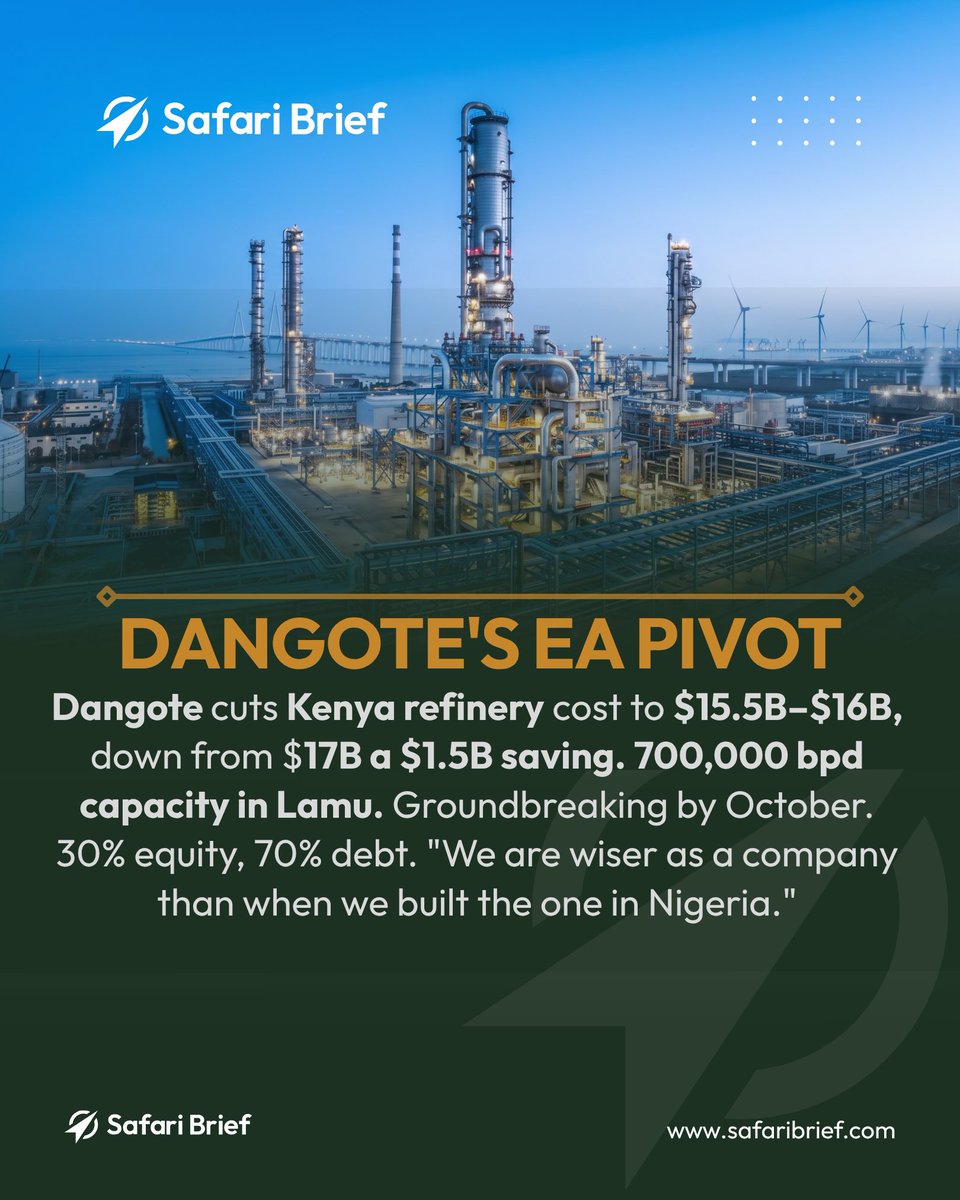
Aliko Dangote just revealed that his planned Kenya refinery will cost between $15.5 billion and $16 billion down from the initial $17 billion projection. The lesson? Experience is a balance sheet asset.
The 700,000-barrel-per-day facility in Lamu on Kenya's northern coast will become one of Africa's largest refineries, serving East Africa and beyond potentially as far as Egypt. Groundbreaking is expected by October, with construction targeted for completion in less than four years.
Dangote attributes the cost reduction to lessons learned from building the Lagos refinery: "This one will be faster, so financing cost will be less, and then also, we are wiser as a company than when we built the one in Nigeria" . The project will be funded by a 30% equity and 70% debt mix, with Dangote expressing confidence in raising the capital.
Lamu was chosen for its strategic position within the LAPSSET corridor a major infrastructure project connecting Kenya's northern coast to landlocked markets across East Africa. The refinery follows the 650,000 bpd Dangote Refinery in Lagos, which eliminated 100% of Nigeria's refined fuel import dependency after commissioning.
The playbook is now replicable. East Africa imports every drop of refined fuel it consumes. Dangote is betting that the same structural gap he closed in Nigeria can be closed again faster and cheaper this time.
Subscribe to The Monday Dispatch to track the macro trends reshaping continental capital pipelines. 👇
#CapitalMarkets #Macro #EnergyFinance #AfricaTrade #TheSafariBrief
Africa attracted $70 billion in foreign direct investment in 2025 down from the exceptional $94 billion recorded a year earlier, but still the third-highest level since 1990.
The rankings tell the story of where capital is landing:
Egypt retained the top spot for the fourth consecutive year with $15.5 billion in inflows. Guinea followed with $7.8 billion, driven by mining investments. Mozambique secured $5.7 billion, supported by hydrocarbons and LNG projects. Nigeria returned to the top five with $4 billion more than double its 2024 figure. Ethiopia rounded out the top five with $3.8 billion. Uganda attracted $3.4 billion, Morocco $3.3 billion, Kenya $3.2 billion, Côte d'Ivoire $2 billion, while Ghana and the DRC each recorded $1.9 billion.
The pattern is unmistakable. Capital is chasing Africa's resources and energy, with natural resources and energy projects dominating the investment landscape. Egypt and Morocco are the only countries that received massive foreign investment that wasn't for minerals or oil and gas.
Capital is concentrating in strategic gateways, not spreading evenly. The question for allocators is which economies are positioned to capture the next wave, and which are being bypassed.
Subscribe to The Monday Dispatch to track the macro trends reshaping continental capital pipelines. 👇
#FDI #Macro #CapitalMarkets #AfricaTrade #TheSafariBrief