🚨 THE NEXT GLOBAL MARKET SELLOFF COULD START BECAUSE OF JAPAN.
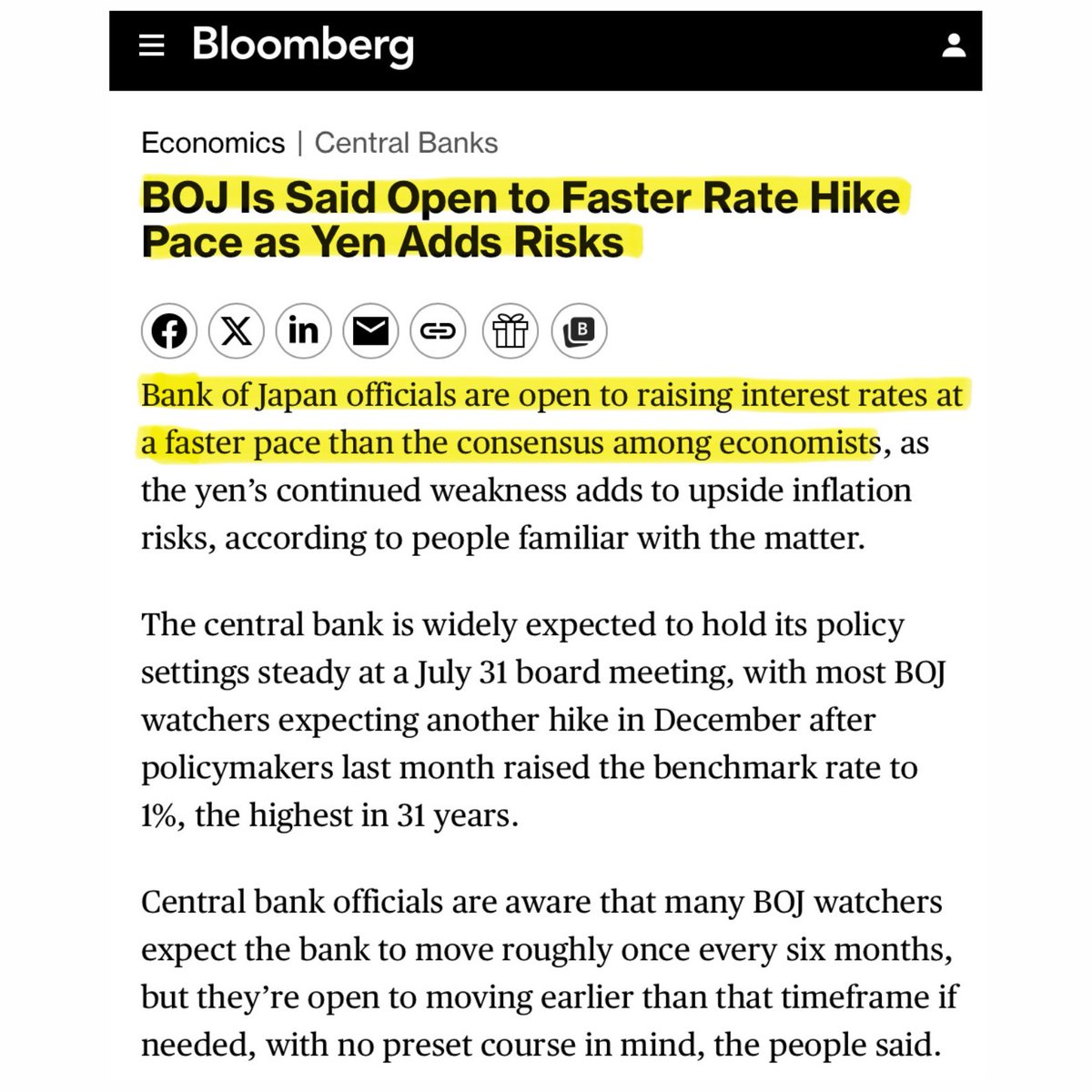
Bank of Japan officials just said they're ready to hike rates sooner than expected, according to Bloomberg.
The reason: the yen keeps falling, and that's pushing inflation risk higher.
The yen just hit its weakest level in 40 years. Right after that, the government warned it might step in.
The next hike was expected in December, six months after June's rate hike.
But officials say they don't have to wait that long. They can hike sooner if needed.
The market is already pricing a rate hike sooner than expected. Traders are pricing in a 72% chance of another hike by October, two months earlier than the usual timeline.
There's another reason for this. Companies are raising prices faster than before, and a weak yen gives them even more reason to keep doing that.
Inflation is now close to the BOJ's 2% target for the first time in 13 years.
A single BOJ rate hike in August 2024 was enough to trigger a massive global stock selloff.
That's because trillions of dollars sit in the yen carry trade, where investors borrow cheap yen and use it to buy higher yielding assets abroad.
Now imagine what a faster, unexpected round of hikes could do.
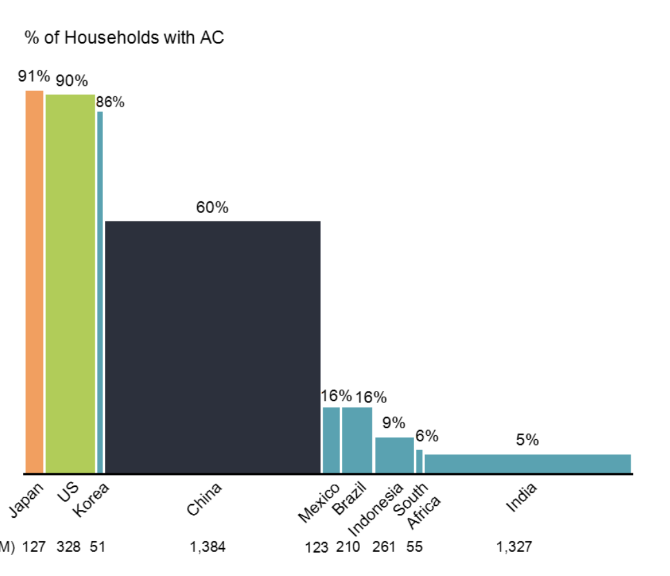
When it's over 90 degrees with humidity every day it's hard to concentrate. You move slower. You think slower. It isn't necessarily a terrible thing, there's a certain pleasure to langour. But you are less of an efficient person.
I'm surprised places like India and Africa don't prioritize A/C as a way to improve productivity. That's something that probably compounds over time. Like Singapore.
Oil reserves buy time, not security; they just delay the moment reality hits. The real risk isn’t "today’s" shortage, it’s a war that possibly outlasts the emergency supply.
Everyone who extracts value which can be quantified is overpaid. Everyone who creates value that can't be quantified is underpaid. There are very few exceptions.
🇵🇰📉If you’re a net saver and decades away from retirement, a falling market isn’t a tragedy. It’s a clearance sale. But no — please panic. Someone has to sell those shares.
If 20–40% drawdowns give you chest pain, sleepless nights, and existential tweets… equities may not be your asset class. Volatility isn’t a glitch. It’s the subscription fee.
At 17% CAGR for the next 30 years (2056), the KSE-100 at 166,000 today would be ~18,000,000 points. Yes, eighteen million. Compounding is boring… until it isn’t.
But relax — none of this works if you’re 100% stocks and 0% emotional stability. Asset allocation exists for a reason. Some fixed income keeps you calm, liquid, and ready to buy when everyone else is crying on TV.
Discipline > emotion. Allocation > prediction.
Panic < patience.
And please — talk to your investment adviser before you sell your house because of a tweet.
The payback period for solar is now 2.4 years (IRR: 76%), instead of 1.7 years (IRR: 147%). The horror of payback increasing by 6 months. This is what people are whining about -- an IRR of 76%.
It is still a ridiculously great idea for everyone to install solar -- go for it. Get batteries as well. VPPs coming soon, you should start selling in evening back to the grid.
Stop whining. Install solar tomorrow.
Dude pvtisation is great , but pls remember "good" PIA has been sold. The " bad " PIA the one with the debt and hotels and the pension liabilities, is still owned by the gov.
The most catalytic initiative that the govt in Pakistan can take here is to set up a fund of funds that is managed by a credible international org with deep expertise. This has been successfully done in many emerging markets.
Let me quickly explain what it is, and why we need it.
I can't freaking believe it's come to this, but here's a visual representation of this ridiculous structure
- bottom: actual portfolio companies, purchased by PE Funds I and II (with respective LPs)
- a secondaries fund comes along, buys LP interest in Funds I and II from some LPs. This secondaries fund raises money from other LPs
- but now, we have a tertiaries fund (!!) This fund will buy secondary interest in secondaries funds (by raising money from other LPs)
Does anyone even remember how many layers back the actual value is created???
P.S. not to be confused with CV vehicles (although CV vehicles are a subset of a secondaries fund bucket) - stay tuned for that visual..