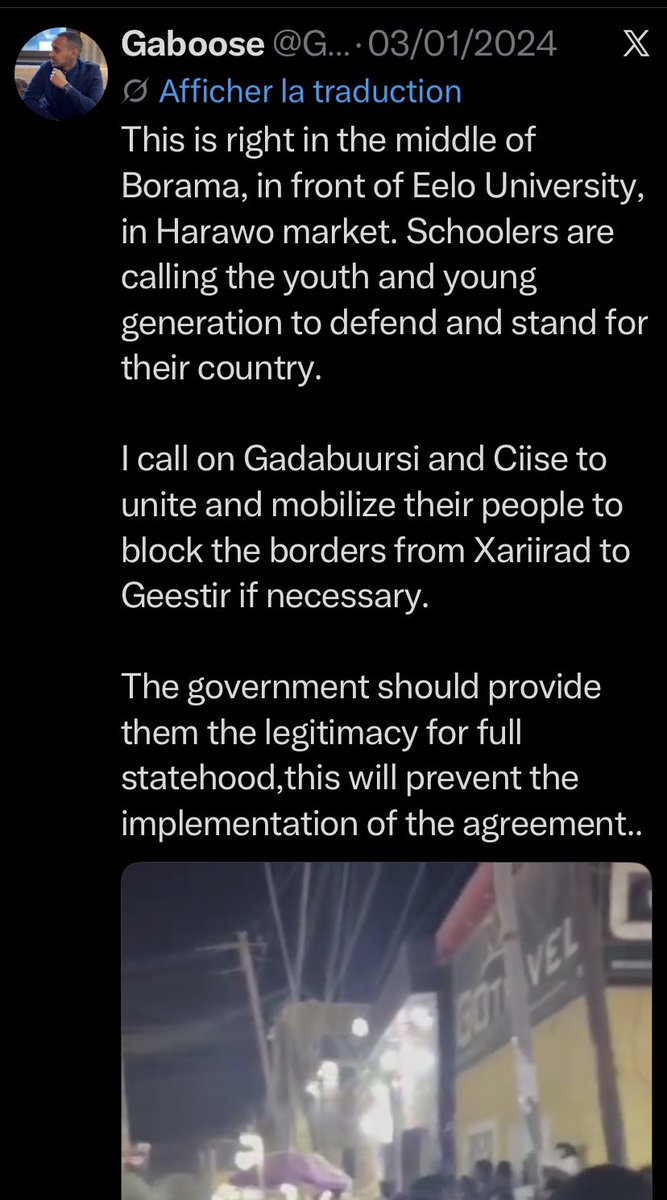
Gaboose, who presents himself as an intellectual from the Ethiopian-Somali (Reer Ethiopia) community, long supported the Awdalist movement and displayed deep hostility toward Somaliland. However, once his brother became a minister in the Cirro administration, he underwent a dramatic political turnaround.
Since then, he has offered unconditional support for Cirro’s policies and government. He has also adopted a particularly virulent tone toward Djibouti, even exhibiting growing hostility toward the Issa people.
Following the failure of the Awdalist movement, he appears to have shifted his position entirely—to the point of giving the impression that he has been co-opted by the Cirro administration. Notably, he has abandoned his previous antagonistic stance regarding Ethiopia’s policy on access to the sea.
This reversal raises a question: is this a genuine evolution of his political convictions, or merely a repositioning driven by personal and political interests? Is he a two-faced individual—or perhaps even a double agent? Where does this persistent hostility he directs toward an entire community—specifically the Issas—stem from?
Is he not, first and foremost, a former activist of the Awdalist movement—a project that ultimately failed? Having faced that failure, did he abandon his former beliefs to pursue his personal ambitions through other means—namely, by securing a position within the Cirro government?
How can one explain such a political about-face—the transition from his previous positions and past hostility toward Somaliland to his current support for the Cirro administration?
Is this a true ideological evolution, or a repositioning dictated by personal interests?
His political trajectory deserves a closer look.
@ay_has@Zaylacawi12@Bouh7777@SomaliBreakingN
@cabdifatax@ThisWeekSland@AlexisMGueldon If you’re going to lie, at least make the effort to make your lie credible. Your rhetoric is as hollow as your arguments are bogus.
Nigga, at this point, you don't even believe what you're saying. You're just saying things for the sake of saying them. Please, don't embarrass yourself any further. This should be enough for you for today.
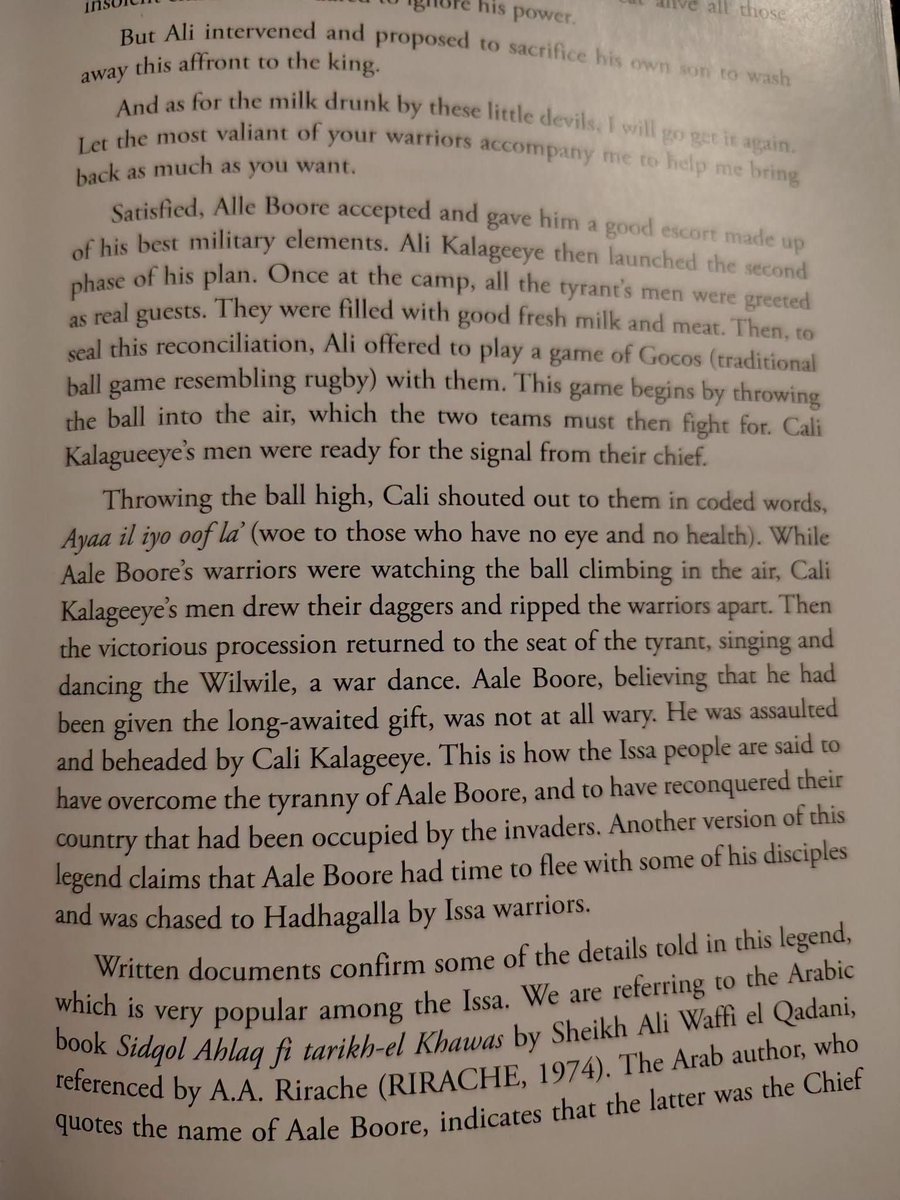
Everyone knows that Wilwile dance and Saylac District belong to the Ciise clan. The same way we rule today is the same way we ruled back then.
In Milan, the athlete from Djibouti breezed through the 21.1 km half-marathon in 1 hour, 8 minutes, and 4 seconds, setting a new benchmark for the event. In her debut on this prestigious course, the lieutenant in the Djiboutian Armed Forces (FAD) did more than just win she made history, while also claiming the national record for the distance. This performance stands as a testament to the talent, determination, and excellence found within Djiboutian sports.🇩🇯❤️🫶✊️
#Djibouti
Il se surnomme « Karim le titulaire », on ne connait pas son âge, et il travaille dans les mines au Burkina Faso. Via les réseaux sociaux il montre son quotidien et dénonce le travail des enfants dans les mines.
The Gode oil refinery project in Ethiopia
Ethiopia has launched the construction of the Gode oil refinery, a major industrial project valued at US$2.5 billion. Located in the Somali region, in the heart of the Ogaden basin, this facility is presented as the largest refinery of its kind in the Horn of Africa. Work officially began on October 2, 2025, and commissioning is planned for the end of 2027.
The project is being developed by the Chinese company Golden Concord Group Limited (GCL) in partnership with Ethiopian Investment Holdings. The refinery will have a processing capacity of 3.5 million tons of crude oil and condensate per year, supplied mainly from the Hilala oil field, one of the region’s main deposits.
The main objective of this infrastructure is to reduce Ethiopia’s heavy dependence on imports of refined petroleum products. The country currently spends about $5 billion per year on fuel imports. By developing its own refining capacity, the government hopes to increase energy self-sufficiency, reduce foreign-exchange outflows, and improve energy security.
Prime Minister Abiy Ahmed, who presided over the groundbreaking ceremony, called the project a historic milestone for the country’s industrial development. According to him, the refinery represents not only economic progress, but also an opportunity to strengthen regional cooperation and support national growth.
The Gode refinery is part of a larger energy program that also includes liquefied natural gas (LNG) infrastructure. In parallel, a major fertilizer plant project with a capacity of 3 million tons per year is to be built in the same area. This plant will use natural gas from the Calub field and should contribute to the development of the Ethiopian agricultural sector.
The choice of the Ogaden Basin is not insignificant; this region has had major oil and gas reserves explored for more than a century. The fields of Calub and Hilala were identified in the 1970s as major energy resources. Since its arrival in Ethiopia in 2013, GCL has gradually become involved in the exploitation of these resources.
Ultimately, the refinery should not only satisfy a significant share of domestic demand for fuels, but also allow the export of refined petroleum products to neighboring countries. The project is thus a key component of Ethiopia’s economic and industrial development plan for the next decade.
The Gode refinery represents one of the most ambitious energy investments in Ethiopia’s recent history. With an annual capacity of 3.5 million tons and an investment of $2.5 billion, it aims to reduce the country’s energy dependence, support its industrialization and make Ethiopia a major regional player in the oil and energy sector.
#DDS
#GodeOilRefinery
https://t.co/7ClvTPT6dS
https://t.co/7ClvTPT6dS
Dr. Abiy Ahmed is a loyal ally of the UAE.
Emirati cargo planes are reportedly landing at Ethiopian airports with complete impunity.
Recent footage, filmed today inside Bole International Airport in Addis Ababa, appears to show approximately seven Ilyushin Il-76TD transport aircraft, which are allegedly linked to the authorities in Abu Dhabi.
According to information accompanying these images, the aircraft are transporting weapons and ammunition intended to supply the RSF in Sudan.
The footage also reportedly shows foreign crew members disembarking from one of the planes—individuals said to be handsomely compensated for their missions.
These revelations once again raise serious questions regarding Ethiopia’s role in the Sudanese conflict—specifically concerning suspected support for the RSF and the country’s close ties to the United Arab Emirates.
Five days ago, Somalia severed relations with the United Arab Emirates, accusing the country of interfering in its internal affairs.
Both situations highlight growing tensions surrounding Emirati influence in the Horn of Africa.
#Soudan
#Somalia
The UAE have reportedly turned Somaliland and Puntland into strategic hubs, enabling them to support their operations and project their influence across the region—all without any meaningful oversight or accountability.
The people of Berbera and Bosaso must carefully weigh the political, security, and geopolitical consequences that the establishment of such foreign infrastructure on their territory could entail. Turning a blind eye to these issues today could come at a significant cost tomorrow.
It is time to recognize the risks, reject being exploited for the sake of foreign interests, and avoid becoming complicit in policies of interference that destabilize the region—most notably in Sudan and Somalia. Allegations that the UAE has provided support to actors involved in these conflicts must be taken seriously, and there must be a firm demand for transparency and accountability.
#Soudan
#Somali
The incident that occurred in Beledweyne is a situation that no one wishes to see repeated.
Those who seek to tarnish the image of the Djiboutian army through opportunistic rhetoric are mistaken. I see this primarily as a form of political exploitation and manipulation of public opinion.
The Djiboutian army maintains particularly close ties with the people of Beledweyne. Over the years, it has built relationships based on trust, fraternity, and solidarity with the local inhabitants—notably through its protective role and its presence on the ground. Such bonds cannot be erased by political controversy.
Furthermore, it is not the role of the Djiboutian army to interfere in political struggles or the internal affairs of Somalia. For those who take the time to understand the framework of its intervention, it is clear that the army is deployed as part of the African Union mission in Somalia (formerly AMISOM, now ATMIS), operating under a specific mandate and in accordance with agreements made with the Somali government. Its missions are carried out within the security framework established in coordination with the Somali authorities.
It is therefore essential to avoid conflating issues or engaging in political exploitation. It is entirely possible to discuss an incident, seek clarification, and determine accountability without undermining the long-standing relationship of trust and fraternity that exists between the Djiboutian army and the people of Beledweyne.
MOYALE UNDER BOMBARDMENT: OVER 30 DAYS OF VIOLENCE, DESTRUCTION, AND MASS DISPLACEMENT
For more than 30 days, the town of Moyale has been subjected to artillery bombardment, attributed to the Oromia army, Oromia special forces, Gada commandos, and the OLA. Day and night, heavy artillery strikes have hit the town, plunging the civilian population into a state of extreme terror and distress.
The human and material toll is reportedly severe: bloodshed, mass displacement of the population, the destruction of homes, and the devastation of places of worship. Several mosques have allegedly been reduced to ruins and ashes, depriving the faithful of their sanctuaries and gathering spaces.
The scale of the destruction is difficult to fathom. Families have been forced to flee, livelihoods have been wiped out, and the entire social and economic life of the town has been profoundly disrupted.
After more than 30 days of bombardment and suffering, Moyale is facing a humanitarian crisis that demands urgent attention. The protection of civilians, an end to attacks on populated areas, and unhindered access for humanitarian aid must be absolute priorities.
Moyale under fire from Oromia forces: the town beset by heavy artillery bombardment
Moyale under bombardment: Oromia forces employ heavy artillery
The town of Moyale continues to be subjected to bombardment by heavy weaponry, carried out by Oromia forces.
According to reports, following a defeat in recent clashes, these forces have intensified their operations by deploying heavy artillery, causing significant damage throughout the town.
Civilian homes, places of worship, and commercial establishments are among the infrastructure hit by the bombardment.
This situation raises grave concerns regarding the safety of the Somali civilian population. The scale of the reported destruction also gives rise to serious questions about adherence to international humanitarian law, which mandates the protection of civilians and civilian property.
The situation on the ground remains concerning and requires urgent attention from the international community.
The UAE have reportedly turned Somaliland and Puntland into strategic hubs, enabling them to support their operations and project their influence across the region—all without any meaningful oversight or accountability.
The people of Berbera and Bosaso must carefully weigh the political, security, and geopolitical consequences that the establishment of such foreign infrastructure on their territory could entail. Turning a blind eye to these issues today could come at a significant cost tomorrow.
It is time to recognize the risks, reject being exploited for the sake of foreign interests, and avoid becoming complicit in policies of interference that destabilize the region—most notably in Sudan and Somalia. Allegations that the UAE has provided support to actors involved in these conflicts must be taken seriously, and there must be a firm demand for transparency and accountability.
#Soudan
#Somali
@AlArabiya_Brk Once again, the uncomfortable truth: the RSF was created by the UAE to destroy Sudan and steal its natural resources. This year, three high-ranking RSF officers defected and joined the Sudanese army.
#Soudan
#BreakingNews | #Borama
At least 12 bodies were brought to Heegan Hospital in the Sibsibta neighborhood of Borama last night following deadly clashes that took place yesterday in several areas, including Beenyo Kulul and Hadeytey, in Lughaya District.
We have confirmed that five of the 12 people killed in the clashes were members of the Reer Maxamed clan.
A large number of severely injured people were also brought to Heegan Hospital for treatment, while those with minor injuries were taken to Boon Hospital.