AI compute is an asset class, but only for $100M+ tickets. Since 2023, ~$231B of AI-compute financing has gone almost entirely to the biggest clouds.
Sail Compute is building ownership for everyone else: B200 nodes, contracted to an AI company before a single server is bought.
Questioning who’s talking is fair (and true and necessary) but it doesn’t answer the claim. Spot prices yes are high, but leading indicators indicating cooling?Contract lengths, resale prices are observable and aren't.
GPU owners and brokers are the ones that benefit from the compute market being hot.
The reality is that it’s cooling down again. When you take in information, think about who it’s coming from and their motives
Compute financing is so exciting right now. You're literally underwriting a way to physically "vote" your preferences on how we navigate AGI.
Would love to join.
Compute financing is currently at the epicenter of fast-moving credit markets. Older GPUs are renting for more, not less, while bridge and takeout financing gets infinitely harder every week. Chris from K8 Capital and I are hosting a night in NYC on the 11th to talk through what it means for anyone lending against compute, and the structures we've been building to get deals done anyway.
Come find us and sign up here: https://t.co/ZH5Ac8DGXl
The writing is on the wall. Those who BUY COMPUTE, SELL COMPUTE, and HEDGE COMPUTE will be the beneficiaries of the Genesis of AI.
This space will be a vital part of the economy. Not just, tech, not just AI, the entire economy.
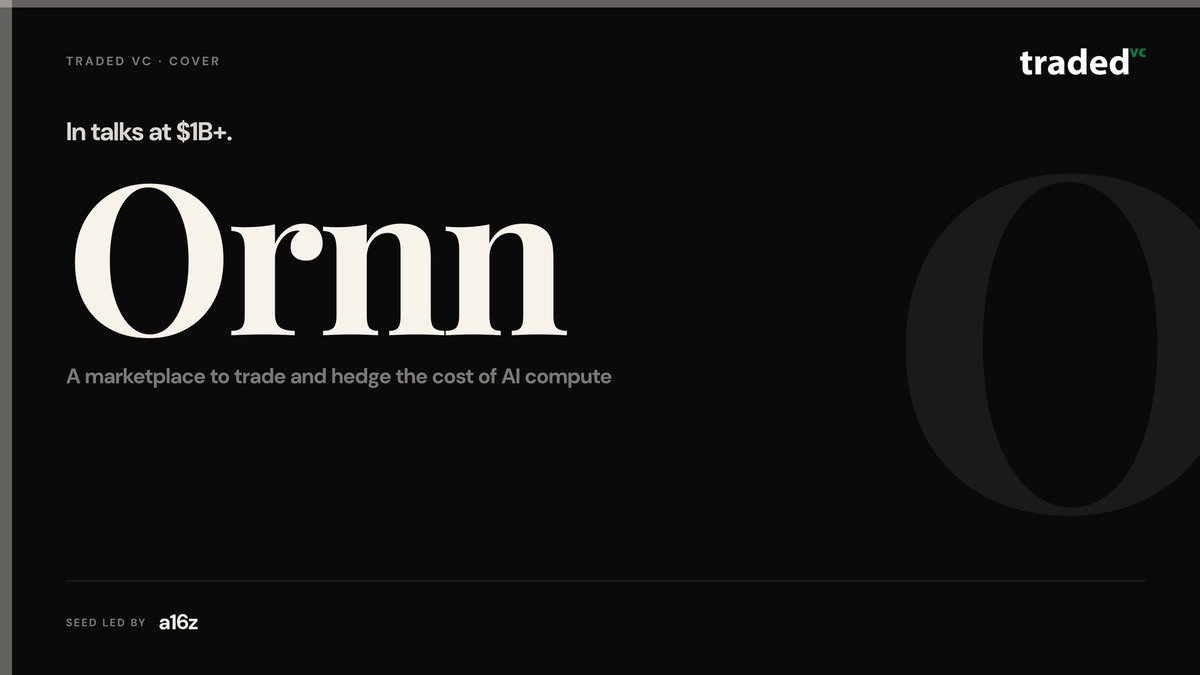
JUST IN: Ornn is in talks to raise at a valuation above $1B.
It just closed part of its Series A at $800M.
Four months ago it raised a $33M seed led by @a16z.
Ornn lets AI companies trade and hedge the cost of GPU compute.
JUST IN: Ornn is in talks to raise at a valuation above $1B.
It just closed part of its Series A at $800M.
Four months ago it raised a $33M seed led by @a16z.
Ornn lets AI companies trade and hedge the cost of GPU compute.
Have had interesting conversations with some of the biggest compute exchanges. They keep telling me to contract out compute month to month, they see B200-hours price going up and up.
It’s clear that demand is not going down anytime soon.. should you sign 36 month contracts?
Thus, don't be the company buying hardware, trying to be a neocloud.
Be the company connecting capital to compute. Plan, execute, operate. No leverage. Thousands of distributed nodes starts to add up quick, all paid in cash. Plus, dispersed compute ownership is hugely moral.
being a neocloud can be a good business, but not a venture scale business
let's say you raised $40M and put aside $10M to buy hardware. you buy a 16 node B300 cluster, begin renting it out at $8 on-demand. your cash-on-cash payback is probably 12 months at best. if you buy nothing else, that investment returns like 2-3x over 5 years
maybe you decide to scale. you can put aside another $10M from your balance sheet for another 16 nodes, or maybe you decide to finance it this time. you get a 12% rate.
now you've got 32 nodes, you've broken even, and you're cash flowing.
but you also spent half your balance sheet on an asset that isn't making your product better
there's a world where you buy a much bigger cluster and sell $100M contracts to labs, but that's not the game you're playing - buying 16 nodes doesn't make you a mini CoreWeave
there's also a play where you become the best in the world at racking and stacking GPUs, and build your team around that
but if you're just buying GPUs as an investment asset off your balance sheet, it's pretty close to using your balance sheet to buy Bitcoin
it's not that it's a bad idea
it's just not really the bet a venture-scale startup should be making
Our view is that compute is becoming the new democratic vote. In the AI era, owning hardware means holding tangible leverage over AGI’s trajectory, dictating who rents your capacity and retaining the ultimate power to pull the plug. Thus, everyone should scramble to own compute…
Crazy day for tech markets. NASDAQ closing down three points, INTC down 30%.
Not a good time to be a overleveraged neocloud. But a great time to own (a lot) of GPU/compute capacity.
People should own compute - bare metal, contracted out- as an asset, just like you'd own a bond.
Own compute itself as a tangible, productive asset. Buy a node, contract it out. Then use the proceeds to fund using frontier models!
We can help you do this.
sam: local inference is a terrible allocation of scarce resources
“a lot of people want local inference, and somehow they assume that the problem is solved now because we have open-source models, we're going to be able to run them on our computers, and so we're not going to need all the stuff in the data centre
but from a global allocation perspective, actually it's quite terrible to have everybody, like, have a bunch of the world's limited supply of DRAM sitting in their own computer and being used five percent of the time
you want maximum utilisation in the cloud if you're trying to deal with this very supply-constrained environment
somehow many people's intuition is the opposite of that”
Every founder I've talked to in SF this past week is actively working on owning their own hardware/assets (chips, shells, factories, etc), non-trivially moreso than before
Something happened recently and it's now clear that the new post-intelligence world order will be dictated by those who can aggregate and allocate capital the best
SF is relearning how small of an asset class venture is, and that legibility to capital will become everything in order to compete in this next industrial revolution
GPUs were supposed to depreciate like a new car off the lot. Today, 2020 legacy GPUs are still seeing their rental prices rise.
Real-time data for the compute economy, powered by Ornn.
Today, there are 3 classes of compute: On-Demand is reliable but expensive, Reserved requires you to commit to your spend years out and Spot is cheap but can be reclaimed at a moments notice and anything running dies. What if we could just... continue a process on a new host? 🧵
Every founder suddenly wants to own chips, shells, factories. Ownership isn’t the hard part. The hard part is financing it. Whoever solves compute financing for non-IG companies unlocks a huge next wave...
We'll give it a go.
The "Rack Spread" is unfolding, token prices are falling while GPU prices climb
Change since mid-July:
- B300 GPU rentals up 106%
- B200 up 66%
- H100 up 17%
- Average token prices down 58%
Charts of the Week: https://t.co/VOYp2wQyoZ
The "Rack Spread" is unfolding, token prices are falling while GPU prices climb
Change since mid-July:
- B300 GPU rentals up 106%
- B200 up 66%
- H100 up 17%
- Average token prices down 58%
Charts of the Week: https://t.co/VOYp2wQyoZ
Democracy will look very different. Monopoly of compute = monopoly of control.
Don't let yourself be an observer instead of a participant in the democracy that is to come.
The benefits of abundant intelligence will accrue far outside of San Fransisco.
Spent the last year writing about capital, sovereignty, and the coming reordering of economic power.
THE COMMANDING HEIGHTS
https://t.co/d048KdAkbv