Founder & CEO Macro Economic Insights (Pvt.) Ltd. Advising governments and corporates on Pakistan's economy, investment options, economic and political risks
URGENT: I call for @nytimes and @NYTimesPR to immediately retract their article entitled, "War May Answer Longtime Riddle of Iranian Dams Built for No Clear Reason" published on November 16th by Erika Solomon and Sanam Mahoozi and issue an immediate statement as to the illegality of targeting Iranian water infrastructure.
In this piece, Solomon and Mahoozi are clearly attempting to manufacture consent for the categorization of Iranian dams and water infrastructure under "dual use infrastructure". This would allow for the United States to have the pretext under international law to target these sites despite the lead reporter on the piece, Sanam Mahoozi, posting the article to X yesterday stating:
"Could some water projects have served to support Iran’s military buildup? No conclusive evidence—but questions worth asking."
According to the X post from Mahoozi, this investigation from The New York Times took "months", but as per her own statement, resulted in zero conclusive evidence.
In addition to this, almost every expert that was quoted by Mahoozi and Solomon on the piece have subsequently issued public statements rebuking the framing and conclusion of the article. This is clearly as a result of Mahoozi and Solomon not being forthcoming with these experts as to what the narrative being pushed by the article would be.
Nima Shokri, Danny Citrinowicz, Nik Kowsar, and Amir Aghakouchak, four separate experts quoted in the article have all issued public statements criticizing the framing and conclusion of the piece.
When an article implicitly seeks to manufacture consent for war crimes, finds no conclusive evidence, and is immediately condemned by the very experts quoted on the piece, it should be clear that it is blatantly dishonest and immoral to publish such an article.
@nytimes and @NYTimesPR should immediately remove to retract the article and condemn the implied conclusion that water infrastructure in Iran falls under dual-use infrastructure.
The men who sold Iraq are the same men who sold Syria, and they are the same men selling Iran. Not Bush. Not Blair. Not Trump. The names that never appear in the headlines are the ones who built the machine, and the machine is still running.
In 1996, a task force convened in Jerusalem for incoming Israeli Prime Minister Benjamin Netanyahu. The document it produced was called “A Clean Break: A New Strategy for Securing the Realm.” Its authors were **Richard Perle, Douglas Feith, and David Wurmser**. The paper called for the removal of Saddam Hussein, the rollback of Syria, and the abandonment of the Oslo framework. It was rejected by Netanyahu at the time. Perle then brought the same plan to Washington.
Iraq: The Office of Special Plans
After 9/11, the plan found its vehicle. The Office of Special Plans was created inside the Pentagon under Undersecretary of Defense for Policy Douglas Feith, with Paul Wolfowitz and Donald Rumsfeld above him. The office was run by Abram Shulsky, a Straussian who believed that “noble lies” are necessary in statecraft. Its deputy was William Luti. The staff included Michael Rubin, David Schenker, Michael Makovsky, and Chris Lehman, almost all of them veterans of the Washington Institute for Near East Policy (WINEP), the think tank of AIPAC, and protégés of Richard Perle.
This was the “Cabal,” as Seymour Hersh documented. It did not gather intelligence. It manufactured it. It bypassed the CIA and the DIA, funneled raw and fabricated claims from Ahmad Chalabi’s Iraqi National Congress directly to the White House, and discarded anything that contradicted the predetermined conclusion. An intelligence official who quit described the operation: “They were using the intelligence from the CIA and other agencies only when it fit their agenda. They didn’t like the intelligence they were getting, and so they brought in people to write the stuff”.
Syria: The Chemical Weapon That Was Not There
When the Iraq playbook was finished, the same method was applied to Syria. The chemical attack in Ghouta in August 2013 was attributed to the Syrian government. MIT weapons expert Theodore Postol analyzed the missile and concluded its range meant it had to have been fired from rebel-held territory, not government positions. US intelligence identified more than one rebel group with the capacity to produce sarin.
The narrative was amplified by a new kind of entity: Bellingcat, founded by Eliot Higgins. Bellingcat presents itself as independent. Its financial records show something else. It received €160,000 from Zinc Network, a “shadowy intelligence cutout” that runs information warfare for UK government ministries and the US State Department. It received funding from Chemonics, a contractor whose founder said he created the firm to “have [his] own CIA,” and which was the conduit for US funds and equipment to the White Helmets. A leaked UK Foreign Office appraisal described Bellingcat as “somewhat discredited, both by spreading disinformation itself, and by being willing to produce reports for anyone willing to pay”.
The White Helmets themselves were created by James Le Mesurier, a former British soldier working for ARK, a consultancy founded by Alistair Harris, described in documents submitted to the UK Foreign Office as an MI6 officer. ARK’s “humanitarian” programs in Syria were designed to collect intelligence. Le Mesurier’s White Helmets received approximately €100 million from the UK, Germany, Holland, and Denmark, $54.7 million from USAID, and millions more from Japan. The organization that provided the “evidence” of chemical attacks was funded, trained, and directed by the same governments that wanted the war.
Iran: The Think Tank That Wrote the War
The Iran war was not planned in the Pentagon. It was planned in five buildings on Massachusetts Avenue and K Street. A 2026 analysis using four different AI models identified the Foundation for Defense of Democracies (FDD), the American Enterprise Institute (AEI), the Hudson Institute, the Washington Institute for Near East Policy (WINEP), and the Heritage Foundation as the most prominent promoters of military action against Iran in the eight months before the war.
FDD’s original 2001 submission to the IRS described its mission as “provid[ing] education to enhance Israel’s image in North America”. Its CEO, Mark Dubowitz, is the single most influential figure in shaping the Iran narrative. He was a prominent critic of the Obama nuclear agreement, and he personally described how the US and Israel orchestrated the deception operation to smash Iran’s nuclear program. The other think tanks are staffed by the same personnel who promoted the Iraq war. Kimberly Kagan founded the Institute for the Study of War (ISW), which provided the “analytical” framing for military action. Lindsey Graham carried the message in the Senate.
The lobby is not hidden. The Mujahedin-e Khalq (MEK) , a cult listed as a terrorist organization until 2012, has paid more than $2.7 million to a lobbying firm run by former Senator Robert Torricelli. It has recruited Newt Gingrich, Howard Dean, and Rudy Giuliani to advocate for regime change in Iran. The MEK is the “moderate opposition” that the think tanks and the lobbyists point to when they need a local partner for the war they are selling.
The Money
The men who write the pretexts do not fight the wars. They invest in them.
The Carlyle Group, the private equity firm where former President George H.W. Bush was a paid senior adviser, held a 49% stake in United Defense Industries and controlled over 10% of the US defense industry. Its investors included the bin Laden family, who remained invested until just after September 11. Carlyle’s profits skyrocketed after the invasion of Iraq.
On the first day of the Iran war, Lockheed Martin stock hit an all-time high. Northrop Grumman closed up 6%. The three largest US defense firms posted a combined shareholder gain of $25 to $30 billion in a single session. BlackRock holds $9.7 billion in Lockheed, $11.5 billion in Raytheon, and $6.9 billion in Boeing. Defense Secretary Pete Hegseth’s broker at Morgan Stanley attempted to make a multimillion-dollar investment in BlackRock’s Defense Industrials Active ETF in the weeks before the strikes.
The energy windfall is darker. Before the war, Qatar was the United States’ principal competitor for long-term LNG contracts. After the US and Israel struck Iran’s South Pars facilities, Iran retaliated by hitting Qatar’s infrastructure. Two of Qatar’s fourteen LNG production trains were destroyed, costing an estimated $20 billion in lost revenue per year. Venture Global CEO Michael Sabel was on an earnings call within days announcing that the United States has “the largest available incremental LNG capacity” in the world. Venture Global shares jumped nearly 24%. Cheniere Energy surged around 7%.
The war was not fought for freedom. It was fought for market share.
The Method
The method is identical across three decades. Identify a target. Commission a document from a think tank. Place the authors in the Pentagon or the State Department. Bypass the intelligence agencies that will not cooperate. Fund a “civil society” organization to produce the evidence. Pay a lobbyist to carry the message. Buy the defense stocks before the first bomb falls. And when the pretext collapses, move to the next country.
The names are not secret. They are in the congressional record. They are in the financial disclosures. They are in the leaked documents. The visible men are interchangeable. The network is permanent.
Iraq was a lie. Syria was a lie. Iran is a lie. The men who told the lies are still in business.
First they came for Imran Khan,
And Bilawal said nothing,
For he was not Imran Khan.
Then they came for the judges,
And Bilawal said nothing,
For justice was not his concern.
Then they came for the journalists,
And Bilawal said nothing,
For the truth was inconvenient.
Then they came for the Constitution,
And Bilawal said nothing,
For power was more precious than principle.
Then they came for democracy,
And Bilawal applauded,
For he had been promised a seat at the table.
And finally, they came for his constituency,
And Bilawal cried out in protest.
But there were no judges left to hear him,
No free press left to speak for him,
No Constitution left to protect him,
And no democracy left to defend him.
For he had stood silent while they dismantled it all,
Never imagining that one day he would need what he buried.
"People, I loved you. Be vigilant!"
Julius Fučík — Notes from the Gallows (1942–43)
A Letter from Prison
An appeal to a system that does not exist
Former Prime Minister Imran Khan’s open letter to the Supreme Court from the darkness of illegal solitary confinement is in a rich tradition of letters written by imprisoned leaders throughout history. Penned by condemned or doomed men, in some rare cases by women, the letters from the past were usually written hours or barely days before their imminent death.
Famous last letters, or a body of letters from prison, include Sir Thomas More’s letter to his daughter Margaret Roper (1535), Sir Walter Raleigh’s letter to his wife Bess (1603), Marie Antoinette’s letter to her sister-in-law Madame Elisabeth (1793), French revolutionary Camille Desmoulins’s final letter to his wife Lucile (1794), Bhagat Singh’s letter from Lahore jail to his brother Kultar (1931), and Antonio Gramsci’s Letters from Prison (1926-37). More recently, Che Guevara and Nigerian environmental activist Ken Saro-Wiwa’s letters are also eminent examples of this dark genre.
These letters encompass a range of emotions and topics ranging from parental or spousal love and tenderness, defiance, moral courage, resistance, revolutionary idealism and serenity. A particularly fascinating – and tragic – subcategory of this genre of letters from prison relates to the final writings of people who were abandoned or condemned by the very political movements, revolutions, or institutions to which they had devoted their lives.
There is a strong element of confronting betrayal – the prisoner is not merely confronting death at the hands of an enemy, but is also confronting the possibility that a lifetime's political commitment may have been misplaced, that the revolution has devoured its own children, or that loyalty has been repaid with persecution.
Russian Bolshevik revolutionary Nikolai Bukharin is an outstanding example of this category. One of the Bolshevik Revolution's leading intellectuals, Bukharin had been close to Lenin, served on the Politburo, and helped shape Soviet economic policy. Stalin eventually had him arrested, subjected to a show trial, and executed. His final letter to Stalin, written in December 1937, is an extraordinary mixture of bewilderment, affection, fear, and an almost unbearable desire to persuade his persecutor of his innocence. What makes the letter remarkable is that Bukharin continued to address Stalin as a former comrade, seeking to understand why the system he had helped build had turned against him.
Imran Khan’s letter, despite his illegal, heart-breaking and inhumane treatment at the hands of the Establishment, betrays a naïve belief in a Pakistan that probably never existed – one committed to constitutionalism, rule of law, democratic freedoms and fundamental rights, one with independent, honest and just courts. Even if a glimmer of that mirage existed before 2022, it has been completely wiped out since. The past is another country. It seems unlikely that we can ever return to it.
Our thoughts and prayers for one of Pakistan's finest.
Bu, gördüğüm en başarılı Jensen Huang güldürülerinden biri olmasının yanı sıra, teknik açıdan da en başarılı yapay zekâ videolarından biri.
Gelecekte film ve dizilerin nasıl üretileceğini merak edenler mutlaka izlemeli. Sinema dünyasının nereye gittiğini gösteren çarpıcı bir örnek.
Italian artist Eduardo Castaldo has unveiled an artwork titled ‘Holy Mothers of Gaza’ inside Naples’ Pappacoda Chapel. By peeling back the painting’s outer layer, the work reveals an actual photograph from Gaza, captured by Palestinian photojournalist Omar El Qattaa.
The case of the missing Shawarma
Pakistan’s elusive search for (quality) FDI
Set up in June 2023, the Special Investment Facilitation Council (SIFC) initially promised to deliver USD 100 billion in inward FDI by 2035. This was subsequently pared down to USD 60 billion over 5 years, then to 25 billion and eventually USD 5 billion.
With even the downgraded figure missed by a mile, the powers that be turned to Saudi Arabia’s popular fast food chain Al Baik, and oversaw an MoU in October 2024 for opening of 200 outlets in Pakistan. While regional countries were accumulating bragging rights from manufacturing deals with some of the world’s biggest corporations, or setting up semi-conductor fabrication plants or multi-billion dollar data centres, Pakistan was, once again, happy to boast about foreign broasted chicken and shawarma being made in the country. (As of November 2026, there is no sign yet of the chicken shawarma!)
This episode is deeply illustrative in many ways of the myopia and lack of vision of Pakistan’s rulers. Not just the current lot but going back many decades. It is a case study that opens a window into understanding why Pakistan fails to attract not just foreign direct investment but also domestic private investment – and will continue to fail with the current mode of ‘thinking’.
The main takeaways from the Al Baik episode are:
o The Pakistani ruling elite, civilian as well as non-civilian, are constantly in pursuit of short-term fixes for the external account constraint (and everything else). This translates into a wild goose chase for any type of FDI, from anywhere, from anyone, with whatever strings attached. It doesn’t have to be ‘quality’ FDI that brings technology, market-access, efficiency – just dollars.
This mindset means that policymakers are content with market-seeking FDI (and are now pitching to resource-seeking foreign investors) rather than pursuing efficiency-enhancing foreign investment.
o Seeking quality FDI from quality investors would require fixing Pakistan’s myriad structural problems. Keeping the elites’ superyacht that is Pakistan afloat for a few more years is the name of the game. Even if it means invisible fiscal costs via sovereign guarantees and tax breaks, market distortions, unintended consequences such as locking into bad agreements for decades as in the case of the IPPs.
There is a more fundamental – and almost always overlooked – lesson. The approach that pursues short term fixes is intricately linked to lack of legitimacy of the political system and the absence of genuine representation for the people. How, you may well ask?
The lack of legitimacy of the wider elitist political regimes in Pakistan – whether direct military rule, hybrid interventions or via unpopular civilian surrogates – breeds a ‘need for speed’ whenever a new set up is installed by the Establishment. The raison d’etre for regime change is almost always presented as ‘preventing economic collapse’ or an ‘imminent debt default’ due to incompetence or maladministration.
Hence, the justification for regime change, and the route to gaining political legitimacy for the new set-up, is to show visible improvement in the shortest possible time in economic indicators – even at the cost of window dressing or pursuing short term objectives over longer term reforms.
With an average government in Pakistan lasting around 2 years, this short-term, anti-reform mindset and approach has become embedded – the go-to default situation. This is reinforced by the constituents and enablers of the Establishment itself: the army, civil service, surrogate politicians, big businesses, pliable media.
The army as well as the civilian elites it props, are ‘insiders’ of the existing system, status quo forces. By definition, they are anti-reform powers. Hence, expecting structural and institutional transformation or meaningful change from them is like expecting a fox to redesign the henhouse to keep out predators!
In the meanwhile, we will continue searching for the missing shawarma ...
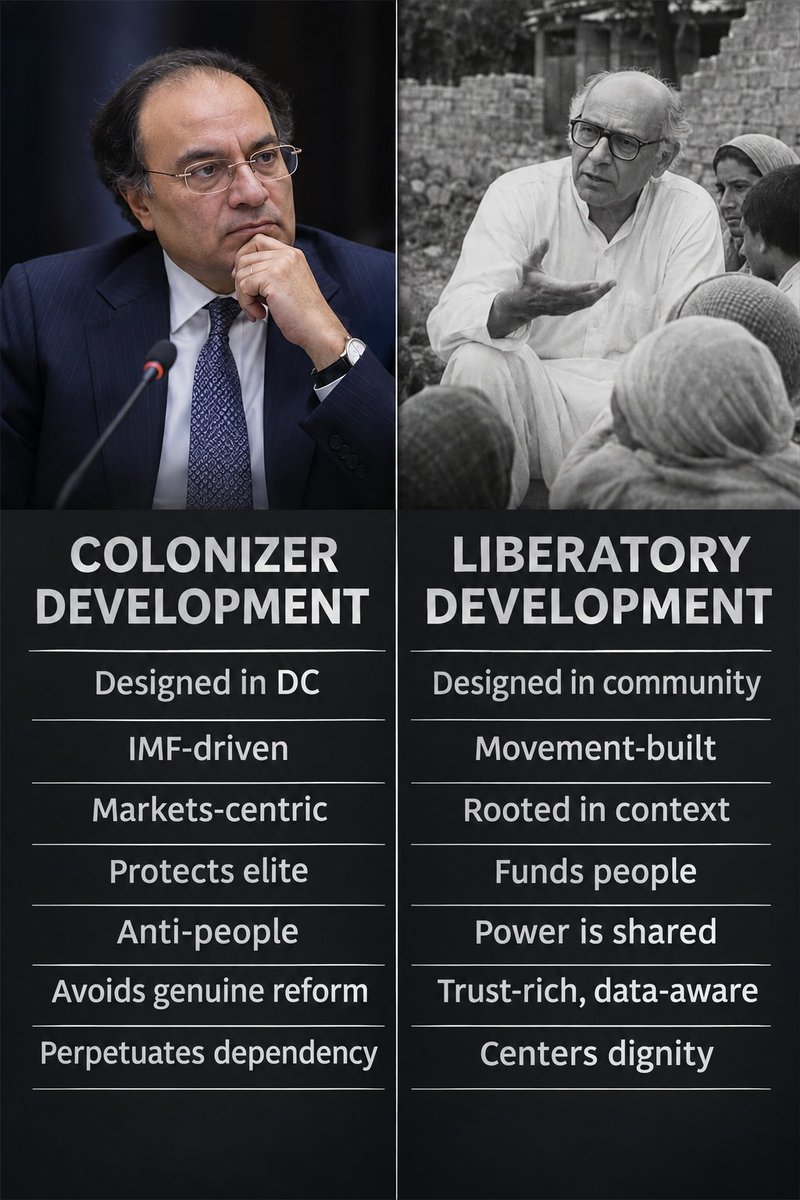
Pakistan's finance ministers, barring 3 notable exceptions (Sartaj Aziz sb, Dr. Hafiz Pasha, and to an extent, Shaukat Tarin), with their Canali suits, Hermes ties, Louis Vuitton shoes and Rolex watches, have sought validation from international capital markets, sovereign credit rating agencies, the IFIs, the IMF and bilateral lenders. They are more at home in Washington DC and London than in Pakistan.
Believers in neo-liberal, trickle-down economics and market orthodoxy, the finance ministers have been committed to a pecking order of preferences that puts preferred creditors and bond market investors above the people.
The betterment of their fellow Pakistanis, or concern about their condition under crushing fiscal austerity they have successively imposed, is neither in their plans nor in their narrative. Style and presentation is emphasised over substance and performance.
A Tale of 3 Finance Ministers
Three months before the Mexican Peso crisis erupted in December 1994, the country’s finance minister Pedro Aspe was the star of the evening at the historic Castillo de Viñuelas in Madrid on a lovely, warm late September night in 1994 to commemorate the fiftieth anniversary of the founding of the IMF and the World Bank at Bretton Woods.
“[W]ith his regal bearing, his smooth and practiced delivery, and—above all—his compelling story, the Mexican finance minister had his audience in thrall. Mexico, he asserted convincingly, had been a “pioneer” in transforming its economy from one that was closed to competition, highly controlled and regulated, and wracked by high debt and inflation, into a modern, open, and efficient economic system based on market principles. […] Mexico had carried out a “profound reform of the State” that had put its troubled economic past on the shelf and positioned it well for a stable and growing future.
Aspe was delivering this message to a distinguished audience of the world’s finance ministers and central bank governors, their spouses, and other guests […] that included Michel Camdessus and Lewis Preston, [the heads of the IMF and World Bank respectively]. He was introduced by Wim Duisenberg as the ‘personification of stability . . . based on sound fundamentals.’
In less than three months, the report card would have to be dramatically rewritten." [Adapted from Tearing Down Walls by James M. Boughton].
In December 1994, Mexico stumbled into its ‘Peso’ crisis whose contagion then spread into what became known famously as the Tequila Crisis. Pedro Aspe was considered a star by the Washington establishment: a Western-educated West-leaning member of the country’s elite, a firm believer in neo-liberal policies and the so-called Washington Consensus. Just the type from borrowing countries that is glorified by the IFIs.
The Mexican finance minister could easily have been replaced in the above episode with most of Pakistan’s finance ministers, barring 3 notable exceptions – Sartaj Aziz sb, Dr. Hafiz Pasha, and to an extent, Shaukat Tarin. The common factors that the IFIs and the debt markets celebrate in finance ministers from developing countries are: western-educated and westernised, preferably Anglophiles, urbane and sophisticated, globally-exposed, markets-savvy, believers in neo-liberal, trickle-down economics. In addition to market orthodoxy, the finance ministers should also be committed to a pecking order of preferences that puts preferred creditors and bond market investors above the people.
It is little surprise then that our finance ministers, with their Canali suits, Hermes ties, Louis Vuitton shoes and Rolex watches, are more at home in Washington DC and London than in Pakistan. They seek validation from international capital markets, sovereign rating agencies, the IFIs, the IMF and bilateral lenders. The betterment of the people of their own country, or concern about their condition under crushing fiscal austerity they have imposed, is never in their narrative. Style and presentation is emphasised over substance and performance.
For this reason, an Akhtar Hameed Khan (or a Dr. Muhammad Yunus of Bangladesh) would be a ‘system anomaly’. As was Yanis Varoufakis – the third type of finance minister (briefly!). A self-described “erratic” Marxist, Yanis was appointed as Greece’s finance minister for a brief period in 2015 from the platform of the left-wing Syriza party in the midst of the Greek debt crisis. As a tribute in The Guardian noted, Yanis Varoufakis “[…] put into words the suffering and resilience of his fellow Greeks”. That alone made him stand apart from his Pakistani counterparts.
Wearing a leather jacket and casual T-shirt, and riding his Yamaha XJR1300 motorbike to official meetings, Yanis was anathema to the staid European establishment and the so-called ‘troika’. So much so that when, as Greece’s finance minister, he arrived for his first meeting with the redoubtable wheelchair-ridden finance minister of Germany, Wolfgang Schäuble, Herr Schäuble refused to shake Yanis Varoufakis’s outstretched hand.
Yet, as the finance minister, Yanis advanced sound proposals keeping the welfare of his Greek compatriots first and foremost, trying to insulate them from the pernicious effects of never-ending fiscal austerity while securing the foundations for future prosperity. Pakistani finance ministers, with the exception of the three honourable mentions, have lacked a vision for the future and have been unable to think beyond stabilisation or accepting each and every conditionality put forth by the IMF and World Bank.
Beyond the issue of competence, another important factor is the misalignment of priorities. Gaining political legitimacy by delivering for the people is neither a requirement for the selected finance ministers nor a priority as they have no grassroots standing or support. Garnering “legitimacy” from the international establishment is. This leads to perverse incentives. Pakistan needs a finance minister with a vision, a deep understanding of economic and social development, connected to the people and committed to their well-being, not just to IMF-led stabilisation or short-run growth.
The Blue Wave and Iran
Will it be ‘Double or Quits’ for President Trump?
The so-called Blue Wave of Democrat victories in the mid-term elections in the US has flipped the Senate as well as the House of Representatives and handed control of both chambers of Congress to President Trump’s political nemeses. The scale of the Republican rout – and President Trump’s personal humiliation – is far greater than what most pundits had predicted.
In the immediate aftermath, Brent futures collapsed, the US and Asian equity markets went into meltdown, yields on US Treasuries retreated, and the US dollar fell initially against major currencies. On the face of it, the scale of the political disaster for President Trump and the lame duck presidency that ensues, with the possibility of impeachment proceedings and other investigations, should constrain his Iran war ambitions. Already, Rep. Tom Massie has announced his intention to re-introduce articles of impeachment against Defence Secretary Pete Hegseth next week.
However, there is a counter-intuitive dynamic at play that could (and is very likely to, in my estimation) lead President Trump to inflict pain on Iran before the new Congress is sworn in. The 120thCongress convenes on January 3, which provides a window of danger between now and then in which President Trump could avenge his ‘humiliation’ and attempt to redeem his ‘honour’ – and Iran is the obvious target. The tendency to strike back after a perceived slight is in keeping with malignant narcissism (widely perceived but not clinically proven in this case).
Hence, the implications for the conduct of the Iran war specifically could be contrary to what most people appear to expect – as pointed out consistently by the leading commentators on the war: @MearsheimerJ
(“The election is over, but Iran is not”), @ProfessorPape (“Three Humiliated Leaders – Why I Raised My Nuclear Odds” and “The Most Dangerous Lameduck”), and @tparsi (“Trump plans huge escalation with Iran after Midterms”).
Two other factors provide support to the above assessment:
1. A US military build-up is underway near Iran, with a third carrier group arriving in the next 7-10 days, along with a US Marine Expeditionary Force.
2. The Israel factor
In my view, the US political dynamic cannot be viewed in isolation from Israeli politics. It has to be seen in conjunction with the political limbo produced by Israel’s recent election. Instead of a clear defeat for prime minister Netanyahu it has instead provided him one last opportunity to pursue his Messianic dream of imposing a ‘final solution’ on Iran and dismantling it as a functioning, unitary state without which Greater Israel cannot be established.
What this could mean for our base case
The two scenarios that could unfold from here – President Trump accepting defeat and turning his focus to domestic politics, or his lashing out at Iran – obviously have diametrically opposite implications for oil prices, the inflation trajectory, financial markets, US Treasury yields and the US dollar. Since “anything can happen” is the Trump presidency’s zeitgeist, we are not revising our base case forecasts yet. For now, we are still projecting Brent at an average of US$100 till end-June 2027.
However, there has been a revision to our domestic inflation forecast – based not on a change in outlook for international oil prices but on the revision to the petroleum pricing formula announced by the government on October 30th. As a result, the pass-through from import prices is considerably lower now, which has led to a downward adjustment in our CPI inflation forecast for FY27 – and the outlook for the policy rate. Nonetheless, even with the revisions, our forecasts remain significantly higher than the current market consensus.
Dire straits
The worst is ahead of us
Earlier this year, I had posited that the Iran conflict is far from over, that the US is engaged in a "strategic pause", and the conflict is likely to enter a more intense and unpredictable phase at some stage. This view was presented to corporate clients in March, at the Regional Insights Forum (on April 14th), to the CFA Society Pakistan (May 8th), and more recently, at the OICCI’s Economic Dialogue on September 3rd.
It is now evident that our worst fears are coming true: the US has pulled itself into an escalation trap, and appears to be on the verge of yet another 'forever war' in the Middle East, despite the recent flurry of last-minute diplomacy. Mid-term elections in the US and Israel’s parliamentary elections will only serve as temporary distractions, in my view.
Some of the key takeaways from my predictions early into the conflict using a combination of game theory and history of the Iran-US-Israel animosity included:
o The war against Iran is far from over. We are likely witnessing a 'strategic pause' due to the November mid-term polls in the US, repositioning of forces, replenishing of strategic armaments stockpiles etc.
o Under a game-theoretic framework, the Iran war represents an asymmetric, dynamic and sequential "repeated game". In the long run, there are potentially 3 equilibria - and only one appears to be plausible in the calculus of the dominant player (hint: not via negotiations).
o This is reinforced, in my view, by the credible 'commitment problem' created by the conflicting goals of the players involved, and the history of the US's repeated reneging of past agreements and negotiations.
o The disruption caused by the Iran war is serious and long-lasting, even if the current pause extends into the medium term. A 'stable' equilibrium has been upended not just in economic terms but in geopolitical terms as well, in my belief.
o Israel appears less interested in regime change than a ‘final solution’ to its perceived Iran problem. I had predicted a flare-up in the separatist insurgency in Iran’s Sistan-Balochistan province, as observed recently.
o The financial markets are truly behind-the-curve, both globally as well as domestically. The coming energy shock is (still) being under-estimated and under-priced, in my opinion.
o Adding to the unpredictability surrounding the scope, duration, and intensity of the conflict is the fact that previous mediators are now compromised in some way or the other. Pakistan's strategic mutual defence pact with KSA and potentially with Qatar are overtly defensive in nature - but any involvement with Kuwait or Bahrain could be different in nature.
Dangerous days lie ahead. Pakistan must tread very carefully and avoid any non-peaceful entanglement that could prove very costly in the long run.
o Meanwhile, oil futures traders are still behind the (physical supply) curve. As warned by oil industry heavyweights, we are approaching an inflection point. The ‘3-2-1’ crack spread is already indicating tight conditions in petroleum product markets. With SPRs down to operationally feasible levels, and in the presence of exchange contracts of which the second (payback) leg is coming due, oil prices have only one way to go.
o The standout implication of this view: market participants are seriously under-estimating the impact on domestic inflation and the policy rate trajectory, in my opinion.
Current view:
The resumption of potentially a more intense phase of the US-Israel war against Iran, and our entanglement in the Saudi-Yemen conflict, will complicate Pakistan’s situation immensely. Energy and other critical infrastructure in the Gulf as well as Iran will be in the direct line of fire, and a severe as well as structural degradation of energy supplies from the region is likely to follow.
Pakistan’s economic situation is highly vulnerable. It has limited buffers in energy, Fx reserves, food or fiscal space - and a very high reliance on the Gulf for energy, trade and capital flows. There are some potential offsets and mitigants that can cushion the impact, however. But these may not fully compensate for the intensity of the external shock, in my view.
So far, the government has handled the supply situation viz. petroleum products and LNG well under challenging circumstances. This will be severely tested in the months ahead if the Iran war resumes. Supply shortages of LPG after the Iran border closure have already fed into domestic inflation, together with the continued repricing of the energy complex, in conjunction with sustained upward pressure in the wider ex-energy commodities indices.
Price chgs, since July 1:
ICE Brent futures: +59 per cent
LNG (JKM): +102 per cent
S&P GSCI: +22 per cent
FAO Food Price: +9.7 per cent (since January 2026)
Domestic wheat price: +36.5 per cent (y/y as of October 22nd)
Domestic LPG price: +107 per cent (y/y as of October 22nd)
Given the sustained inflationary pressure in the pipeline, the inflation forecasts for FY27 of SBP, IMF, professional forecasters as well as the wider market still appear too benign:
Latest inflation forecast for FY27:
SBP: +5.5 – 7.5 per cent (annual avg.)
IMF: +8.5 per cent y/y (+9.9 per cent annual avg.)
World Bank: +8.2 per cent (annual avg.)
Professional forecasters: ~+9.9 per cent
Market participants: ≤10 per cent (66% surveyed)
I expect a reality check in the months ahead leading to significant revisions of the inflation as well as policy rate forecasts .
@wynneflh Thank you for posting this and bringing this hero's story to us albeit belatedly. May he rest in peace and may his compassion and humanity shine through to the people committing genocide and crimes against humanity itself
Pakistan’s hybrid regime has existed for decades, and the data leaves little doubt about its true purpose: it was built not to share power between civilians and the military, but to extract resources. In this arrangement, political elites are tasked with containing public anger while the military centralizes economic wealth, leaving the population disenfranchised and in disarray. The country is in turmoil because of this extraction model. Poverty climbs year after year for a simple reason that the system was never built to run a functioning society.
https://t.co/wKGLm7Snyv