Tokenized equities are emerging as the trading center of the onchain RWA market.
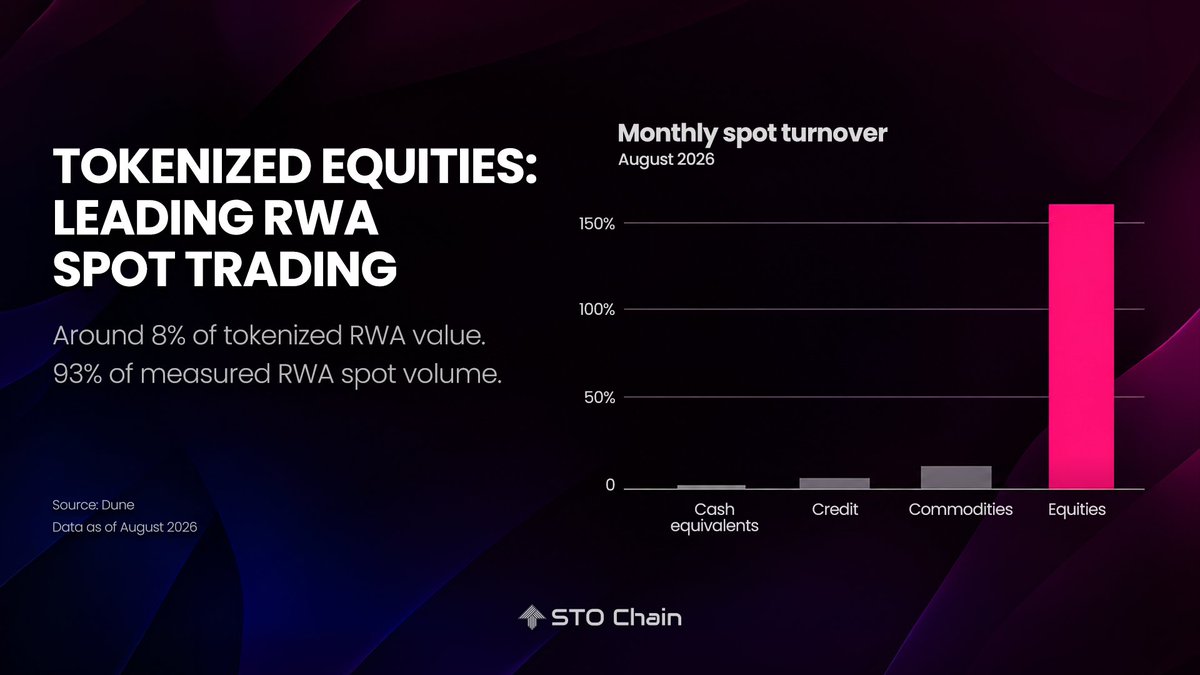
Dune’s Q3 2026 report shows that, through August:
→ Equity supply expanded roughly 25× year over year
→ Equities represented around 8% of tokenized RWA value
→ August equity spot volume reached $12.6B—93% of measured RWA spot trading
Cash equivalents remain the largest asset class by value, but trade infrequently. Equities account for a smaller share of assets outstanding while generating most spot trading activity.
This points to distinct market roles: tokenized cash-equivalent products are largely held, while equity tokens support active trading of securities exposure.
For exchanges and market operators, that makes execution quality, alignment with underlying prices, and liquidity depth central to building a functioning tokenized equity market.
#STOChain #RWA #Tokenization
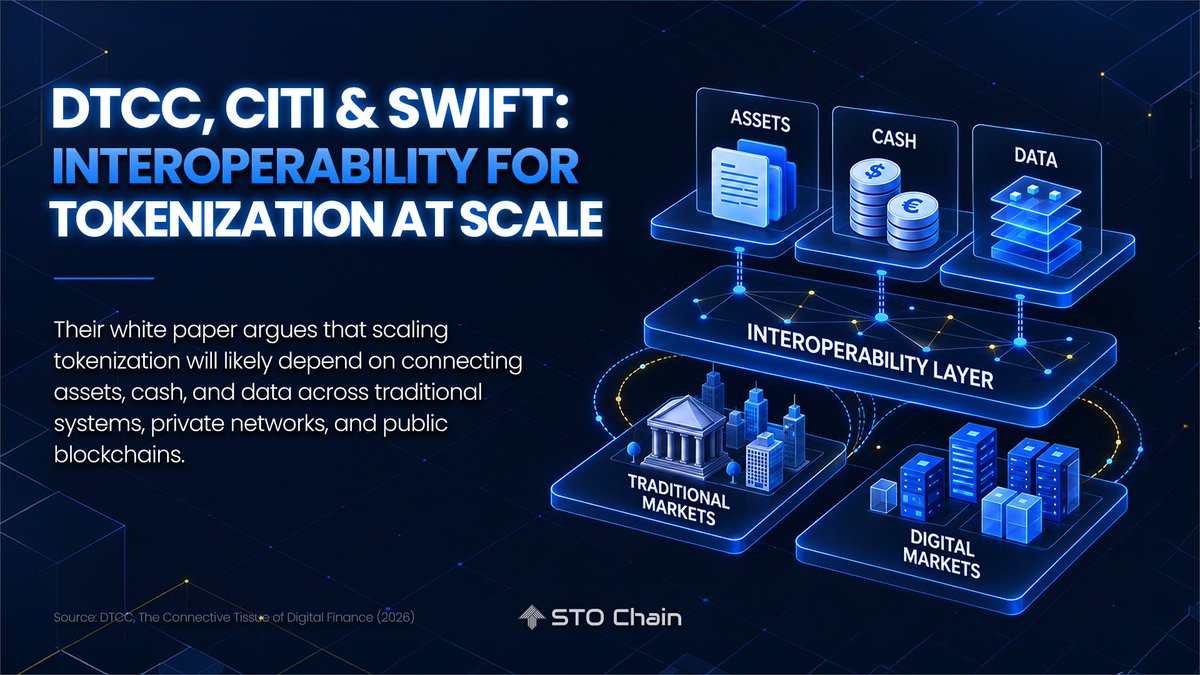
Tokenization is creating more digital assets. The harder challenge is making them work together.
DTCC, Citi, and Swift argue that institutional-scale tokenization will likely depend on interoperability — connecting assets, cash, and data across traditional systems, private networks, and public blockchains.
Without those connections, tokenized assets risk remaining fragmented, increasing operational complexity and limiting liquidity.
The next phase is therefore less about choosing a single technology platform and more about building a hybrid financial system where different networks can exchange value and information while preserving trust, resilience, and governance.
Tokenization scales when digital assets become part of connected market infrastructure.
#STOChain #RWA #Tokenization
Korea’s Hana Bank has taken a significant step into digital capital markets.
Hana Bank issued a $100 million digitally native bond on Euroclear’s D-FMI, becoming the first Korean bank to issue a digital bond through the platform. The five-year floating-rate note also became the first digital bond listed on SGX.
What matters is how the transaction connects digital issuance with existing market infrastructure.
The bond was issued directly on DLT infrastructure and supports same-day settlement, while international institutional investors can access and trade it through their existing Euroclear accounts and systems. Hana Bank also used its established GMTN funding program.
This points to a broader shift in tokenized debt markets.
The next stage is not simply issuing bonds on DLT infrastructure, but making digital securities fit naturally into institutional distribution, secondary-market liquidity, and existing investor workflows.
For digital bonds to scale, digital and traditional markets may not need to compete. They need to connect.
#STOChain #RWA #Tokenization
Tokenized finance is moving from market experiments toward real institutional infrastructure.
The Eurosystem has launched Pontes, enabling wholesale tokenized asset transactions to settle in central bank money. At the same time, the ECB has begun preparing to invest a small portion of its own funds directly in tokenized securities.
The initial focus is euro-denominated securities issued by euro area governments, public agencies, and European supranational institutions. The ECB aims to gain practical experience across the investment lifecycle, including execution, settlement, systems, and portfolio management.
The significance is that the ECB is approaching tokenized markets from both sides: providing central-bank-money settlement through Pontes while preparing to participate as an investor.
This points to tokenization moving beyond issuance toward institutional investment, market infrastructure, and trusted settlement within the same environment.
The investments have not started yet, but Pontes is already live, bringing tokenized finance closer to established financial-market infrastructure.
#STOChain #RWA #Tokenization
Tokenized equities are moving from digital representation to market structure.
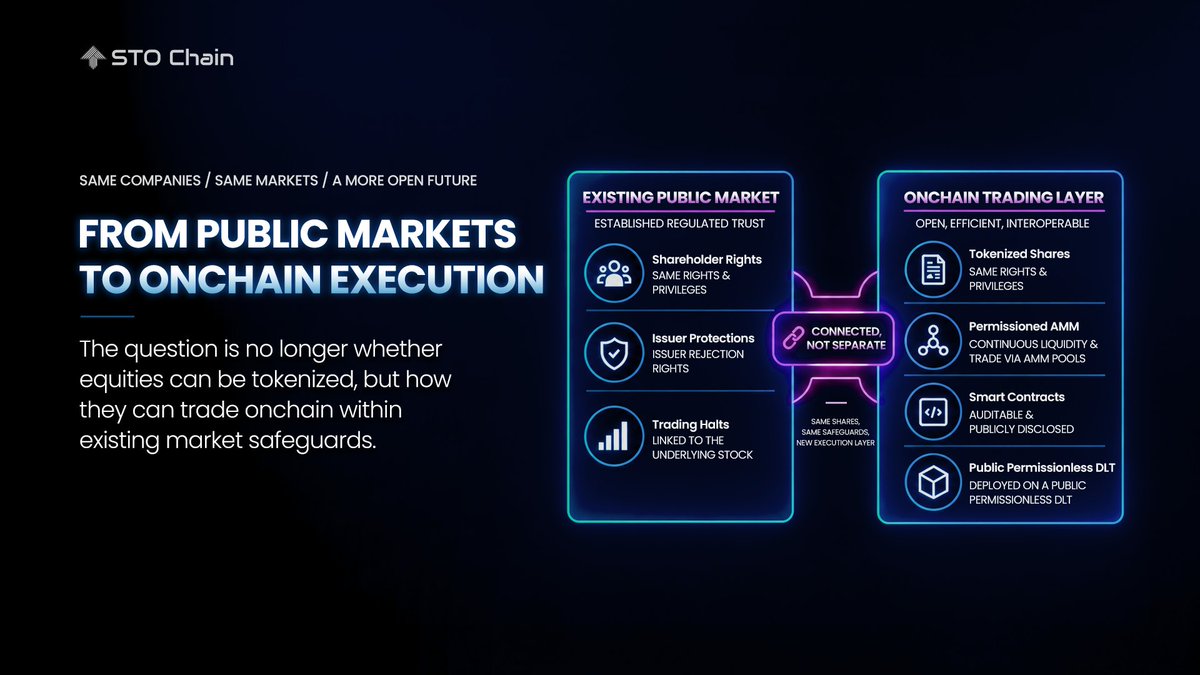
The SEC’s Innovation Exemption creates a temporary, conditional framework for onchain secondary trading of tokenized NMS stocks through permissioned AMM liquidity pools.
Key conditions include:
- Same shareholder rights
- Issuer objection rights
- Public, auditable smart contracts
- Public permissionless DLT
- Linked trading halts
The key question is no longer whether stocks can trade onchain, but how tokenized equities can operate while preserving the rights, protections, and controls of the underlying public market.
The framework keeps shareholder rights, issuer protections, permissioned access, and existing anti-fraud and market-integrity requirements in place.
This moves tokenization beyond digital representation toward building an operating market around the asset.
The exemption is temporary, but it creates a framework for testing blockchain as an execution layer within existing capital-market structures rather than a separate parallel market.
#STOChain #RWA #Tokenization
Gold has been a core financial asset for centuries. Tokenization could make it easier to transfer and use across digital markets.
The FCA is examining whether tokenized gold can improve how physical gold is traded, transferred, pledged, and held in UK markets — including its potential use as wholesale collateral.
The key question is not whether gold can be represented on-chain, but whether tokenization can make it easier to transfer, mobilize as collateral, and use across financial-market workflows.
This points to a broader shift in RWA tokenization: from bringing ownership on-chain to making assets operational inside real markets through collateral management and post-trade processes.
For tokenized gold, the real value may lie less in the token itself and more in reducing friction as the underlying asset moves through the financial system.
If that model works, RWA tokenization moves beyond digital representation toward making existing assets more usable within financial infrastructure.
#STOChain #RWA #Tokenization #Gold
Canada’s OSFI has clarified its view on tokenized deposits: the technology does not change the legal nature of the deposit.
Under its technology-neutral approach, tokenized deposits are not legally distinct from traditional deposits. What matters is the underlying financial product — not how it is represented or delivered.
Traditional Deposit
→ Tokenized Representation
→ Same Legal Nature
→ New Digital Rail
The broader implication is that tokenization may not require creating a new legal category for every tokenized financial product. Existing rights can remain intact while the way those products are represented and delivered becomes digital.
This offers a practical path for regulated finance to move on-chain: modernize the rails without creating a parallel legal system.
The focus is shifting from whether a financial product can be tokenized to whether digital infrastructure can preserve legal certainty, regulatory compliance, and operational resilience.
#STOChain #RWA #Tokenization
Nasdaq is moving tokenized equities beyond digital representation and into market infrastructure.
Nasdaq and Payward are advancing Nasdaq Equity Tokens (NETs), with launch expected in Q2 2027, alongside global distribution, trading, and post-trade capabilities while preserving issuer and investor rights.
Public Equity
→ Tokenized Equity
→ Trading
→ Post-Trade
Payward will also adopt Nasdaq’s surveillance technology across its venues.
The bigger implication: tokenized equities are converging with regulated public markets. The challenge is no longer issuance alone, but building liquidity, governance, investor protection, and market integrity at scale.
Nasdaq’s approach points to blockchain becoming an operating layer within capital-market infrastructure.
#STOChain #RWA #Tokenization
India has taken a significant step in tokenized capital markets.
REC completed India’s first pilot issuance of tokenized corporate bonds under SEBI’s Regulatory Sandbox, raising ₹500 crore (₹5 billion). The tokenized structure enabled pay-in, allotment, and listing to be completed on the same day.
Corporate Bond
→ Tokenized Ownership Record
→ Atomic DvP
→ Same-day Allotment & Listing
Through Demat 2.0, securities ownership is recorded and tracked on a permissioned distributed ledger, while the settlement structure incorporates CBDC-enabled payments and atomic Delivery-versus-Payment.
The significance lies in the workflow, not simply the token itself. By connecting ownership records, payment, and settlement within a regulated digital process, the pilot shows how tokenization can extend beyond issuance into capital-market infrastructure.
As tokenized markets scale, this infrastructure may become just as important as the assets being brought on-chain
#STOChain #RWA #Tokenization
South Korea’s latest tokenized securities roadmap matters for RWA markets because it moves beyond isolated issuance.
The FSC plans to expand tokenization beyond fractional investment products to conventional securities such as stocks, bonds, and funds through a three-phase roadmap.
Phase 1 — February 2027
Institutional private MMFs
Private bonds for institutional investors
Trust-structured unlisted stocks
Public fractional investment securities
Phase 2
Expand tokenization to all publicly offered securities
Phase 3
Plan to build a stablecoin-linked on-chain payment infrastructure
What matters is the direction of travel. Tokenization is moving beyond issuance toward broader capital-market infrastructure.
For RWA to scale, regulated issuance, distribution, ownership management, and settlement need to work together. South Korea’s roadmap points to that next phase — connecting tokenized securities from issuance to settlement.
#STOChain #RWA #Tokenization