How do bacteria build their flagella?
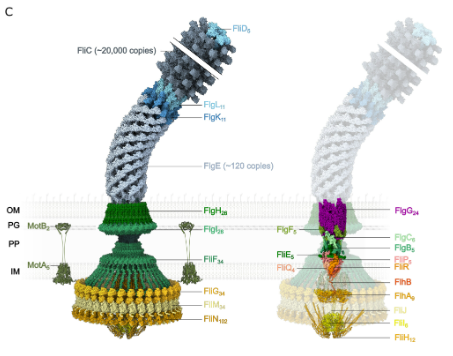
We’ve put together an animation of Salmonella flagellum assembly based on cryo-EM and X-ray structures.
From the membrane-embedded machinery to the growing filament, here’s how the parts come together, step-by-step.
@BrinedewBio@NMITaylorLab Thanks! There is no animation package behind it. Custom Python renders the real PDB/AlphaFold structures in Goodsell’s Illustrate style, and ffmpeg assembles the frames.
Bacteria have immune systems to defend against their viruses.
This animation shows the proposed mechanism of the Zorya defense system from our work with @NMITaylorLab: a proton-driven membrane complex related to the bacterial flagellar stator.
https://t.co/SNzxnbQZVS
@bazilione Good point! The filament rotates around its helical axis, even when tilted relative to the motor. The flexible hook acts as a universal joint to transmit torque. Our animation focuses on assembly, so the rotation and hook deformation are simplified.
How do bacteria build their flagella?
We’ve put together an animation of Salmonella flagellum assembly based on cryo-EM and X-ray structures.
From the membrane-embedded machinery to the growing filament, here’s how the parts come together, step-by-step.
@asa_sulense Thanks! I'm glad you noticed. We wanted to avoid the usual depiction of an almost empty cytoplasm. The molecular crowding is based on Brownian-dynamics simulations, while the flagellar components are modeled using experimental and predicted protein structures.
@DefinitelyPitou Glad you find it interesting! We also made a step-by-step explanation of flagellar assembly that might be useful for your essay:
https://t.co/SAP9tMg3Np
@your_friend_bot Yes! Flagella are surprisingly dynamic. Motor stators are continuously exchanged, and we showed that broken flagellar filaments can regrow by assembling a new cap. Interestingly, whether they regrow depends on how they were damaged!
https://t.co/yGHbtq8p9M
We also made a longer animation illustrating the experiments and simulations behind the study, from flagellar gene expression and proteome allocation to bacterial growth and motility.
Watch the full 3-minute animation:
https://t.co/dnCvfq3OEs
Can bacteria have too many flagella?
More flagella help Salmonella swim faster and spread farther, but building them slows growth.
In our new preprint, we quantify this trade-off and predict an optimum close to wild type.
📄 https://t.co/vQvAeK9ONN
More flagella improve motility, particularly in spatially structured environments. But the benefits saturate. Our model predicts an optimum near 3% of proteome invested in flagella, close to the estimated WT investment. Beyond this point, the costs outweigh the benefits.
What makes flagella so expensive?
Surprisingly, our results suggest that most of the cost comes from building them, particularly synthesizing flagellin, rather than rotating the motors.
Increased investment in flagella also comes largely at the expense of ribosomes.
How does flagellar number affect bacterial swimming?
This simulation compares Salmonella with fewer (PproA) or more (PproB) flagella in liquid and an agarose-like environment.
Try it yourself:
https://t.co/xQVaniCXLv
Salmonella-phage networks
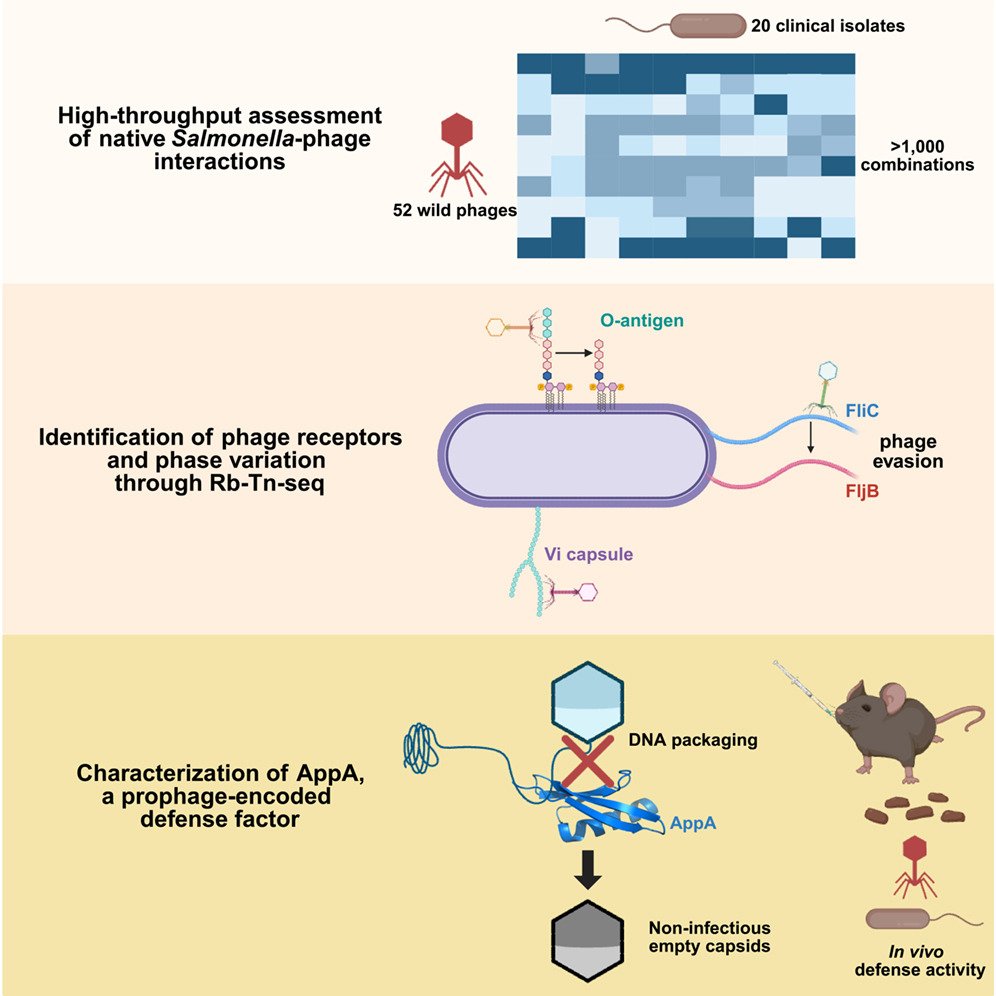
Profiling >1,000 global Salmonella-phage interactions reveals layered resistance &high contribution of surface architecture to defense. Discover AppA, which blocks phage DNA packaging via mimicry of terminase assembly interface
https://t.co/0ZRXWvruct
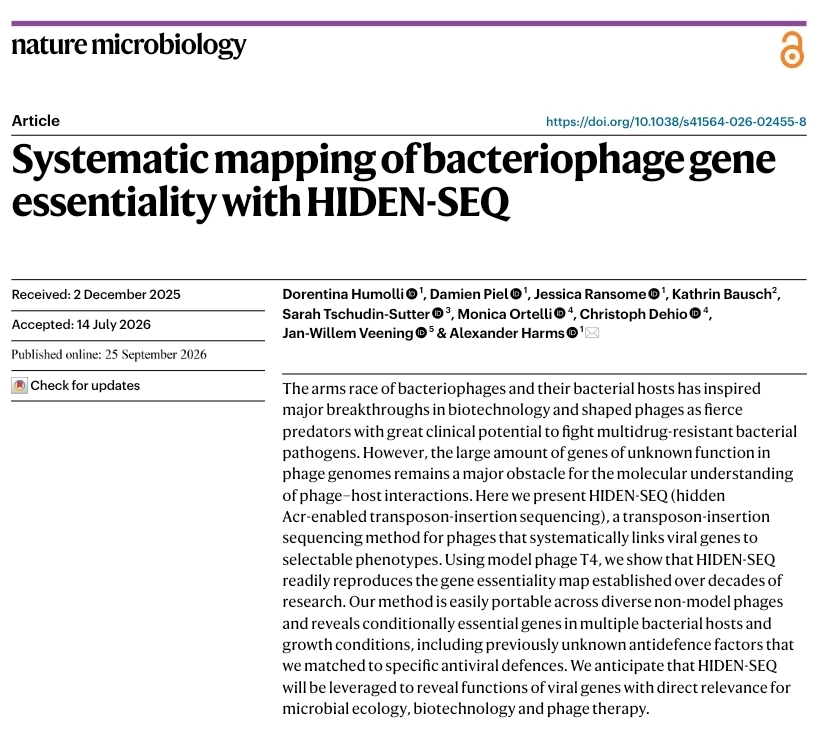
The final version of our manuscript on TnSeq in bacteriophages (“HIDEN-SEQ”) is out today – if you have an interesting phage phenotype and want to know the underlying genetic basis, this one is for you! 1/3
PhD opening in my lab
@HumboldtUni
Join our DFG SPP 2389 project on bacterial biofilms & multicellularity.
Study how F-pili conjugation shapes biofilms using genetics, microfluidics & 3D imaging.
📅 Apply by 3 June 2026
🔗 https://t.co/WZcv6HML0K
#PhD#Microbiology#Biofilms
Postdoc opening in my lab @HumboldtUni!
Join our Einstein Foundation-funded collaboration with the Hebrew University of Jerusalem on T3SS, spatial RNA localization, imaging & bacterial cell biology.
📅 Apply by 2 June 2026
🔗 https://t.co/ucKBG42Md1
#Postdoc#Microbiology
Congratulations to first author @AritzRoa for his amazing work on how T4 delivers its genome and blocks other phages from injecting theirs 🥳 Check out his beautiful movie📽️ Thanks to all authors and collaborators MLNielsen and @AHarms485 https://t.co/9qcKtAcyPq #cryoEM#phage
#MicrobiologyMonday: The bacterial flagellum is built through a hierarchical assembly process and powered by a dynamic motor capable of astonishing speeds. What's new in our understanding of these complex nanomachines? Find out in #MMBRJournal: https://t.co/9OqEqJNBiL