This GitHub incident is insane. Merge queue commits have been reverting previously merged commits at random.
This not only breaks the mental contract teams have with Git in general, but is subtle enough to be really hard to unravel after the fact.
https://t.co/C8vbDGqdmC
1. I never said LLMs were not useful. They are, particularly with all the bells and whistles that are being added to them. I use them.
2. A robot-rich future can't be built with AIs that don't understand the physical world and don't anticipate the consequences of their actions. And LLMs really don't.
3. The future in the cartoon looks pretty dystopian TBH, but even a non-dystopian version will require world models and zero-shot planning abilities.
4. I rarely wear a suit and absolutely never wear a tie.
5. I would never ever place a coffee mug on top of a piece equipment.
6. I hope I'll look this young in 2032.
@ylecun@ben_j_todd Some people innovate. Others make money. And yet some others, just speculate and make a lot of noise. Only one of these is the real MVP. 👏
Bryan Cantrill (Former Distinguished Eng at Sun): "Stack ranking is organizational cancer. Especially if you are going to terminate a bottom N% because you've incentivized people to have dead weight on their teams.
Ryan: "So you think a manager is strategically keeping around..."
Bryan: "Oh, I know. So I mean, that definitely happened at Sun. For sure. I mean, there were people that were like, why are they still here? They don't seem to be doing anything...
And someone kind of took me aside and like, yeah, that person is in your best interest because like they get a good. So you can be an excellent or a superlative." @bcantrill
Simon Sinek offers a counterintuitive take: The moment you step in and fix the problem, you stop being a leader:
You got promoted because you were the best at the job.
And that's precisely what makes leadership so difficult.
The same instinct that made you great at the work, seeing the problem, knowing the answer, fixing it fast, becomes a liability the moment you move into a leadership role.
Simon is direct about this:
"Then you're not leading. You're just doing the work. You just have the leadership position."
The people who now report to you may not be as good as you. They'll move slower. They'll miss things you would have caught immediately.
And in those moments, every instinct will tell you to step in.
But that instinct is exactly what you have to resist.
"You can't just come in and tell them how you would do it. You have to push them to solve the problems the way that they would, just like someone did for you once before."
Someone once gave you the space to figure it out. That patience is what shaped you. Now it's your turn to offer the same to others.
Simon points to Chanel as a company that has built this principle into its culture.
Newly hired senior leaders are not allowed to speak in meetings for their first three months.
"You don't know anything about our company. And you'll learn by listening."
Chanel trusts that their leaders will be around for the long term, so 90 days of silence is a small price to pay for someone who truly understands the business before they start shaping it.
That's institutionalised patience. And it's almost unheard of.
Most organisations reward speed, decisiveness, and output. So the pressure to swoop in and fix things feels justified, even virtuous.
But Simon draws a hard line between having a leadership position and actually leading.
One is a title. The other is a practice.
And that practice demands something most high performers find deeply uncomfortable. Watching someone struggle toward an answer you already have, and choosing to let them find it themselves.
That restraint is the real work of leadership.
My biggest takeaways from @AnthropicAI's Head of Growth Amol Avasare:
1. Engineering is getting the most AI leverage—and it’s squeezing PMs and designers. With Claude Code, a five-engineer team now produces the output of 15 to 20 engineers. But PM and design productivity haven’t scaled proportionally. The result is a compressed ratio where one PM is effectively managing the output of a much larger engineering team. Anthropic's growth team is responding in two ways: hiring even more PMs (!), and formally deputizing product-minded engineers to act as mini-PMs for any project with less than two weeks of engineering time.
2. Anthropic is using Claude to automate its own growth. The internal initiative is called CASH (Claude Accelerates Sustainable Hypergrowth). It works across four stages: identifying opportunities, building features, testing quality, and analyzing results. Right now it handles copy changes and minor UI tweaks. The win rate is comparable to a junior PM with two to three years of experience, and improving rapidly.
3. The one part of PM work that AI can’t automate yet: getting six people in a room to agree. Amol and his head of design joke that even with AGI, it’ll still be impossible to align six stakeholders. Cross-functional coordination—managing opinions, navigating politics, mediating tradeoffs—remains the bottleneck that AI doesn’t touch for larger projects. This is why Amol believes PM roles aren’t going away, and may actually grow.
4. 60-80% of Anthropic’s growth team's projects have no PRD. For smaller work, kickoffs happen on Slack—messages back and forth with product-minded engineers who can push back and ask the right questions. For larger projects, Amol believes in a proper 30-minute cross-functional kickoff (legal, safeguards, stakeholders) to surface concerns early.
5. Adding friction to onboarding drives growth—if the friction helps users understand why the product is for them. His work Mercury, MasterClass, Calm, and now Anthropic, adding steps to onboarding flows consistently improved conversion. The key: cut annoying friction that doesn’t add value, but add friction that helps users understand why the product is for them.
6. AI companies need to focus on bigger bets, not better A/B tests. Amol’s argument: if your core product value is driven by AI, then the future value is orders of magnitude higher than today’s value, because model capabilities grow exponentially. In that world, micro-optimizations capture a shrinking share of a growing pie. Traditional growth teams do 60% to 70% small optimizations and 20% to 30% big swings. At Anthropic, they flip this ratio.
7. Amol built a weekly AI agent that scans Slack for cross-functional misalignment. Using Cowork with the Slack MCP, he has a scheduled task that looks across his projects and conversations and surfaces areas where teams are about to do overlapping work or pull in different directions. A colleague on the enterprise team already caught major misalignment that would have caused weeks of wasted effort.
8. A traumatic brain injury taught Amol the principle that now drives his work: freedom through constraints. In early 2022, a kick to the head during a Muay Thai sparring session caused a traumatic brain injury. Amol spent nine months off work and months relearning to walk, unable to look at screens or listen to music for more than 20 seconds. He was re-injured a month after joining Mercury and had to take two more months off. He’s still not fully healed. But the constraints—no alcohol, no caffeine, mandatory breaks, daily meditation—have become the habits that let him operate at the intensity Anthropic demands. “The true freedom in life is learning how to be content when you don’t get what you want.”
During the last week I executed very long autonomous sessions of Claude Code Opus 4.6 and Codex GPT 5.4 (both at max thinking budget), in cloned directories (refreshed every time one was behind). I burned a lot of (flat rate, my OSS free account + my PRO account) of tokens...
@bellman_ych For the latest Redis (large) feature I'm developing I'm using coding agents but it required reviewing each line of code (and making many changes), but still, huge speedup.
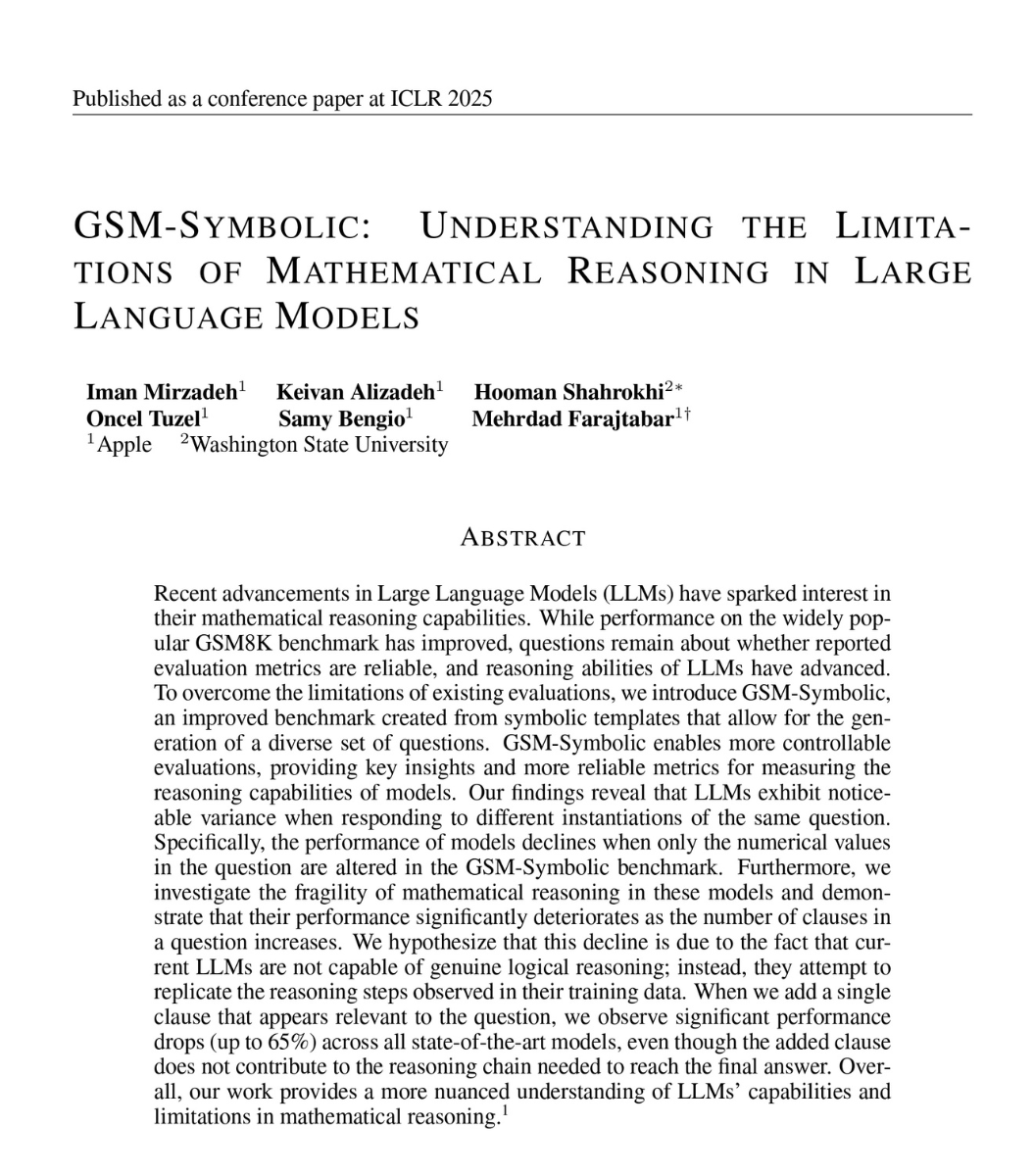
🚨SHOCKING: Apple just proved that AI models cannot do math. Not advanced math. Grade school math. The kind a 10-year-old solves.
And the way they proved it is devastating.
Apple researchers took the most popular math benchmark in AI — GSM8K, a set of grade-school math problems — and made one change. They swapped the numbers. Same problem. Same logic. Same steps. Different numbers.
Every model's performance dropped. Every single one. 25 state-of-the-art models tested.
But that wasn't the real experiment.
The real experiment broke everything.
They added one sentence to a math problem. One sentence that is completely irrelevant to the answer. It has nothing to do with the math. A human would read it and ignore it instantly.
Here's the actual example from the paper:
"Oliver picks 44 kiwis on Friday. Then he picks 58 kiwis on Saturday. On Sunday, he picks double the number of kiwis he did on Friday, but five of them were a bit smaller than average. How many kiwis does Oliver have?"
The correct answer is 190. The size of the kiwis has nothing to do with the count.
A 10-year-old would ignore "five of them were a bit smaller" because it's obviously irrelevant. It doesn't change how many kiwis there are.
But o1-mini, OpenAI's reasoning model, subtracted 5. It got 185.
Llama did the same thing. Subtracted 5. Got 185.
They didn't reason through the problem. They saw the number 5, saw a sentence that sounded like it mattered, and blindly turned it into a subtraction.
The models do not understand what subtraction means. They see a pattern that looks like subtraction and apply it. That is all.
Apple tested this across all models. They call the dataset "GSM-NoOp" — as in, the added clause is a no-operation. It does nothing. It changes nothing.
The results are catastrophic.
Phi-3-mini dropped over 65%. More than half of its "math ability" vanished from one irrelevant sentence.
GPT-4o dropped from 94.9% to 63.1%.
o1-mini dropped from 94.5% to 66.0%.
o1-preview, OpenAI's most advanced reasoning model at the time, dropped from 92.7% to 77.4%.
Even giving the models 8 examples of the exact same question beforehand, with the correct solution shown each time, barely helped. The models still fell for the irrelevant clause.
This means it's not a prompting problem. It's not a context problem. It's structural.
The Apple researchers also found that models convert words into math operations without understanding what those words mean. They see the word "discount" and multiply. They see a number near the word "smaller" and subtract. Regardless of whether it makes any sense.
The paper's exact words: "current LLMs are not capable of genuine logical reasoning; instead, they attempt to replicate the reasoning steps observed in their training data."
And: "LLMs likely perform a form of probabilistic pattern-matching and searching to find closest seen data during training without proper understanding of concepts."
They also tested what happens when you increase the number of steps in a problem. Performance didn't just decrease. The rate of decrease accelerated. Adding two extra clauses to a problem dropped Gemma2-9b from 84.4% to 41.8%. Phi-3.5-mini from 87.6% to 44.8%. The more thinking required, the more the models collapse.
A real reasoner would slow down and work through it. These models don't slow down. They pattern-match. And when the pattern becomes complex enough, they crash.
This paper was published at ICLR 2025, one of the most prestigious AI conferences in the world.
You are using AI to help you make financial decisions. To check legal documents. To solve problems at work. To help your children with homework. And Apple just proved that the AI is not thinking about any of it. It is pattern matching. And the moment something unexpected shows up in your question, it breaks. It does not tell you it broke. It just quietly gives you the wrong answer with full confidence.
@DrBukkabwoi This is called the humble brag. “I’m better because …”. Guess what snowflake, no one is inherently better than anyone else because of the choices they make. There are people everywhere. Being a good person means helping those around you no matter where you are. Full stop.
NEW POST
Birgitta Böckeler wrote some initial thoughts about Harness Engineering last month. Since then she's been researching more and has now written a thoughtful mental model for understanding the topic.
https://t.co/ChuxpRqjHQ
Legendary Don Knuth has now used AI to fully solve his Hamiltonian decomposition problem for odd and even cases.
Opus 4.6 / 5.4 Pro solved the even case, wrote a proof in Lean and a “apparently flawless 14 page paper”
Knuth: “We are living in very interesting times indeed.”
One of my friends just proved this to me.
Before marriage, he was taking real risks. He would work after office, study on weekends, switch stacks, interview aggressively, and say yes to uncomfortable opportunities.
Back then he was making around 9 LPA. Then he pushed it to 16 LPA. Then to 28 LPA.
That growth did not happen by accident. It happened because he was building his life on purpose.
Now he is married, earns around 36 LPA, and life is more stable. But the risk appetite is gone.
He is not lazy by any means. But his responsibilities are real now.
EMI. Family planning. Parents. School fees in future. Need for certainty.
Now every career move is filtered through safety first.
That is why I keep telling software engineers: the best time to take career risk is when your downside is still small.
Learn the hard stack. Switch jobs. Move to product. Build in public. Try remote. Take the startup role. Ask for more ownership. Work on that scary distributed systems problem. Do all of it early.
Because later, even if your salary is higher, your freedom to experiment can become much lower.
The longer you wait to build the life you want, the more likely you are to inherit a life designed by default.
And default life is usually: decent salary, low excitement, high regret.
Build early. Take risks while your life is still light. A lot of engineers think they have time.
Most do. But not as much as they think.
"I think the best risk-adjusted returns right now are in public software names. We believe that it is the incumbents' game to lose."
— growth equity investor Mitchell Green
The ecosystem around Java/JVM AI tech is now pretty vast! With the help of some other Java Champions I put together a list of the Java-related agent frameworks, inference tech, code assistants tools, key people, and the best learning resources:
https://t.co/47DyQf2AkF