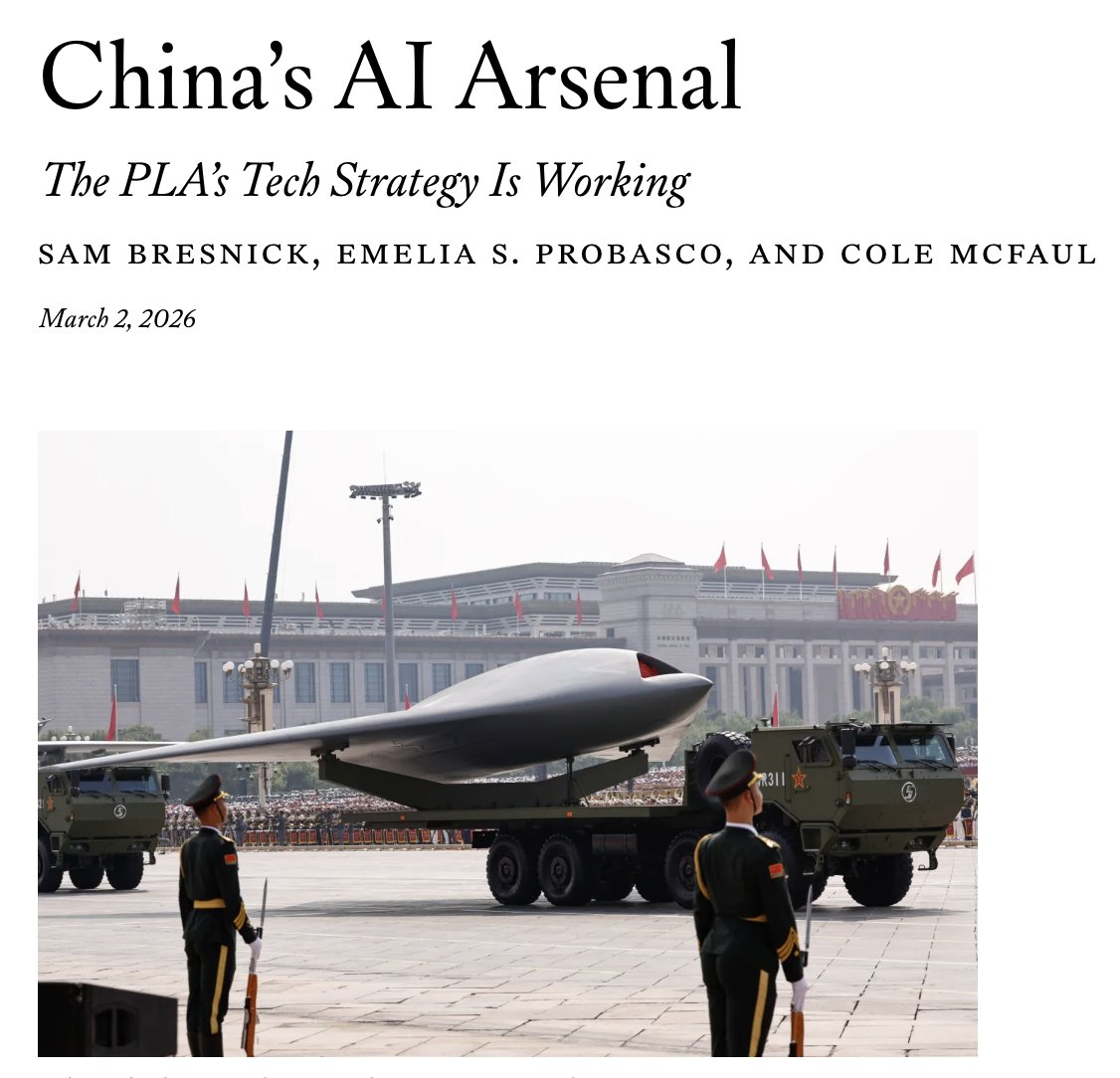
1/ In @ForeignAffairs, @EmmyProbasco , @colemcfaul, and I examine the Chinese military’s AI ambitions.
BLUF: The PLA is making progress on “intelligentization,” its third phase of military modernization.
Thread below:
4/ That said, we argue against banning Chinese open-weight models. Instead, Washington should foster a more robust U.S. open-weight LLM ecosystem.
Link: https://t.co/4ZjsKRavBf
1/ In @FortuneMagazine, @jacob_feldgoise, @HannaDohmen, and I highlight a paradox at the heart of the Trump administration's AI strategy:
The United States leads on chips, but this infrastructure is helping Chinese models spread around the world.
3/ As of now, the best open-weight models are Chinese. So, when U.S. infrastructure serves open-weight models, Chinese labs gain users, revenue, and soft power. DeepSeek's latest model, for example, is available from at least 16 inference providers based outside China.
Read my latest in Fortune w/ @HannaDohmen and @SamBresnick:
"Data centers full of U.S. chips are serving Chinese AI models–undermining Trump’s tech ambitions"
1/ In @lawfare, @EmmyProbasco and I discuss how open-source and commercial data are becoming increasingly attractive targets in the emerging age of AI-driven military decision making.
Thanks to @thedispatch for counting my essay on Jensen Huang as today’s “must-read.”
His personal affair epitomized all that was wrong with the company’s much deeper, years-long policy fight in Washington.
.@SamBresnick and @HannaDohmen emphasize that there will be strong legislative pushes for tighter export controls on #AI chips following the Nvidia scandal. They state in @barronsonline that “the days of frictionless exports to Southeast Asia are likely coming to an end.” https://t.co/bUyWLPFisY
The Scandal Is Bigger Than Jensen Huang
I argue the most alarming revelation in this mess may not be that America’s most influential AI executive was involved with a suspected Chinese spy—but that senior administration officials were warned about the danger and nevertheless continued relying on him.
American strategy has come to depend, to an extraordinary degree, on powerful private-sector actors whose incentives the government cannot simply assume will align with the national interest.
The power of these individuals is fast escaping the reach of the institutions responsible for guarding against technological and geopolitical risks.
The lesson of this scandal is not simply that these people are fallible. It is that we need institutions capable of checking their influence and managing the consequences of their mistakes before these individuals become too powerful to be held accountable.
Read it in @TheAtlantic here: https://t.co/pUl0eEX9Gt
The PLA’s Push for Military Robotics by @SamBresnick
Drawing on over 2,000 open-source procurement documents published between October 2022 and December 2025, this report examines how the People’s Liberation Army is pursuing robotics across the ground, maritime, and space domains. These include quadruped renaissance robots and ordnance disposal systems, as well as undersea platforms and satellite manipulation devices. The data reveals a military experimenting with still maturing, mostly human-controlled systems. Sensors, navigation, and software will likely matter as much as hardware for Beijing’s military robotics ambitions.
https://t.co/FALAegiPOo
1/ 🧵 New @CSETGeorgetown report! I analyzed 2,000+ open-source PLA requests for proposal (Oct 2022–Dec 2025) to see what kinds of 🤖 robots 🤖 the Chinese military is buying.
Short version: there’s way more than humanoids.
9/ There’s also evidence some requested platforms include tech from U.S. and allied firms. The U.S. should explore whether Entity List additions for certain Chinese robotics companies would keep U.S. sensors and chips out of their supply chains.