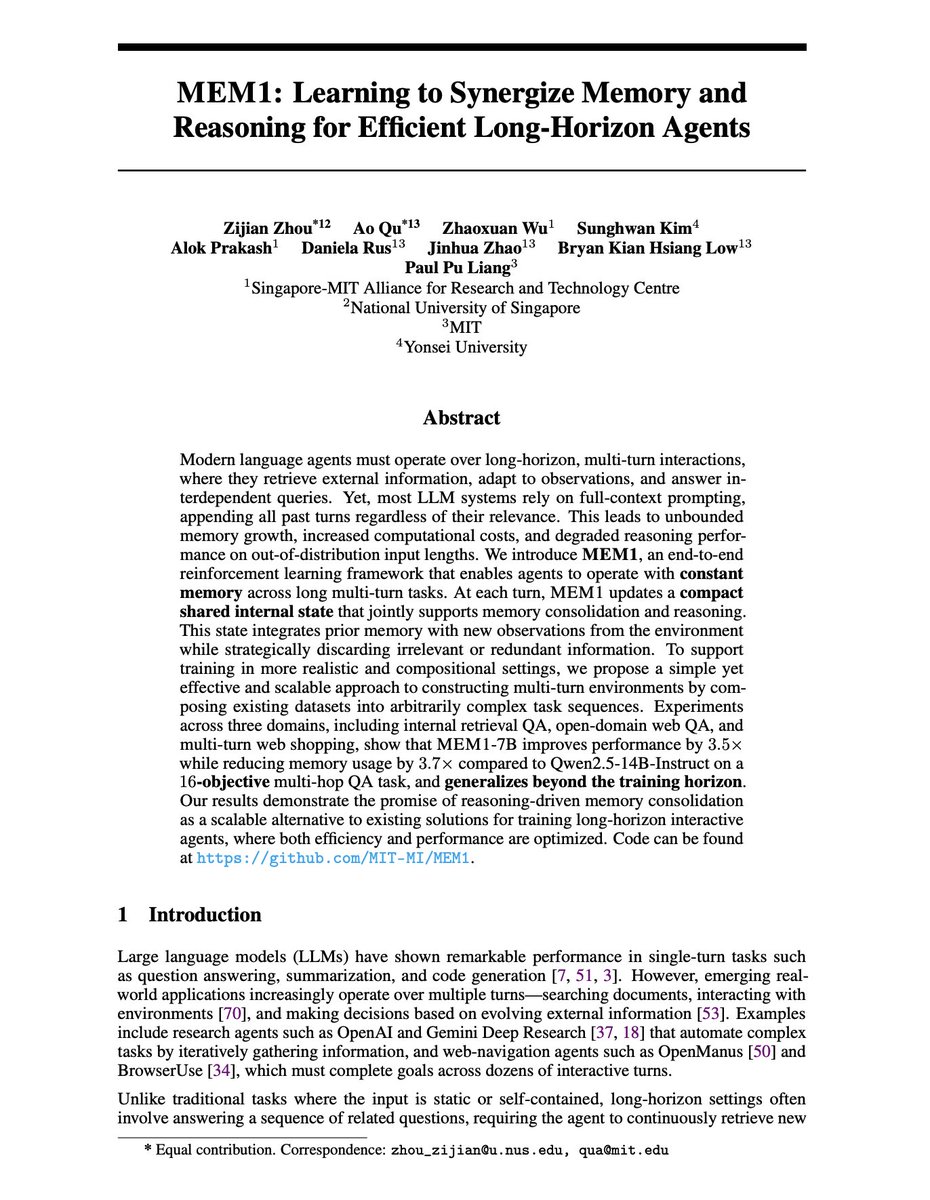
This is a fascinating paper.
It's well known that long-horizon agents have a memory problem.
The standard approach is to append everything to the context. Every past observation, action, and thought gets added to the prompt.
This creates three compounding issues: O(N) memory growth, degraded reasoning on out-of-distribution context lengths, and attention dilution that causes the model to forget key details even when they're technically in the prompt.
This new research unifies memory and reasoning into a single process.
It introduces MEM1, an RL framework that trains agents to maintain constant memory across arbitrarily long multi-turn tasks.
At each turn, the model updates a compact internal state that simultaneously consolidates prior information and reasons about next actions. After each turn, all previous observations, actions, and states are discarded. Only the most recent internal state remains.
Inference-time reasoning serves two purposes. While reasoning about the current query, the model also extracts and stores exactly what it needs for future turns. Memory consolidation becomes part of the reasoning process itself, not a separate module.
Training uses PPO with a masked trajectory technique. Because MEM1 dynamically prunes context, standard policy optimization breaks since tokens don't belong to a single continuous trajectory. The authors solve this by stitching sub-trajectories together and applying 2D attention masks that restrict each token's attention to only what was visible when it was generated.
The results show dramatic efficiency gains:
On 16-objective multi-hop QA, MEM1-7B improves performance by 3.5x while reducing memory usage by 3.7x compared to Qwen2.5-14B-Instruct. Peak token usage stays nearly constant as task complexity increases, while baseline methods scale linearly. On WebShop navigation, MEM1-7B outperforms AgentLM-13B (twice the parameters) with 2.8x less peak token usage.
Notably, the agent trained on 2-objective tasks generalizes to 16-objective tasks. Performance actually improves relative to baselines as horizon length increases, because baseline models degrade on out-of-distribution context lengths while MEM1 maintains constant context.
Emergent behaviors appear in the trained agents: maintaining structured memory for multiple concurrent questions, shifting focus when one objective stalls, and interleaving reasoning with selective memory updates.
External memory modules require separate training and engineering overhead. Full-context approaches don't scale. MEM1 shows that end-to-end RL can train models to consolidate memory as part of reasoning, achieving both efficiency and performance without architectural changes.
Paper: https://t.co/q9pEIxBpit
Learn to build effective AI Agents in my academy: https://t.co/JBU5beIoD0
.@DavidDeutschOxf: The future of civilization depends entirely on what we think and do. If civilization fails, that won't be something that just happens to us. It'll be the consequence of choices that people have made.
And if civilization survives, then that will be because people have succeeded in solving the problems of survival. And that too will not have happened by chance.
It’s wild and kinda funny that people think AGI and ASI will come along, solve all their life problems, and they’ll just get to chill and enjoy. I honestly have no idea where they’re getting this level of confidence.
Meta spent as much as the Manhattan Project on GPUs in inflation-adjusted dollars.
Really curious how long they will continue to release open models with that sort of capital expenditure and models that are getting more economically valuable.
Curioser and curioser.
Isn't that weird - o1 seemingly rampages through olympiad level problems, only to break on AIW+ that is far below this level? Might it be many of those olympiad problems were in training set and we have a contamination case https://t.co/lE7FbrQxfA ? 12/n
Meta CTO Andrew Bosworth says that eventually AI will get to know us so intimately that it will have, contained within its systems, a version of our consciousness
And the @Simulon human integration does more than automate rotoscoping, it also emulates the focus shift as a human enters the frame at close proximity. Notice how the Stegosaurus is shifted in and out of focus to match the footage.
Google really cooked with notebookllm.
1. I can use it in EU (Finally)
2. Really good RAG
3. Intuitive design
4. Podcast feature is quite fun (actually useful sometimes)
5. Got endorsed by @apples_jimmy
recommend everyone to check it out: https://t.co/YhT1CbkwoV
Diffusion Models Are Real-Time Game Engines
abs: https://t.co/ILLlxR9dj3
project page: https://t.co/x8pGRvfD9k
Google presents GameNGen, the first game engine powered entirely by a neural model that enables real-time interaction with a complex environment over long trajectories at high quality. GameNGen can interactively simulate the classic game DOOM at over 20 frames per second on a single TPU. Next frame prediction achieves a PSNR of 29.4, comparable to lossy JPEG compression. Human raters are only slightly better than random chance at distinguishing short clips of the game from clips of the simulation. GameNGen is trained in two phases: (1) an RL-agent learns to play the game and the training sessions are recorded, and (2) a diffusion model is trained to produce the next frame, conditioned on the sequence of past frames and actions.
So Simulation Playground is about the coolest app that I’ve seen on Vision Pro so far.
The best apps on visionOS are the ones that truly take advantage of what it’s uniquely capable of.
The physics simulation created a feeling of mixed reality presence unlike any other!
🥳 Excited to share that our latest work on generating sample-based instruments from text or audio prompts has been accepted at #ISMIR2024! 🎹 — Our take on making AI-based music generation models useful for musicians!
🔊 https://t.co/NNjYl1jKvb
📜 https://t.co/sSluHNWSrS
(1/6)