Exploring new horizons...
Former Regional Evidence Advisor, Africa. Scientist, exploring the nexus between people and the environment. Reader, dad, Kenyan.
“We are called to assist the earth, to heal her wounds, and in the process heal our own.”
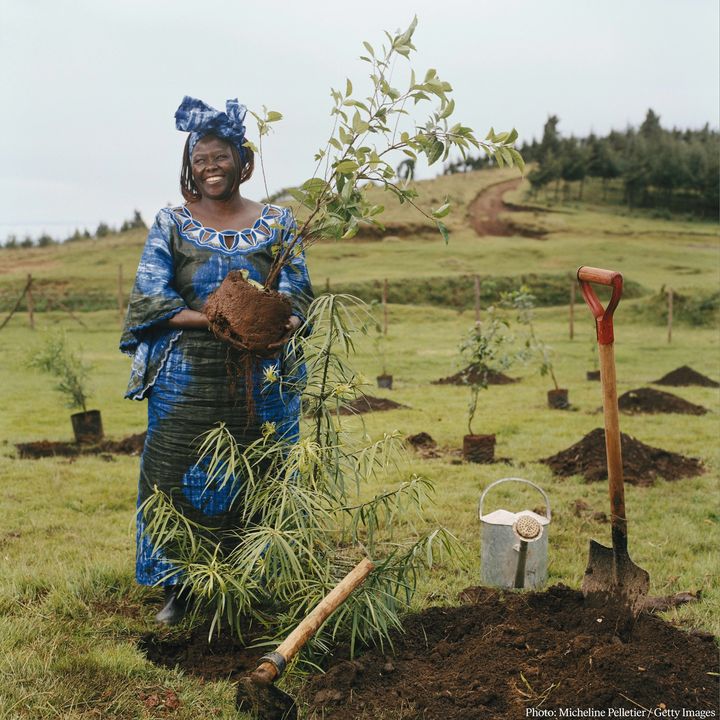
After becoming the first woman to earn a doctorate degree in East and Central Africa, Wangari Maathai started a movement that led to the planting of 50 million trees, a more democratic society and the Nobel Peace Prize.
In 1976, Wangari Maathai became involved with the National Council of Women in Kenya. She suggested that they should start community-based tree planting to combat deforestation and desertification. In 1977, she developed her idea into a grassroots movement organisation called the Green Belt Movement (GBM).
Maathai began the project by planting nine trees in her own yard – as it grew it became the largest tree planting project Africa had ever seen, encouraging women to plant trees in “green belts” around their towns and villages and to think ecologically. Her movement grew and spread to other African countries. With the GBM, Maathai hoped to promote sustainability as well as create jobs for women and empower them to gain economic and social power.
Besides giving jobs to women and planting more than 50 million trees, the movement also became a symbol for a democratic struggle and a token of peace. According to widespread African tradition, trees are used as white flags during disputes. In Wangari Maathai’s own words: “The tree also became a symbol for peace and conflict resolution, especially during ethnic conflicts in Kenya when the Green Belt Movement used peace trees to reconcile disputing communities.”
In 2004, Maathai was awarded the Nobel Peace Prize "her contribution to sustainable development, democracy and peace." She was the first African woman to receive the peace prize.
Photo by Micheline Pelletier / Getty Images
Prof. Patrick Okori: the African University model must aspire to operate at the 4th Generation level, going beyond teaching, research and outreach to be truly game changers in people's lives.
African Universities can and will feed the continent.
@RUFORUM @ NEPAD @buan
Prof. Patrick Okori: RUFORUM must go beyond training 100k PhDs. The RoIC is clear, with every $1 spent in higher education, the returns on investment are around $38.
Attending the 21st RUFORUM AGM in Gaborone, Botswana.
Key questions that featured during the opening ceremony:
Prof. Patrick Okori -
The African University must rethink its role, with transformative education as an imperative. It's important to develop fit-for-purpose courses
They bulldozed 100,000 trees in the Amazon rainforest for a highway to shuttle 50,000 delegates to COP30—and private jets are falling from the skies in a carbon confetti parade. The Avenida Liberdade (Liberty Avenue) slices 13 km through the protected Belém Environmental Protection Area south of Belém (Nov 10–21). The irony of desecrating the iconic rainforest to host a climate summit!
Red dirt is flanked by dense green jungle. Yellow excavators and bulldozers grind forward amid scattered vehicles. Experts warn of fragmented habitats, supercharged roadkill (Brazil loses ~475 million wild animals yearly to roads), & a red carpet for illegal loggers and sprawl.
Net zero on the tarmac: biodiversity in the ditch.
#COP30Hypocrisy #AmazonHighway #COP30
🚨 AGORA em Belém: Lideranças indígenas e manifestantes ocupam a Blue Zone da #COP30! ✊🏽🌿
Eles protestam por:
🌎 Demarcação dos territórios
🚫 Fim da Ferrogrão
💧 Contra a privatização dos rios Tapajós, Tocantins e Madeira. #Belém#COP30
You have the bedside manner of those guards who once escorted people to gas chambers. . .
You are a significant contributor to the tone deafness exhibited by H.E. @WilliamsRuto and then you top it off with your nasty tendency to mock WaKenya whenever you can.
Unless you suffer from Tourette's, why is it impossible for you to maintain radio silence until, well, forever? Or is STFU easier for you to understand since you enjoy crude language?