On Evals - getting messages on “ok so how do I actually start learning this?”
there is no better way than by just doing so you can copy this to Claude Code and get started today
<instructions>
1. Go look up the @harborframework and the Terminal Bench 2.0 dataset. Go look up the Harbor Skills GitHub repo for help. Pick 1 Task in the dataset and explain every single piece that’s in that task folder
2. Explain what my agent sees when it does the task, what it has to output, and how we know if it got the problem right?
3. Now let’s actually run a Task using the built in Claude Code integration, it’s just a flag
4. Once that’s done let’s read the ATIF file that was produced together and help me understand what just happened. Did we pass the task? If not can we dig into why it failed? Go check the verifier logic to see what went wrong.
5. Ok let’s try to improve our agent by adjusting the prompt. And let’s rerun on a few tasks? Is this helping?
6. Ok we’re doing evals! Using this same format, help me make my own. Let’s do this together
…
</instructions>
Spend a few days reading a bunch of traces, actually running evals, understanding traces, internalizing agent failure modes, and being super in the loop of what the agent sees and does
Have fun! Evals are super important, they don’t have to be scary. DM if I can help or just tweet out what you’re doing, someone will help I promise, we’re all learning
Personal update: I've joined Anthropic. I think the next few years at the frontier of LLMs will be especially formative. I am very excited to join the team here and get back to R&D. I remain deeply passionate about education and plan to resume my work on it in time.
@tom_doerr How has your experience been with olmOCR when processing multi-column pages, for example, pages with three columns that include images spanning two columns and tables extending across all three? Does it accurately preserve the original page structure?
@mervenoyann@andimarafioti@HKydlicek Which models are best at preserving a document’s layout and structure - particularly when it includes elements like images spanning one or two columns, and complex tables within a three-column page format?
Kicking off a focused deep dive into LLM inferencing - exploring optimization, quantization, and deployment pipelines.
If you’ve read any great papers/blogs/videos or tried interesting frameworks lately, drop them here 👇
#LLM#AI#ML#DeepLearning#MLOps#Inference#GenAI #AIResearch #AIInfra #ModelServing
@1littlecoder@abidlabs@MistralAI Turns out, for my use case, this one extracts text better than other libraries - and even keeps the structure of complex tables intact...
Is AI-SLOP a real phenomenon?
I have never encountered machine learning slop or deep learning slop in my extensive research. Or am I, perhaps, overlooking a critical component?
#AISlop#AI#ML#MLOps
Weekend vibes....
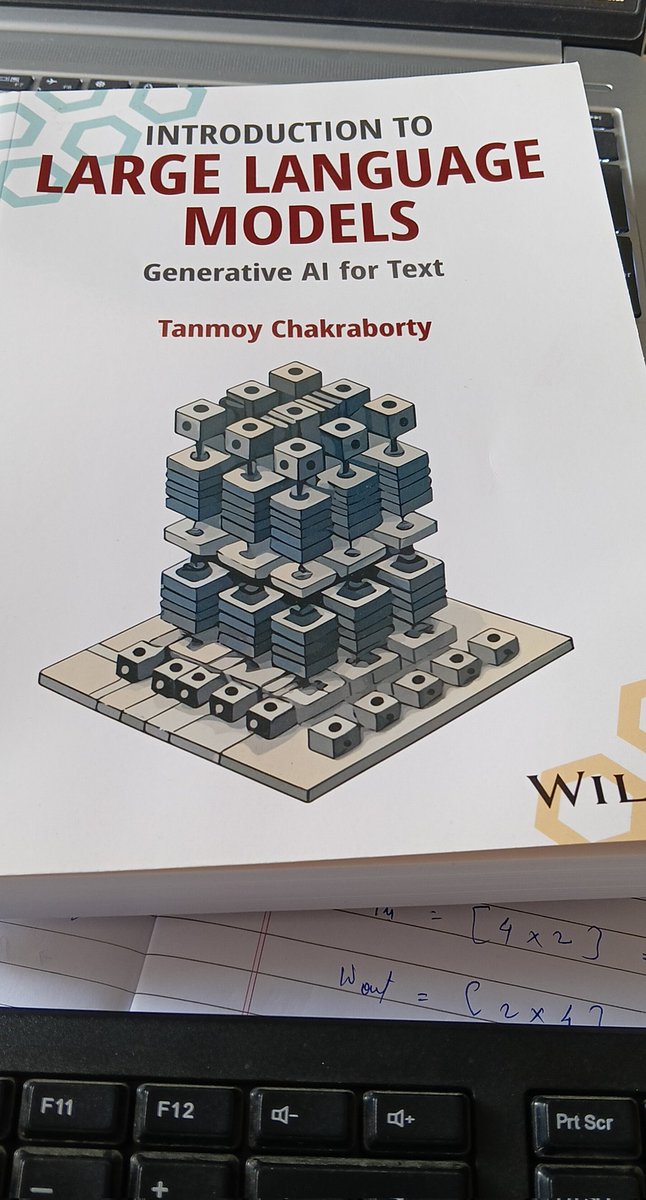
Diving into the Multilingual & Multimodal LLMs chapter, by @Tanmoy_Chak.
Honestly, this book is so underrated - packed with clear explanations and solid insights.
Why squared error fails for classification and its lessons for ML design
Revisiting my ML notes, I found a key insight: squared error loss from linear regression doesn't work for classification. It creates a non-convex loss function with local minima, trapping gradient descent and preventing optimal solutions.
The solution is logistic loss, which is convex and ensures convergence to a global minimum. My notes detail its derivation, highlighting the mathematical elegance behind our tools.
The broader lesson: every ML, DL, or LLM problem—multi-class classification, ranking, sequence generation, or reinforcement learning—requires a carefully designed loss function. The right loss shapes learning, optimization, and performance.
- Squared error: Linear regression
- Logistic loss: Binary classification
- Cross-entropy: Multi-class problems
- Contrastive loss: Embedding learning
Each domain needs a tailored approach. Success hinges on understanding the mathematics enabling learning, not just choosing a model architecture.
#AI #ML #LLMs #MLSystemDesign