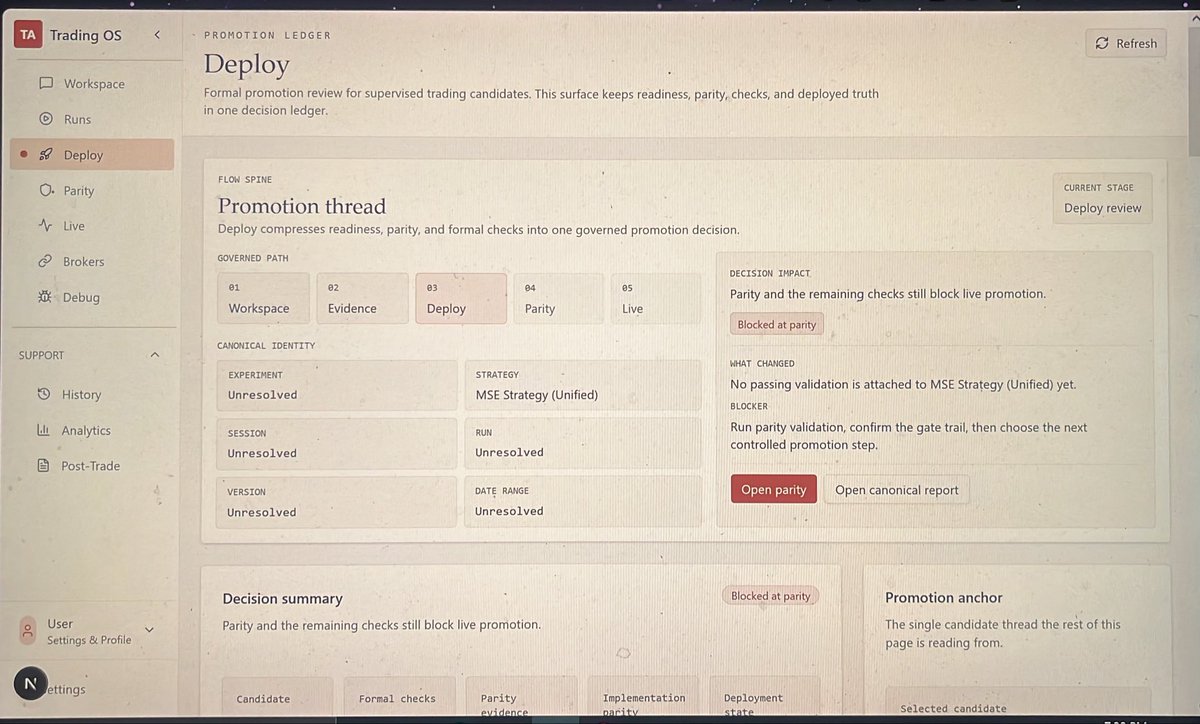
Most trading ideas never make it to a proper backtest to Deployment cycle .
We have curated a solution to change that -
Agent Z
Describe your strategy in plain English, and Agent Z helps turn it into a structured workflow across research, backtesting, validation, and deployment readiness using AI agents and frontier models.
As a closed beta user, you get early access to an AI-native trading workbench designed to help you test strategy ideas in a fraction of the time.
You bring your market knowledge, Agent Z brings the agentic workflow, model access, coding support, and connected context.
The best part - you stay in loop at every step.
Apply for early beta access: https://t.co/2niYHC9Z6b
AgentZ
#FirstLook
12 Agent collaborating and helping you from backtesting to deployment in live Markets.
You express!!
Agents implement!!
Coming soon!!
Algos Sabh ka hain boss
#NIFTY#systematicTrading#algo#agents#AI
you could build a top tier venture firm just focusing investment decisions short and long term based on deep model benchmarking / evals
find capability overhang, find areas models suck and track trajectory, etc
Token costs are why there will be no saas apocalypse / good dev tools are cached intelligence for agents!
The popular theory goes: agents can write code, so they'll just rebuild every tool from scratch and hit raw APIs. no more dev tools, no more CLIs, no more software layers. just agents and endpoints!
We just tested this and the data says the opposite. We benchmarked Claude Code and Codex on real Hugging Face Hub tasks (~1,000 graded runs), with two setups: the agent-optimized hf CLI vs the agent hand-rolling curl or SDK calls from scratch.
Hand-rolling burns up to 6x more tokens on multi-step tasks and fails more often (84% vs 94% task success).
And that's just dropping one abstraction layer. It would obviously be orders of magnitude more tokens and a dramatically higher failure rate if the agent tried to bypass HF altogether and rebuild model hosting, versioning, and distribution from scratch. Every time an agent re-derives a workflow from raw API calls, you pay for that reasoning in tokens. every single run. a good CLI compresses that entire chain into a few high-level commands the agent can't get wrong.
In a world where everyone is complaining tokens are too expensive, abstraction is leverage: thousands of hours of design decisions your agent doesn't have to re-reason about at inference time.
Good tools are cached intelligence for agents!
So no, agents won't rebuild everything from scratch. they'll gravitate to the most token-efficient tools, because that's what their owners pay for. The software that survives won't just be accessible to agents, it will be accurate and cheap for them to drive.
We're seeing it happen with HF, which is becoming the platform for agents to use AI: ~49M requests in just two months, and growing fast!
https://t.co/Y7q6yuxZrZ
@prasann_pandya Customer usage + feedback + product change is the real loop.
Funding will come when the proof is strong enough.
Till then, the job is to keep building, fixing, learning, and making the company harder to ignore.
Hot take: Universities charge $300,000 for a degree that teaches you skills any LLM can do for free. At some point we need to have an honest conversation about whether higher education is the greatest individuals misallocation of capital in recent history.
@PhysInHistory Until humans treat AI as a tool and nothing more, it will remain a tool. The moment we start giving our thinking away, we will lose.
The issue is outsourcing thinking over the long term… that’s when one becomes incapable, and that’s where we lose!
@Yuchenj_UW@SanaKhan134340 I think of LLMs from a training pov … if an LLM can be trained to be better at a task!
The natural intelligence can also do the same …more or less mid and post training refining is what matters the most
@RayDalio Question worth pondering: in markets and operator systems, how much edge comes from the idea itself versus the process that keeps decisions honest when the idea is wrong?
@benln From a builder lens, community ops matters because it turns user feedback into product judgment. When that loop is strong, the whole system learns faster.
@ataiiam Curious how you think agent-user collaboration should work here: should the interface show the agent's reasoning, or simply make the next action easier to trust?
I think there still remains a lot of optimisation needed on the goal! The fine line is difficult to tune as it is quite vague right now. More importantly, if the goal gets too deep it solves it in one go, but if too vague it goes down multiple rabbit holes.
Yes, these are fixes the system needs, but the product state or iteration doesn’t need to solve every aspect in first attempt . Rather, what is the priority to make it work? That is one major issue I see with goals as of now: no clear priority of goals to finish the tasks.
Also the goal feature is only good for 5.5 but its burns through token like no other model
so I doubt if its not made more steerable than current vague aspects …one can’t truly leverage it with current cost !
PRO TIP: Gamify your notebooks
Don't just read your notes— investigate them. Our new Sherlock Holmes notebook turns studying into an interactive mystery game. Deduce facts, uncover clues, & prove that even the most complex matters can be elementary.
➡️ https://t.co/Z5gAzflax9
We’ve been researching new ways for ChatGPT memory to carry context across conversations and keep it useful over time.
Today, that work is rolling out as a more capable memory system in ChatGPT. https://t.co/0MyFKCe2Mu
Wrote something small today.
Some lessons don’t come with a syllabus.
You only understand them after you enter the field and let reality teach you.
https://t.co/0e08jrejDn