@shavnyuy Your post reminded me of Inzalo Yelanga (Translated: Birthplace of the Sun) aka Adam's Calendar another ancient stone monument here in South Africa.
This should have been President Thabo Mbeki’s real speech if he was genuine:
“I am a Thatcherite.
I owe my being to the financial markets and jobless economic growth, the privatised SOEs and the tyranny of the Reserve Bank, the currency manipulators, the banksters, the bondholders and the ever-fluctuating interest rates that define the face of our corporate wasteland.
I am a Thatcherite”.
Thatcherism is a belief in free markets and a weaker government. Rather than planning and regulating business and people's lives, the government's job is to get out of the way, be restricted to defence of the realm and the currency. Everything else should be left to corporations, rejecting state ownership of businesses and public economic planning.
Thatcherism advocates for controlling the money supply with high interest rates, which the South African Reserve Bank adopted under Thabo Mbeki in 2000, the same year he confirmed in Parliament that his programme of privatisation would continue.
Generally speaking, the point of Thatcherism is to satisfy global financial markets and to maintain currency stability, which was a dismal failure, by the way. Thabo Mbeki formally adopted his inflation-targeting framework on 23 February 2000. By December 2001, the rand had lost 47.4% of its value, and the cost to purchase one US dollar in rands surged by 90% over this 22-month window.
It went so pear-shaped that Mbeki appointed the Myburgh Commission of Inquiry into the Rapid Depreciation of the Rand in early 2002 to investigate the causes behind the crash. The cause was the policy.
So, even though Mbeki’s primary goal was to have an economy that looked good on paper regardless of the reality on the ground, his administration failed to do that as far as the currency was concerned.
Yes, the policies that Mbeki pioneered delivered strong financial stability and greater confidence among foreign investors. These achievements were widely praised by financial markets and much of the business press, contributing to a perception that South Africa was an economic success story under Mbeki’s presidency.
This is also why his fanboys are convinced his era was a time of prosperity, mostly because during the 2000s, South Africa experienced respectable GDP growth and stable macroeconomic indicators, and the corporate media loved it, even though the policies had little to no impact on inequality or poverty and instead led to long-term deindustrialisation rather than an active industrial policy aimed at deliberately creating mass employment.
So, regardless of what Mbeki and his supporters believe, under his presidency, financial stability became an end in itself rather than a means to achieving full employment and industrial development, in a country that desperately needed the latter.
When a state loses its monopoly on violence, the basic deal between people and their government, something known as the social contract, starts to fall apart, and what follows is a slow crisis of governance where insecurity spreads and whole regions slide into chaos.
Power ends up in the hands of warlords, gangs, and militias, and the ordinary person is left to survive on vigilante justice and whatever private security they can afford.
The rot usually shows itself in a few ways.
The rule of law goes first. Once the state stops working, the police and the courts lose their authority almost overnight, and crime, extortion, and banditry rush in to fill the space they leave behind. In most cases, judges and police officers participate in the extortion and corrupt practices.
Then the mini-states appear. Armed groups take territory and run it like their own country, setting the rules, collecting taxes, and handing out punishment to anyone who refuses to go along. Their punishments are usually brutal and may lead to death of their new subjects.
People respond the only way they can, which is to defend themselves. Farmers form patrols. Villages arm their young men. It works for a while, and then it turns, because a group raised to stop violence usually becomes another source of it. This time, targeted on anyone that doesn’t look like them. It turns out our basic instinct is survival, and we often do that in clans.
Underneath all of this, the economy quietly dies. Families flee. Farms are abandoned. Investors read the news and move their money somewhere safer, and the decline starts feeding on itself.
In the end you get a failed state. A government that still has a flag, an army and even a currency but can no longer give its people the one thing a government exists to give: safety.
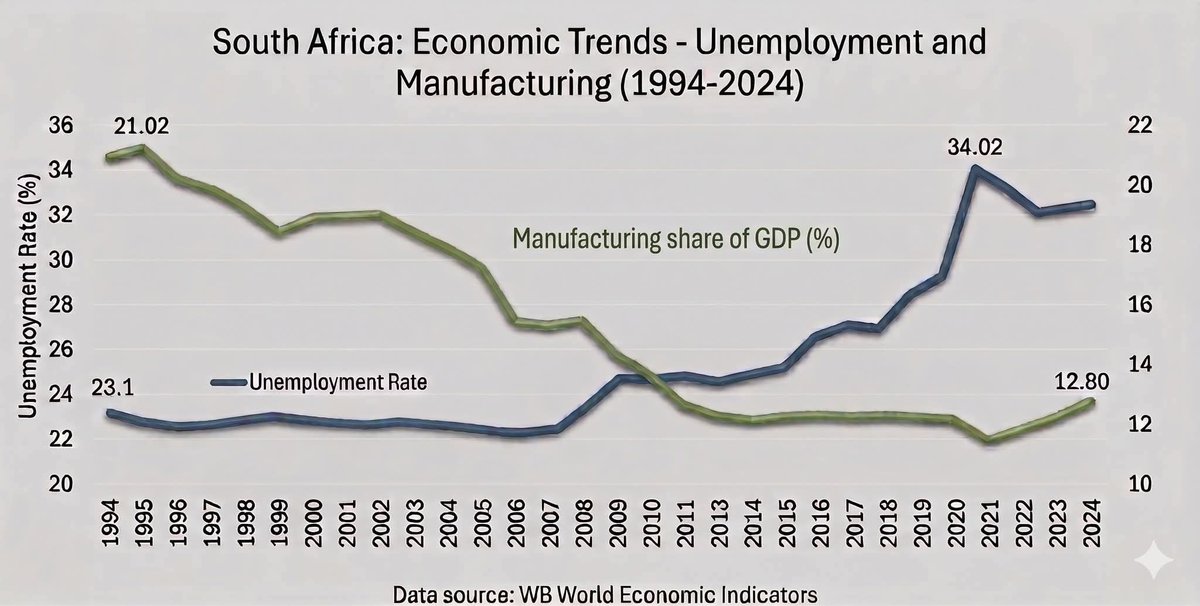
The primary cause of SA’s astronomical unemployment is the lack of an industrial policy.
The more manufacturing shrank, the higher unemployment rose.
The government gave corporations carte blanche to build world-class malls instead of factories, now they’re all acting surprised.
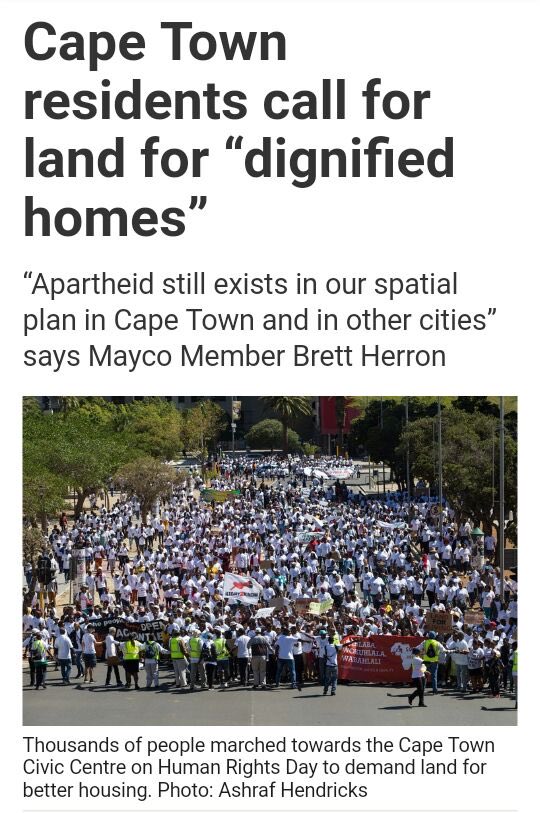
The DA, under Helen Zille, sold land in Sea Point for revenue instead of using it for affordable housing.
The Constitutional Court has just declared the sale unlawful!
Proud to have been part of the organisations that challenged this in 2014 when we found out about the sale 😭
Six months into 2026, here is what actually happened in the markets this year so far.
On the JSE, the standout has been MTN, up around 34 percent since January and still climbing. Among the banks, Capitec gained about 14 percent and Standard Bank around 11 percent, with a healthy dividend yield on top. In retail, Boxer led the way at roughly 18 percent and Shoprite did well at 9 percent, while Spur added around 13 percent. Driven by the oil situation, Sasol surged strongly, and Netcare grew steadily at around 14 percent.
But not everyone shared the party. Pick n Pay lost around 16 percent and Woolworths shed about 10 percent. The real disaster was Spar, down roughly 50 percent, with its half-year earnings collapsing by more than half. That was not just bad luck, it was a botched distribution centre and software rollout, heavy promotional costs, and a CEO resignation all landing at once. Naspers and Prosus also struggled, down around 26 and 31 percent.
Here is one that surprises people, the popular Satrix 40, a local index many beginners hold, was actually down about 5 percent for the half year. Index is heavy in mining and resource shares, and those got hammered.
Bitcoin fell around 33 percent, gold slipped, and the gold miners followed it down, with names like Sibanye, Implats, Harmony and Gold Fields posting losses of up to 42 percent. Anglo American was the exception, gaining around 18 percent.
Globally, the story flipped completely. The AI and technology theme carried everything. Intel had an extraordinary run of over 250 percent on the back of its turnaround and major partnerships, with fellow chipmaker AMD up around 170 percent. AstraZeneca, Coca-Cola, Google and Costco all posted gains. Global ETF funds shone too, the Satrix emerging markets feeder up around 22 percent and the Stanlib tech feeder around 16 percent. But even in tech there were losers, with Microsoft, Netflix, Adobe, Facebook and Xiaomi all in the red.
The lessons...
First, look at how wildly different the outcomes were. In the same six months, one share rose over 250 percent while another fell 50 percent. This is exactly why pouring all your money into single stocks is so dangerous, and why diversification through ETFs spreads that risk.
Second, notice that the local Satrix 40 was down while global feeder funds were up sharply. That is the offshore and currency story playing out in real time. If you were invested through a global ETF this year, it worked for you while the local headlines panicked, and that is precisely why global diversification works for us here in Southern Africa.
Third, and most important, six months is nothing. These are point-in-time figures and they will look completely different by December. The investor who panics over a bad half year, or chases the stock that just ran 250 percent, usually loses. The one who stays diversified and consistent through it all is the one who wins over time.
This is not financial advice, just something to think about.
The @Our_DA must take responsibility alongside its GNU partners, including the @MYANC for its part in creating a lack of services, infrastructure, and housing, by going along with the pretence that the rand issuing state magically has no rand to invest and employ, and depends on rand using middlemen for funding, at exorbitant interest costs, even when demand for goods and services is insufficient, and inflation is cost pushed.
While inflation in SA is cost pushed & demand for our labour, goods & services is too low (unemployment), the Rand issuing state can steadily increase employment at a rate that ensures a healthy amount of demand for goods and services (govt employees spend their wages on the goods and services the rest of us sell).
A moderate amount of demand pull incentivises private sector investment & employment to profit from matching new demand with increased supply of goods and services.
If govt focuses on employing & investing in ways that reduce household & businesses costs, like rolling out energy, water & public transport networks, education, healthcare etc, then the drop in costs & cost push inflation, is further incentive for private investment & employment.
Continuing SA’s extreme unemployment, poverty and inequality largely along racial lines is far more risky than targeting a healthy rate of demand pull inflation to drive development, employment, education growth & investment.
It’s counterproductive and just plain stupid to pretend that the Rand issuing state has no money to drive the improvements we need, while the Rand using private sector is clearly incapable and unwilling to do so, largely because of lack of demand & high costs / risk caused by that pretence.
Govt spending creates money. When the state taxes, money is destroyed.
While inflation is cost pushed and demand is too low, govt can offset more of its spending with low interest SARB credit (to increase demand and reduce costs) and less with taxes and high interest bond sales, which add cost and reduce demand.
When the state pays a govt employee to build, teach, police, nurse etc, the amount in the govt employee’s account is increased.
That employee then spends those Rand onward on the goods and services the rest of us sell, which increases incomes, sales and profit.
Govt taxes a portion of those incomes sales and profit, destroying a portion of those Rands created by the govt spending.
The people who sold those goods and services then spend what remains of those Rand onward, again increasing incomes, sales & profit, and again a portion is destroyed by taxation.
Eventually after a few transactions, all the money govt spent into supply on the public servant’s wage is removed by taxation.
But in the meantime, we had increased incomes, sales, profits, employment & GDP. And more private sector investment & employment.
When we understand the process properly, it becomes clear that the state can drive productive growth, employment and development.
This should have been President Thabo Mbeki’s real speech if he was genuine:
“I am a Thatcherite.
I owe my being to the financial markets and jobless economic growth, the privatised SOEs and the tyranny of the Reserve Bank, the currency manipulators, the banksters, the bondholders and the ever-fluctuating interest rates that define the face of our corporate wasteland.
I am a Thatcherite”.
Thatcherism is a belief in free markets and a weaker government. Rather than planning and regulating business and people's lives, the government's job is to get out of the way, be restricted to defence of the realm and the currency. Everything else should be left to corporations, rejecting state ownership of businesses and public economic planning.
Thatcherism advocates for controlling the money supply with high interest rates, which the South African Reserve Bank adopted under Thabo Mbeki in 2000, the same year he confirmed in Parliament that his programme of privatisation would continue.
Generally speaking, the point of Thatcherism is to satisfy global financial markets and to maintain currency stability, which was a dismal failure, by the way. Thabo Mbeki formally adopted his inflation-targeting framework on 23 February 2000. By December 2001, the rand had lost 47.4% of its value, and the cost to purchase one US dollar in rands surged by 90% over this 22-month window.
It went so pear-shaped that Mbeki appointed the Myburgh Commission of Inquiry into the Rapid Depreciation of the Rand in early 2002 to investigate the causes behind the crash. The cause was the policy.
So, even though Mbeki’s primary goal was to have an economy that looked good on paper regardless of the reality on the ground, his administration failed to do that as far as the currency was concerned.
Yes, the policies that Mbeki pioneered delivered strong financial stability and greater confidence among foreign investors. These achievements were widely praised by financial markets and much of the business press, contributing to a perception that South Africa was an economic success story under Mbeki’s presidency.
This is also why his fanboys are convinced his era was a time of prosperity, mostly because during the 2000s, South Africa experienced respectable GDP growth and stable macroeconomic indicators, and the corporate media loved it, even though the policies had little to no impact on inequality or poverty and instead led to long-term deindustrialisation rather than an active industrial policy aimed at deliberately creating mass employment.
So, regardless of what Mbeki and his supporters believe, under his presidency, financial stability became an end in itself rather than a means to achieving full employment and industrial development, in a country that desperately needed the latter.
I have served long enough in leadership to recognise a troubling pattern. Too many among South Africa’s elite - black and white - appear to believe the rules that govern the rest of us do not apply to them.
As chairman of an SOE, I am regularly approached by business leaders asking me to intervene in operational or procurement matters. When I explain that my role is governance and oversight, not management, they say they understand. Yet the requests continue. This reveals a belief that exceptions exist for the connected few.
It was therefore striking to see Business Leadership South Africa and BUSA, organisations that have been vocal against state capture and political interference in state-owned enterprises, actively advocate for political intervention to transfer transmission assets to the Transmission System Operator. These are the same bodies that insist on corporate governance and board independence. Where, then, is the role of the SOE board? What exactly do they believe in?
Equally concerning are recent allegations involving former Democratic Alliance leader Tony Leon. Senior figures within his own party, including John Steenhuisen and Dion George, have raised issues that appear to involve conflicts of interest and undue influence. This from a voice that has long lectured on ethical standards and clean governance. Do these rules apply to everyone, or only when politically convenient? Selective morality is not morality at all.
When those who position themselves as guardians of good governance apply different standards to themselves, public trust erodes. But South Africans are watching. We see the inconsistencies. We now know where people stand.
The path forward requires courage. We must expose wrongdoing wherever it occurs without fear or favour. We must demand that those who preach accountability live it consistently. We must insist that rules bind the powerful as they bind ordinary citizens. And we must model the ethical society we want to build.
South Africa does not lack good people. What we need is the collective will to insist that principle applies to all. Let us find that courage. Let us call out double standards and build a nation where no one is above the law. That is the South Africa worth fighting for. #ProudlySA
@eyeNeye@SizweLo You know @Princymthombeni and @JacintaNgobese are different people right?
Lets leave JZ era behind, Rosatom is a global leader in nuclear implementation it's a no brainer to work with them.
On my Qn I was alluding to the idea that the US favours colour revolution & regime change
Michael Parenti (1933-2026):
‘The free market mythology argues that the most ruthless, selfish, opportunistic, greedy, calculating plunderers, applying the most heartless measures in cold blooded pursuit of corporate interests and wealth accumulation, will produce the best results for all of us through something called the invisible hand.’
I found this absolutely hilarious.
So China has this nationwide policy called "Green Channel" (“绿通”): if you transport fresh produce like fruits or veggies, you don't need to pay highway tolls.
It's real, I checked, here is a government website describing the policy: https://t.co/1ktAm1lL1c
This is meant to reduce food costs and reduce friction in food logistics. If you're a small farmer producing - say - watermelons in Xinjiang, thousands of kms from Eastern cities, highway tolls alone could cost more than the watermelons themselves are worth.
There is, however, a loophole that's going viral on Chinese social media these days 👇 It applies to pickup trucks! So if you have a pickup truck, you just need to pack the back with cheap cabbage and - voilà - free highway for you 😂
So in China these days, if you go on the highway, you're increasingly seeing more and more pickup trucks packed with fruits and veggies in the back 😅
It actually doesn't go wasted and may even work in favor of the policy. When they arrive at destination, the drivers do sell the produce so, on top of waiving highway fees, they even make a profit - basically becoming the small-scale food distributors the policy was designed to support.
The video describes a driver from Zhengzhou, Henan who reportedly bought 500 yuan of cabbage, drove toll-free to Xinjiang, sold it for 1,500, then loaded up watermelons for the return trip and sold those back in Henan. He saved 2,000 RMB in highway fees and probably got his gas paid by the food profit!
I'm myself planning to drive the whole summer touring Western China with my family in an RV: I wonder if it applies, I might try it! If you're in China and see a French guy driving a RV packed with cabbage, don't get surprised 😂
Massive looting and shop breaking has been unleashed by March and March thugs in Mariannridge, province of KwaZulu-Natal, this evening .
Jacinta has unleashed a demon, that she herself is unable to contain.
@cecild84 Could you give us a reference or source for this event\video?
Where in SA did this happen?
It's very easy these days to use footage from elsewhere to push a narrative.
Saw it with Venezuela using a video of some crowd to frame it as the locals rejoicing at Maduro's kidnapping
@MainlandAfrica The surveillance state is where all neoliberal democracies are going especially with the AI push (humans would have a hard time sorting through all that data)
At least it APPEARS as if China did it for a state owned agenda Vs the interests of private capital.