In medieval times, within the arms race of ever more demonic torture devices, some sadistic genius came up with the idea of the Little Ease.
This was a prison cell built so small in every dimension that a grown man could not stand upright in it nor lie down at full length nor properly sit.
The pain is relentless and without relief and inflicted by one's own body. Prisoners were known to go insane within a few days. A stay at the Little Ease was considered even more cruel than the rack, the thumbscrew, and the other ghoulish machinery of the Tower of London.
A breeding pig will spend her whole life in a version of that box.
These are social, roaming creatures (more intelligent than dogs) who will never leave this corset of steel.
They have been selectively bred to be bigger than their frames can support. Yet we put them in cells so confined that they cannot comfortably sit, and their attempts to do so (for example, by sneaking their limbs into adjacent stalls) reliably lead to fractures and sprains.
They cannot sweat, yet have nothing to roll around in to cool themselves off. Except their own manure, which (contrary to the common misconception) they are so averse to (thanks to their strong sense of smell) that new sows will often suffer from constipation to avoid soiling the space from which they eat and sleep.
Here is how the writer Matthew Scully described what saw at one of Smithfield’s “gestation barn”:
> “Sores, tumors, ulcers, pus pockets, lesions, cysts, bruises, torn ears, swollen legs everywhere. Roaring, groaning, tail biting, fighting, and other “Vices,” as they’re called in the industry. Frenzied chewing on bars and chains, stereotypical “vacuum” chewing on nothing at all, stereotypical rooting and nest building with imaginary straw. And “social defeat,” lots of it, in every third or fourth stall some completely broken being you know is alive only because she blinks and stares up at you … creatures beyond the power of pity to help or indifference to make more miserable, dead to the world except as heaps of flesh into which the [insemination] rod may be stuck once more and more flesh reproduced.”
—
The Save Our Bacon Act is trying to unroll the few state protections we have against this barbaric cruelty - for example California’s Prop 12 - which banned the sale of pork from pigs kept in gestation crates.
It’s incredibly important we don’t end up with this sort of federal preemption.
SOB will not only kill the most important animal welfare related laws in the US of the past decade, but more importantly, it will also restrict ALL future legislative progress (aka how the animal welfare movement has gotten its biggest wins).
The Senate is currently deciding whether to add the SOB Act to the Farm Bill.
With relatively little money now, we can discourage the most pivotal senators in the Ag committee from backing this amendment.
Defeating this bill is even more important given the amount of philanthropic funding I expect to come online in the next year or two.
It will plausibly be over 10x more expensive to repeal SOB than to prevent it from passing in the first place.
All that money that could be spent transforming our society's relationship to mass animal suffering will instead have to be spent just getting us back to where we are right now.
That's why money spent now fighting this bill (and I mean right NOW) is so effective.
If you’re in a position to donate six figures, please DM me.
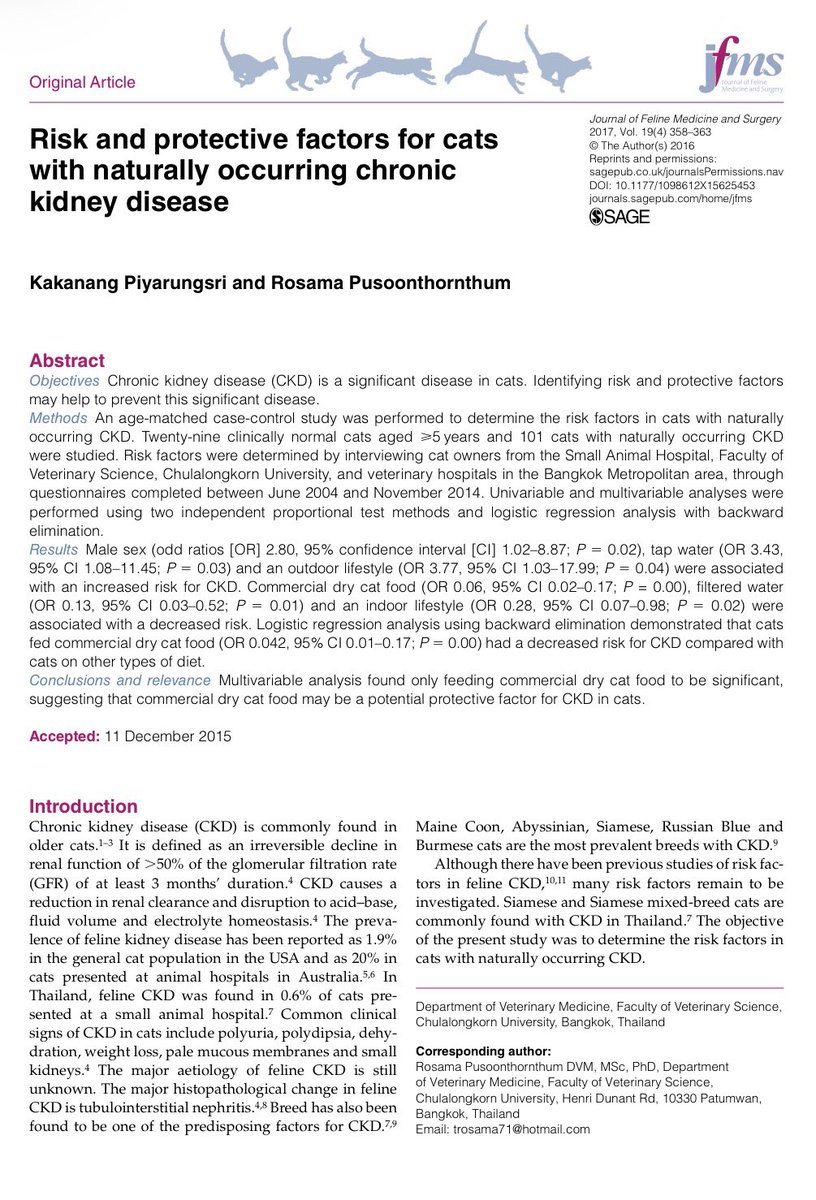
Cats who drink filtered water live longer.
Cats who drank primarily filtered water had 87% lower odds of developing kidney disease. Tap water led to 3.4x higher risk.
Toru Miyazaki gave 11 cats with advanced kidney disease an experimental injection. 15 others didn’t get it. A year later, 9 of the 11 treated cats were alive. Only 3 of the 15 untreated cats survived. He just filed for approval, and the drug fixes a defect only cats have.
Most cats die from one thing: their kidneys fail. By age 10, 4 in 10 cats already have chronic kidney disease, and by age 15, the rate doubles to 8 in 10. Once diagnosed, a cat has about 2 years left.
The reason kidney disease hits cats so hard is a broken protein in their blood. All mammals carry a protein that helps the kidneys clean out waste. In humans and dogs, the protein floats freely and goes to work when the kidneys are in trouble. In cats, it stays stuck to another protein and can’t get loose. So the waste piles up, and the kidneys eventually give out.
Miyazaki originally found the protein in 1999, back when he was at the University of Tokyo. He figured out the cat-specific glitch in 2015. The paper he published in the Veterinary Journal in February laid out the trial. The injection is a working version of the missing protein. His company, the Institute for AIM Medicine, filed the approval paperwork with Japan’s Ministry of Agriculture on April 24, 2026. If the review clears, the drug goes on sale in spring 2027.
The 30-year lifespan figure in the tweet is Miyazaki’s own projection of what cats could reach without kidney disease. The trial only ran a year, and the average cat today lives 15. Most die from the same disease this injection treats.
The research almost died in 2020. After running out of funding during COVID, Miyazaki went public. Cat owners across Japan responded by sending in 300 million yen, around 2 million dollars total. He resigned from the University of Tokyo and worked on the drug full time. The treatment in front of regulators today exists because cat lovers refused to let the research die.
Sent another 64 ETH to the Animal Welfare Fund.
I encourage others to think and act more in support of our non-human cousins too! The extreme suffering we're imposing on them in the billions is not something we talk about often, but it continues to be one of the larger blights on humanity.
And I'm getting optimistic that this century we can finally end it. Farming practices are improving, synthetic alternatives are improving.
Also, in my recent experience, good old low-tech vegetarian and vegan food has improved massively worldwide over the last ten years; I encourage anyone who has tried it long before and given up to take second look; there are far more healthier and tastier options today than the "pasta and salad" you would often get ten years ago.
In 2025, we killed:
- 300 million cows
- 400 million rabbits
- 500 million turkeys
- 600 million goats
- 700 million sheep
- 1.5 billion pigs
- 4 billion ducks
- 70 billion chickens
- 250 billion shrimp
- 2 trillion fish
When is “Enough is enough”?
How many more animals do we have to kill for people to wake up and realize what’s happening?
Having spent most of his life inside labs, the chimp’s stunned awe when he finally sees the open sky says everything about how freedom belongs to every living being by nature. 🐒
In 2025, we killed:
- 300 million cows
- 400 million rabbits
- 500 million turkeys
- 600 million goats
- 700 million sheep
- 1.5 billion pigs
- 4 billion ducks
- 70 billion chickens
- 250 billion shrimp
- 2 trillion fish
When is “Enough is enough”?
Activist @JohnOberg says pigs should NOT be confined to factory farms. 🚫
Our choices will decide their fate! 🙏
Clips from sisurefuge (IG) | lancasterfarmsanctuary (IG) | Alice Basilio | animalsaveportugal (IG) | uncleneilshome (IG) | @TheGentleBarn#animals#pigs#farming #veganfortheanimals #govegan
Pigs play video games (and love them).
Hamlet is the breed (Yorkshire) most commonly used in pig farming. Please stop turning these amazing creatures into bacon.