<New Podcast> With @KofmanMichael, we discuss the US/Western obsession for speed in warfare. We take as a starting point my 2020 article in @IAJournal_CH (link below) and talk about what has changed, in particular in light of the Ukraine-Russia and US-Iran wars (spoiler: not much: we are still obsessed with speed). Thanks to @AmosFox6 for bringing us together and for being a gracious host. 1/
https://t.co/lnmSmoeiDB
When I published my 2020 article on “wartime paradigms” in @IAJournal_CH, I was looking at what seemed to me a central paradox of contemporary warfare: war is getting faster and slower at the same time.
For decades, Western militaries assumed that operational superiority came from speed: faster sensing, faster decision-making, faster targeting, faster force projection. But adversaries understood this. And much of what we are seeing in Ukraine, and in the confrontations involving Iran, is a deliberate effort to slow Western warfare down.
At the tactical level, war is accelerating. Drones, sensors, precision fires, electronic warfare and targeting cycles compress the time available to commanders. Units are detected faster, targeted faster and forced to adapt faster.
But at the operational and strategic levels, tempo is decelerating. Campaigns become harder to initiate, harder to sustain, and harder to translate into political outcomes. Logistics are exposed and industrial capacity becomes decisive, while concerns about escalation management slows decision-making.
Ukraine illustrates this perfectly: tactical adaptation is extraordinarily fast, but the war’s strategic rhythm is defined by attrition, mobilization, ammunition production, fortifications, alliance politics and endurance. The Iran case points in the same direction. US/Israeli targeting may be flawless, but Iran understood that it had strategic leverage through a denial strategy of blocking Ormuz.
So the issue is not simply that Western militaries need to “go faster.” Instead, one of the key challenges of military theory and practice will be to reconcile these disjointed temporalities: tactical acceleration, operational pacing and strategic endurance.
https://t.co/9ggmEbTahg
New article by two of my colleagues (Tom Crosbie and JF Bélanger) and Orlando J. Perez looking at how Canada, Denmark/Greenland and Panama react to the Trumpian moment. https://t.co/aAECfbBg0V
'Preparing for War' by @Olivier1Schmitt is an original approach to the study of war, attempting to capture the entire phenomenon of military adaptation—whether strategic, institutional or in the field.
20% off w/code SCHMITT20 ➡️https://t.co/fwpb97YPGo
🚨 It's publication day!
Very happy that "Preparing for War" is now in the wild.
This English edition is the culmination of more than a decade of research on how armed forces transform, and why it matters.
At a moment when Europe is rearming and Russian and Ukrainian forces are engaged in a relentless cycle of adaptation and counter-adaptation, the essential question is no longer whether militaries must change, but how they actually do.
In the book, I move beyond static assessments of the balance of power to study its dynamics. I propose a unified framework that disentangles five drivers of military transformation (the international system, civil–military relations, technology, internal organizational logics, and war itself) and identifies the mechanisms (constraint, circumvention, learning, and diffusion) through which armed forces reinvent themselves, or fail to.
My hope is that it offers scholars, analysts, and practitioners a common vocabulary and an analytical grid for understanding why some militaries adapt under fire while others remain stuck fighting the last war, a question with profound consequences for the distribution of power in a re-militarizing international system.
Huge thanks to the colleagues, mentors, and friends who shaped this work over the years.
@HurstPublishers
https://t.co/GWCAfXsXeC
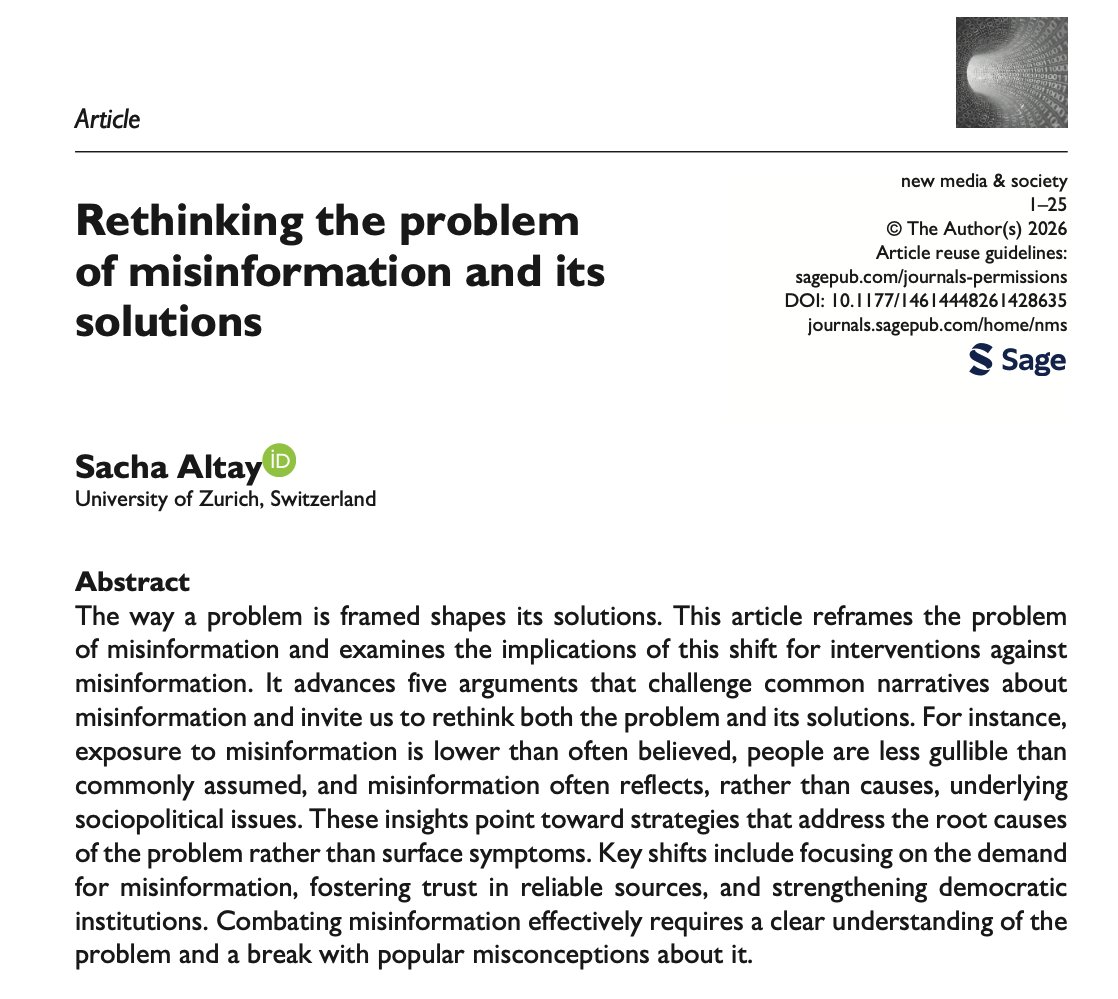
One of my favorites paper got published 🥳 It covers a lot of ground and it’s the best summary of my views on misinformation and what to do about it. Give it a read :)
💫🪖 NEW: "Beyond the manual: Doctrine’s role in military transformation reconsidered" by John Nisser (@Forsvarshogsk).
👉 Open access: https://t.co/abIAx7u1FW
The ideological congruence is clear, and is largely documented. But what I find the most pathetic is the armchair « realists » who pontificate and speculate about US grand strategy, while enabling the destruction of liberal democracy in the US.
Invoking Munich & Chamberlain to talk about Ukraine is fashionable but often misleading. In @jststs, I review two recent books on appeasement - and examine how hype about new tech (air power) distorted British strategy in the 1930s. 50 free copies here 👇 https://t.co/JPx4vZ5rsK
Complexity science as folk theory in NATO’s future warfighting concept of multi-domain operations - “a strong performative master narrative for a variety of orientations, yet one whose practical relevance for the organization of security can be questioned” https://t.co/htOPztaUBg
New in @Nature: Misunderstanding the harms of online misinfo https://t.co/LV5GSDrw5G
Debunks unsupported claims about social media exposure/effects and shows low exposure concentrated in motivated fringe. We recommend holding platforms accountable for exposure in high-risk tails
Since emotions are arguably the main mechanism through which morality matters to strategy, strategic studies scholars should engage with the emerging emotion science to better understand how moral judgements translate, or fail to translate, into strategically relevant behavior.
In a new Comparative Strategy article, I argue that contemporary psychological literature can improve our understanding of how morality and emotions interact in the context of military strategy. https://t.co/lOaDu9wWS8
This @TXNatSecReview article by @gavinbwilde is a must read. It offers a pragmatic and historically grounded approach on the implications of misinformation. Check it out: https://t.co/C2I7bXcDAw