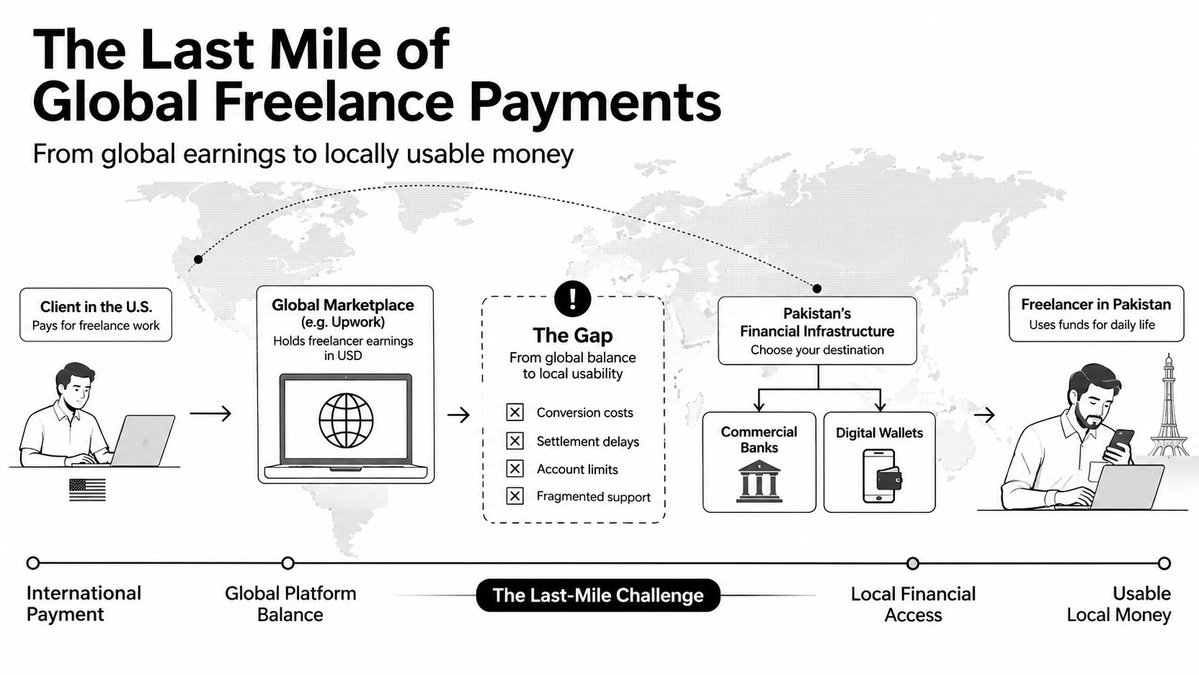
Upwork already lets Pakistani freelancers withdraw straight to a bank.
So what do wallets actually add?
Speed: minutes vs up to 4 business days.
What they leave open: FX transparency, provider limits, and whether a wallet credit counts like an ESFCA credit.
Breakdown 👇
Upwork’s direct-to-wallet payouts are live in Pakistan, Bangladesh, Indonesia, the Philippines and Kenya.
Five different markets, one shared problem: global platforms hold the earnings, but freelancers live inside domestic financial systems.
The last mile is where the two meet.
Dear algorithm,
Please connect me with fintech founders, emerging-market operators, payments professionals, investors, and people building the future of financial infrastructure.
People working across borders, solving real problems, and making money move better.
Upwork already lets Pakistani freelancers withdraw straight to a bank.
So what do wallets actually add?
Speed: minutes vs up to 4 business days.
What they leave open: FX transparency, provider limits, and whether a wallet credit counts like an ESFCA credit.
Breakdown 👇
Paraguay's president resigns following a crisis over a bank collapse, leaving millions of customers unable to access their money https://t.co/iqFr0NIuM8
@padrinoIG That's exactly the gap. The sending side may confirm the transfer, while the local bank handles the incoming payment. But when it gets stuck, there often isn't clear ownership of the resolution. The customer ends up chasing both sides.
I’m not building a PayPal or Stripe alternative.
I’m focused on getting Pakistan’s side of cross-border payments right: clear rules, fast processing, accountability when something fails. Better access starts there.
My Fintech News Pakistan interview explains how.👇
@MoitOfficial Pakistan’s growing social media presence is an opportunity, but digital growth needs more than connectivity. It also needs reliable digital payments, financial inclusion and infrastructure that allows people to turn online activity into economic value.
On 27 October a foreign client sent us a USD remittance under a signed contract. The receiving bank in Pakistan - MCB - said the purpose code was missing. On 2 November the sender's bank told us to reverse the payment and so they can resend it with the code, although we had shared the purpose with the receiving bank under the contract. It is 5 November. The money has been neither credited to us nor returned to the sender.
This is one reason founders incorporate abroad. The issue is not tax. It is that a Pakistani company cannot be sure of receiving its own foreign income without weeks of follow-up.
@MCBBankPk@MManshaOfficial@Financegovpk@StateBank_Pak
What's interesting is the breadth: payments, core banking, banking software and digital banking. The Netherlands is producing fintech companies across multiple layers of the financial system, not just one segment.
The Netherlands 🇳🇱 is quietly becoming a FinTech powerhouse.
And the numbers are pretty wild.
Mollie is the most valuable Dutch unicorn 🦄 at $6.5B.
Mambu is nr. 2 at $5.5B.
Then you have Backbase at $2.6B and bunq at $1.9B.
So while FinTech represents 4 of the 11 companies on this list, together they are valued at $16.5B.
That’s more than 52% of the combined $31.6B valuation of all Dutch unicorns shown here.
The top 7 alone include four FinTech companies:
Mollie — $6.5B
@Mambu_com — $5.5B
@backbase — $2.6B
@bunq — $1.9B
Payments. Core banking. Banking software. Neobanking.
For such a small country, the Netherlands continues to punch far above its weight in financial technology.
And seeing @MolliePayments at nr. 1 makes this list even better. 🙌
Which Dutch company do you think will be the next one to join this list?
𝗣.𝘀. kudos to Multiples for this data/insight👌
And if you want the news behind the numbers? Join 200,000+ FinTech fanatics getting my daily newsletter: https://t.co/Diq3VhoWM1