Poor comms judgment sending a severe alert with wildfires advice.
My central London train carriage suddenly screamed with alarms on everyone’s phones (two times each) about something that had zero urgency here.
Other countries routinely send normal SMS for government guidance.
Dear @UKgovcomms deploying the emergency message for a very hot day only serves to dilute the effectiveness of service. UK is not under nuclear attack or about to be slammed by a meteor.
I’ve had the rare privilege to embed among traveling England fans at this World Cup and over time, I’ve observed how and why these chants emerge with the detachment of an anthropologist.
It’s fascinating.
England football chants are born through a decentralized, bottom-up process that functions like a cultural meme-plex.
They draw on pre-existing, widely recognized melodies from the English cultural repertoire - pop songs, hymns, nursery rhymes, or TV themes - and layer new lyrics tailored to the match or players.
The mechanism is straightforward - a single fan initiates the chant at high volume. If the tune is familiar and the lyrics fit the rhythm and moment, nearby supporters join in rapidly. Participation spreads organically through the crowd. Attempts that lack resonance or timing might fail to gain traction and fade quickly, though this is uncommon for well-crafted ones.
They typically develop a signature chant for each beloved player. Bukayo Saka’s uses the ABBA track “Voulez-Vous,” with adapted lyrics. Jude Bellingham’s repurposes The Beatles’ “Hey Jude.” These adaptations succeed because the base melody requires minimal learning, allowing instant widespread uptake.
This system serves a practical social function as it acts as an informal in-group signal. Knowing the tune and lyrics demonstrates shared cultural knowledge and belonging. In a way you can think of it as a test: do you know the tune? Do you know the lyrics? Do you love England? Are you one of us?
Supporters who participate affirm their place in the collective; those who do not simply observe. The process requires no central coordination, relying instead on rapid social transmission in highly stimulating environments such as pubs, stadiums or even subways on the way to a big game.
Tl;dr: English football chants represent an efficient form of emergent group identity - low-effort to join, high-reward for cohesion, and continuously evolving based on real-time fan creativity. This explains their speed of adoption and persistence across matches.
This is so lame. I was always a Liverpool fan, albeit not an avid one. Now I can say I’m not one at all.
Shouldn’t need to choose between national identity and your particular flavour of foreign investor-owned premiership team, but it’s an easy choice to make.
@SaveWimbldnPark Beyond parody
You campaigned against converting a failed golf course so Wimbledon tennis gets a world class venue
Local population gets a hugely expanded park and lake access, previously used by a small number of golfers
Delighted to welcome the 2025 and 2026 cohorts of @francobritish Young Leaders 🇫🇷🇬🇧 to the Residence yesterday evening.
At a time of global uncertainty, these connections matter more than ever - building the relationships that will shape the future of the Franco-British partnership.
A major new research project by the Independent Commission on Community and Cohesion is trying to address the problem of increasingly fractured communities.
Project chair Sir Sajid Javid and playwright James Graham discuss the social cohesion crisis.
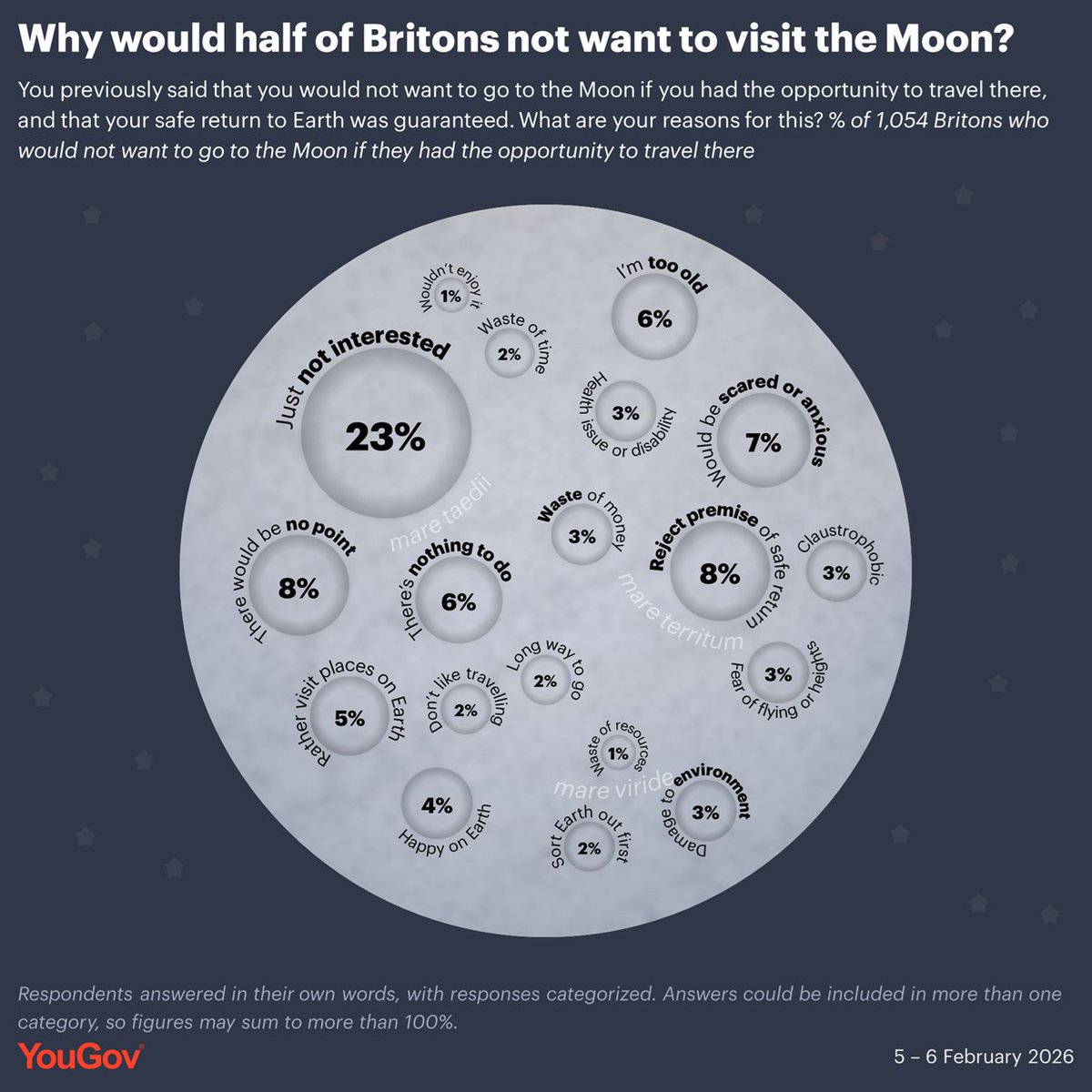
Among the half of Britons who say they would turn down an opportunity to visit the Moon, a simple lack of interest is the most common reason to not want to go
Not interested: 23%
No point: 8%
Reject idea of safe return: 8%
Would be scared or anxious: 7%
Nothing to do: 6%
Too old: 6%
Places on Earth I want to visit first: 5%
Happy on Earth: 4%
Claustrophobic: 3%
Would damage environment: 3%
Waste of money: 3%
Fear of flying/heights: 3%
Health issues: 3%
https://t.co/qt2hwFy8tW
I get Starmer is in a tricky position. Problem is that he appears to regard international law as a substitute for moral judgment/leadership. Like he hopes it will dictate what to do. It's the wrong way round: legal frameworks are derived from our sense of what's right and wrong.