So the IND players were abused during the whole match by the PAK team & the PAK crowd from the stands.They were using racial slurs( Kale Kalutte etc which can be heard here ) for the IND players when PAK were ahead.Thats why our boys reacted that way
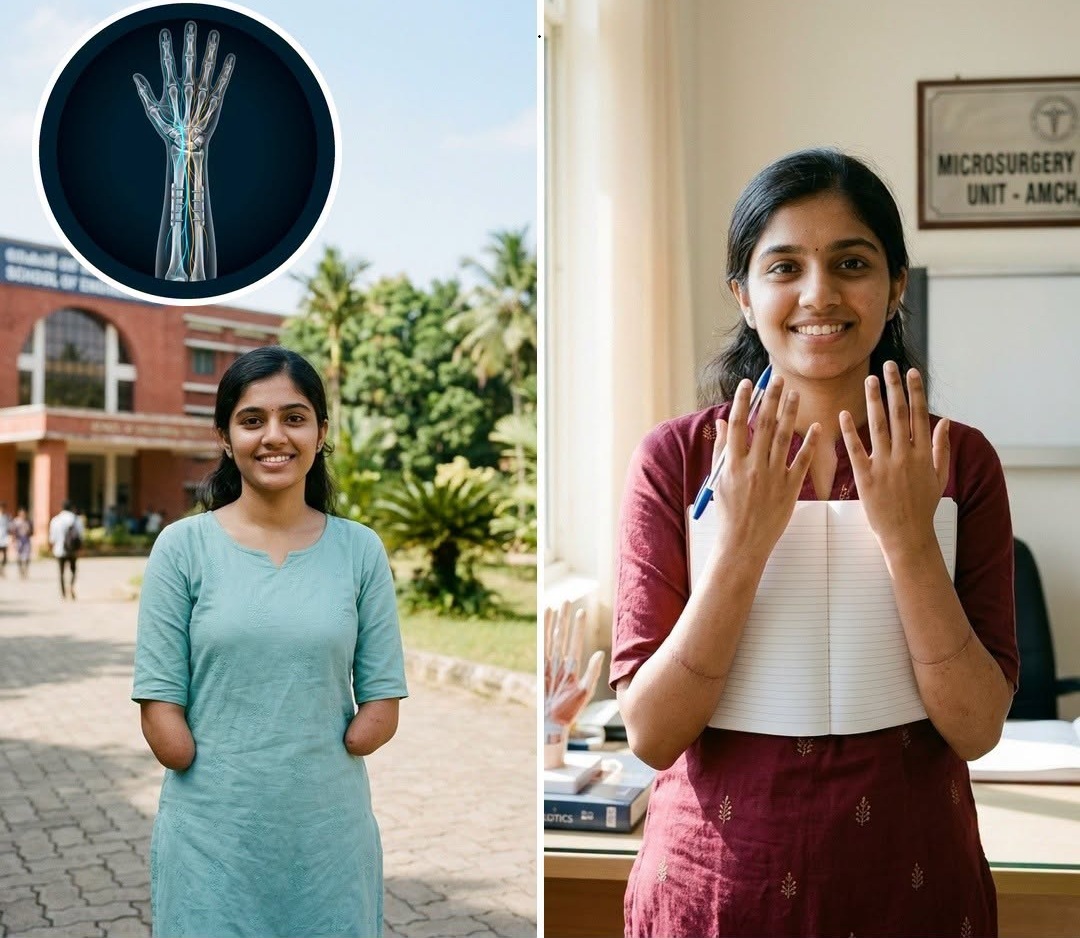
When 19-year-old chemical engineering student Shreya Siddanagowda lost both arms in a devastating bus crash on her way to college in 2016, doctors told her that upper-limb transplants in Asia were virtually unheard of.
One year later, at Amrita Hospital in Kochi, India, a team of 20 reconstructive surgeons and 16 anesthesiologists led by Dr. Subrahmania Iyer performed a grueling 13-hour operation — achieving Asia’s first upper-extremity double arm transplant and the world’s first male-to-female bilateral hand transplant, using limbs donated by Sachin, a 20-year-old male college student.
What happened over the next three years stunned reconstructive surgeons worldwide:
• Reconnecting Bones, Arteries, Tendons & Nerves: Surgeons plated both donor radius and ulna bones to Shreya’s residual arms, microscopically sutured arteries and veins to restore blood flow, and spliced dozens of flexor tendons and peripheral nerve trunks so her brain could learn to drive the new hands.
• Biological Remodeling of Male Limbs: Immediately after surgery, the male donor arms were bulkier, hairier, and noticeably darker in complexion than Shreya’s natural skin tone. Over three years of nerve reinnervation, hormonal circulation, and lymphatic remodeling, muscles subtly slenderized to match her frame — and her body gradually lightened the donor skin’s melanin pigment until the hands blended seamlessly with her own arms.
• Writing Her Own Exams Again: After nearly two years of intensive neuromuscular rehabilitation, Shreya regained fine finger dexterity — returning to university to hand-write her own engineering exams.
Source : @engineeringpost
How does this homily apply to those foreign lobbies which have always sought to weaken India in various ways including our internal political and social divisions?
By all means have this samvad between disparate political and intellectual thinking within our citizenry as part of our democracy.
How many foreign countries engage in samvad with us about their internal political and social issues?
This tendency we have to lecture to ourselves from a high moral ground about our traditions should be tested by our historical experience.
How much has this samvad helped us to make our foreign interlocutors understand, respect and learn from our Indic traditions.
This samvad was a great Indic tradition but it failed miserably with the Islamic conquest of India, British colonialism and India’s partition. @ShashiTharoor
Just look at these two stories today about India’s October trade deficit.
It widened. Or narrowed.
Depends on which month you compare it with…
And with Diwali shifting from October last year to November this year, the comparisons are even trickier.
Reminds me of an American writer’s famous observation:
“People generally see what they look for, and hear what they listen for.”
Confirmation bias at work.
We don’t always use statistics to decide what to believe. Sometimes we decide what to believe, and then choose our statistics.
But there’s something in these numbers that I find genuinely encouraging.
India’s merchandise exports surged 45% in October to a record $49.47 billion. And goods exports are up 22% in the first seven months of this financial year.
For decades, services exports have been our saving grace. An unusual strength for a developing economy, built largely on our IT skills.
But now, I believe we’re seeing the beginnings of a fundamental transformation.
We’re developing the manufacturing muscle we’ve badly needed.
An economy standing on two strong legs, services AND manufacturing, will be far more resilient to global shocks.
So my cure for confirmation bias?
To look for the underlying, longer-term trends.
That’s where I think the real story always is…
This reminds me of the case where Chandigarh or Mohali administration had mandated that Safai Karamcharis will wear a band which will geotag their location.
Reason being, many safai karamcharis would themselves not do any work but had hired others at daily wages to their job. They got government salaries whiles the help they hired got pittance.
A straightforward administrative issue was made into human rights issue by some people.
India now generates more electricity than Japan and Germany. Combined.
2025 generation:
India: 2,082 TWh
Japan + Germany: 1,530 TWh
India is 36% bigger than both put together. World #3, behind only China and the US.
The crossover happened just 4 years ago. In 2014 India was 25% smaller than the two combined (1,259 vs 1,682 TWh). It passed them in 2021.
Since 2014: India +65%. Japan + Germany: -9%.
Sources: Ember Global Electricity Review 2026; Energy Institute Statistical Review of World Energy 2026
On this auspicious first day of Chhath Puja (Nahai Khae), I am delighted to announce my next book—a journey into the history, philosophy and civilisational story of one of Bharat’s most extraordinary festivals.
For me, Chhath is also childhood. I remember excitedly going to the ghats as one of my grandmothers—my father’s aunt—observed the fast. And, of course, waiting all year for thekua!
As I grew older, I began asking: where did this extraordinary tradition come from? Why do millions offer arghya to both the setting and rising Sun?
I searched for a book exploring Chhath beyond rituals—its history, philosophy, solar worship and its deep connection with Bharat and nature. I could not find the book I was looking for.
So I decided to write it.
Across the ancient world, great civilisations worshipped the Sun. Many ancient solar cults faded into history. Yet in Bharat, the relationship between humanity, nature and the Sun continues to live.
And Chhath is among its most beautiful expressions.
A journey that began with childhood memories—and perhaps thekua—is now becoming a book.
Chhath Puja ki hardik shubhkamnayein!
The US is the most nationalist country with its sense of exceptionalism. No other country says it is exceptional.
That leads the US to want to shape the world according to its own image.
This explains its unilateralism and policy of sanctions.
The propagation of its values world wide is another facet of US nationalism which is infused with evangelist fervour.
The Speaker of the House and Hegseth are glaring examples.
The USICRF set up by the US Congress exemplifies US Christian anti- Hindu nationalism.
There is no need to be defensive about “Hindu nationalism” before the Americans and Indian Americans sold out to them.
Moral of the story according to Dhume: A "good Hindu" is one who observes religion in private. Keeps head down. Shows no outward expression of religiosity in foreign land.
A "bad Hindu" is the antithesis. A bad Hindu tries to assert identity, wield political power. These "Hindoo nationalists" invite the opprobrium from the Left. Just deserts!
India's growth story is boring in the best possible way. No hype. No stimulus binge. Just steady compounding that the world keeps underpricing. @Noahpinion is right to call it out.
The balance sheets are clean. A decade ago, stressed corporates and banks buried in bad loans held this economy back. Today both are deleveraged and well capitalised. That is exactly the setup you want before a private capex cycle. When private investment turns, 6.5% becomes the floor, not the ceiling.
Indian savings are now funding Indian growth. Crores of households invest every single month through SIPs, rain or shine. Foreign money comes and goes. This money stays. Very few emerging markets have that kind of domestic cushion.
Formalization is the quiet multiplier. GST and UPI pulled small businesses into the formal system. Formal businesses get credit. Credit funds expansion.
Demand is spreading beyond the metros. In distribution, I see it every quarter. Tier 2 and tier 3 towns are buying more, and better roads now take goods to places that were off the map ten years ago.
China built its rise with the world's support. India is building its own with a cleaner financial system and a broader domestic base.
The next decade rewards the patient Indian investor. Stay invested.
@ECISVEEP please file a case and prosecute these people for spreading rumours and fake narratives. Unless you prosecute them this will not stop. They must be made to pay for such misleading mails. @AmitShah
Arguing that India should accept dual nationality, citing numerous cases of Bollywood actors carrying foreign passports, his own son and
actor Imran Khan’s case is a superficial view as it
overlooks serious issues
That the heart of these individuals and the diaspora bats for India is questionable and if in many cases they carry foreign passports for convenience of travel etc. that says it all about their mentality.
Here are the serious issues involved:,
Article of the Indian Constitution explicitly forbids holding Indian and foreign citizenship at the same time. A Constitutional revision will be required.
Section 9 of The Citizenship Act, 1955enforces this constitutional rule.
Post partition there was need to establish clear, undivided national boundaries and prevent ambiguity over who belonged to India versus newly formed Pakistan.
Also preventing divided allegiance and to ensure that citizens—and especially future political leaders—did not hold competing allegiances to former colonial powers or neighboring states.
That concern remains.
National Security and Governance Concerns are real.
There are intelligence and espionage risks. Dual nationality complicates background checks and counter-intelligence. Allowing individuals with foreign state loyalties to hold sensitive government jobs, military positions, or public office presents major security risks.
Dual citizenship can create legal loopholes for individuals accused of financial fraud or criminal offences to evade Indian law enforcement.
Managing tax obligations, property ownership laws, and foreign exchange rules for millions of dual citizens would create severe administrative friction. Dual status could be exploited to bypass domestic financial restrictions or create tax loopholes.
India has one of the largest overseas diasporas in the world. Granting full voting rights and domestic political influence to tens of millions of non-resident dual citizens could drastically skew local elections .
Managing dual nationals requires intricate legal coordination regarding taxation, military conscription, and diplomatic protection. Current administrative systems are not designed to track dual legal obligations for millions of diaspora members. @ShashiTharoor
Shashi Tharoor in IE today says India should accept dual nationality, citing numerous cases of Bollywood actors carrying foreign passports, and his own son.
Article is triggered by actor Imran Khan’s case.
In his view the heart of these individuals and the diaspora bats for India, and in many cases they carry foreign passports for convenience of travel etc.
Flimsy reasoning.
Article of the Indian Constitution explicitly forbids holding Indian and foreign citizenship at the same time. A Constitutional revision will be required.
Section 9 of The Citizenship Act, 1955enforces this constitutional rule.
Post partition there was need to establish clear, undivided national boundaries and prevent ambiguity over who belonged to India versus newly formed Pakistan.
Also preventing divided allegiance and to ensure that citizens—and especially future political leaders—did not hold competing allegiances to former colonial powers or neighboring states.
That concern remains.
National Security and Governance Concerns are real.
There are intelligence and espionage risks. Dual nationality complicates background checks and counter-intelligence. Allowing individuals with foreign state loyalties to hold sensitive government jobs, military positions, or public office presents major security risks.
Dual citizenship can create legal loopholes for individuals accused of financial fraud or criminal offences to evade Indian law enforcement.
Managing tax obligations, property ownership laws, and foreign exchange rules for millions of dual citizens would create severe administrative friction. Dual status could be exploited to bypass domestic financial restrictions or create tax loopholes.
India has one of the largest overseas diasporas in the world. Granting full voting rights and domestic political influence to tens of millions of non-resident dual citizens could drastically skew local elections .
Managing dual nationals requires intricate legal coordination regarding taxation, military conscription, and diplomatic protection. Current administrative systems are not designed to track dual legal obligations for millions of diaspora members.
India’s March to a Digital Bureaucracy
Over the past month I have tried to get the PUC (Pollution Under Control) certificate for the car of an elderly relative. Normally it is straight forward. Go to a PUC Center and in a few mins it’s done. Now however it needs “digitisation” to do the PUC.
You go to the Parivahan website to update your details and upload documents. The PUC Center guy said he can do it for ₹300. It seemed like a straightforward task so I decided to do it myself. Uploaded the requisite documents. For almost a month no response.
Today was driving and saw another PUC Center. Decided to check. He said he can do it for ₹300. Also said the govt website is useless for the consumer. Gave him the details. He had an instant response telling him the name in Registration Certificate and Aadhar was a slight mismatch. The name and surname matched. But the Aadhaar had a middle name as well. So it was a mismatch.
His Solution: Change the name at RTO or Aadhaar so that the PUC can be done.
So many questions on this digital bureaucracy.
1) Why should getting a PUC even need such a requirement?
2) Doing a name change means going from the online to the offline world - which defeats the purpose of digitisation
3) Why does a govt website provide instant response to a vendor but not the citizen?
Digitisation was supposed to eliminate bureaucracy. Instead in the Transport World - India is instead becoming a digital bureaucracy @nitin_gadkari@MORTHIndia
6/6
The cost to detain such a vessel could be more than $400,000 per month.
With about 5 months gone, this figure would be US$ 2 million or more.
Selling the oil (worth $ 40 million) could result in a legal action from the shipowner.
On the other hand, holding a loaded tanker indefinitely at anchorage or at berth will be challenging, with winter storms expected until March 2027.
UK would not like a repeat of the 1967 Torrey Canyon oil spill.
5/6
The arrest of SMYRTOS was presumably a well-planned operation by the UK authorities, as evidenced by the statement of Mr DAN JARVIS, Defence Secretary (MP) in the House of Commons, on 16th June 2026... that hundreds of people were involved in the arrest of SMYRTOS and that it was arrested 25 NM south of the Isle of Wight (when SMYRTOS was in international waters)
4/6
UNCLOS does not:
a. ...require every vessel to be flagged.
a. ...state what action can be taken by a State for a Stateless vessel.
b. ...restrict a pirate ship to be flagged by a Flag State.
c. ...consider it a crime if a ship is sailing without a flag.
d. ...authorise action against crew, or seizure of ‘Stateless’ vessels such as SMYRTOS.
3/6
The Master does not decide on the employment or charter of the vessel; Master (he/she) only executes the charter for the carriage of goods from point A to point B in accordance with the Charter party requirements.