Hi, I'm Manuel, and I'm an economist working on platform competition and algorithmic pricing. I joined Twitter to comment on what is going on in these areas and keep up-to-date. You can expect short summaries and recommendations of key works. Views are my own.
New paper accepted at Economics Letters!🎉 We derive the Stackelberg equilibrium of Armstrong (2006) two-sided platform model, and find it overturns a classic result: the side subsidized under simultaneous pricing can become the taxed side when one platform moves first.
Both platforms earn strictly more under sequential than simultaneous competition, yet it's often the follower who profits most (second-mover advantage). Staggered platform launches, like console generations, may be less about luck and more about equilibrium incentives.
@IgorLetina It could be just a collateral effect (I mean, the waste of tokens). They may increase temperature artificially just to be a bit creative so to avoid getting stuck.
My latest paper on MDE is about this, a simple model in which acquisitions are contingent on payments shows the first effect, and a simple Cournot model illustrates the second. Hope you find it useful! https://t.co/cdrtKz7efQ
The “take it or leave it” assumption is common in M&A models, since the bargaining process only determines the allocation of the surplus among the parties and simplifies the model, right? Yes, but it is a double-edged sword, since it is only true if (...)
a) payments are conditional on the acquisition or b) no pre-merger decisions are considered. If either of these conditions fails, the “take it or leave it” assumption is an extreme case and (sometimes) a very strong assumption.
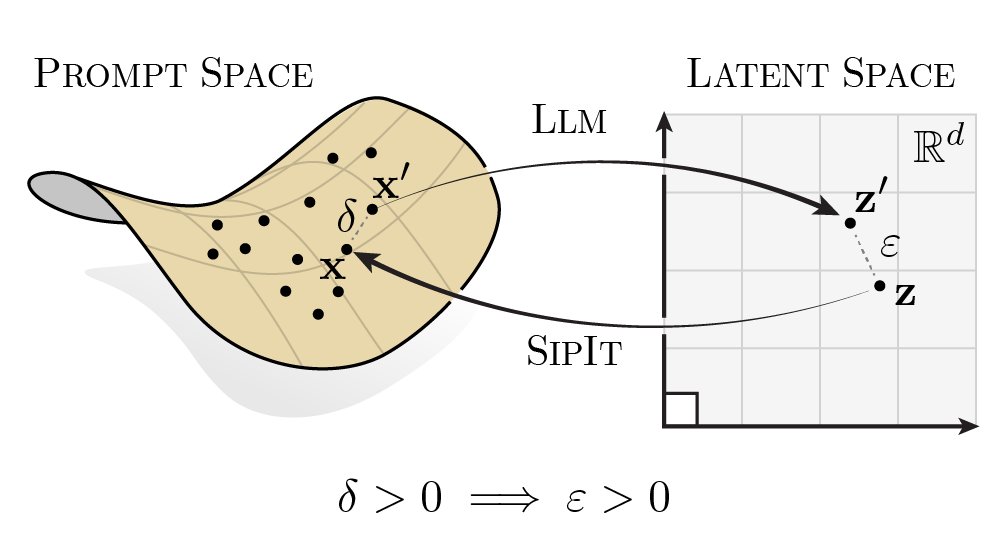
LLMs are injective and invertible.
In our new paper, we show that different prompts always map to different embeddings, and this property can be used to recover input tokens from individual embeddings in latent space.
(1/6)
BREAKING NEWS
The Royal Swedish Academy of Sciences has decided to award the 2025 Sveriges Riksbank Prize in Economic Sciences in Memory of Alfred Nobel to Joel Mokyr, Philippe Aghion and Peter Howitt “for having explained innovation-driven economic growth” with one half to Mokyr “for having identified the prerequisites for sustained growth through technological progress” and the other half jointly to Aghion and Howitt “for the theory of sustained growth through creative destruction.”
#NobelPrize
Google users who encounter an AI summary are less likely to click on links to other websites than users who do not see one. But Google won't kill the content market...[1/3] https://t.co/Dqua9pTeft
...nor has incentive to do so. However, we can expect a reduction of content and providers, but not everywhere. Competitive markets and those with barriers to entry are more resilient to Google AI summaries. Why? In a recent published article, we answered this and more [2/3]
Happy to share our latest work! GenAI may reduce content and increase its price when it summarizes content that can be found on the Web, such as Wikipedia or news articles. But not all markets will suffer the same fate...
Moreover, we find that there is a relationship between the number of creators pre- and post-GenAI and the "summarization effect". We hope this and other results may help others estimate the effect of GenAI in digital markets.