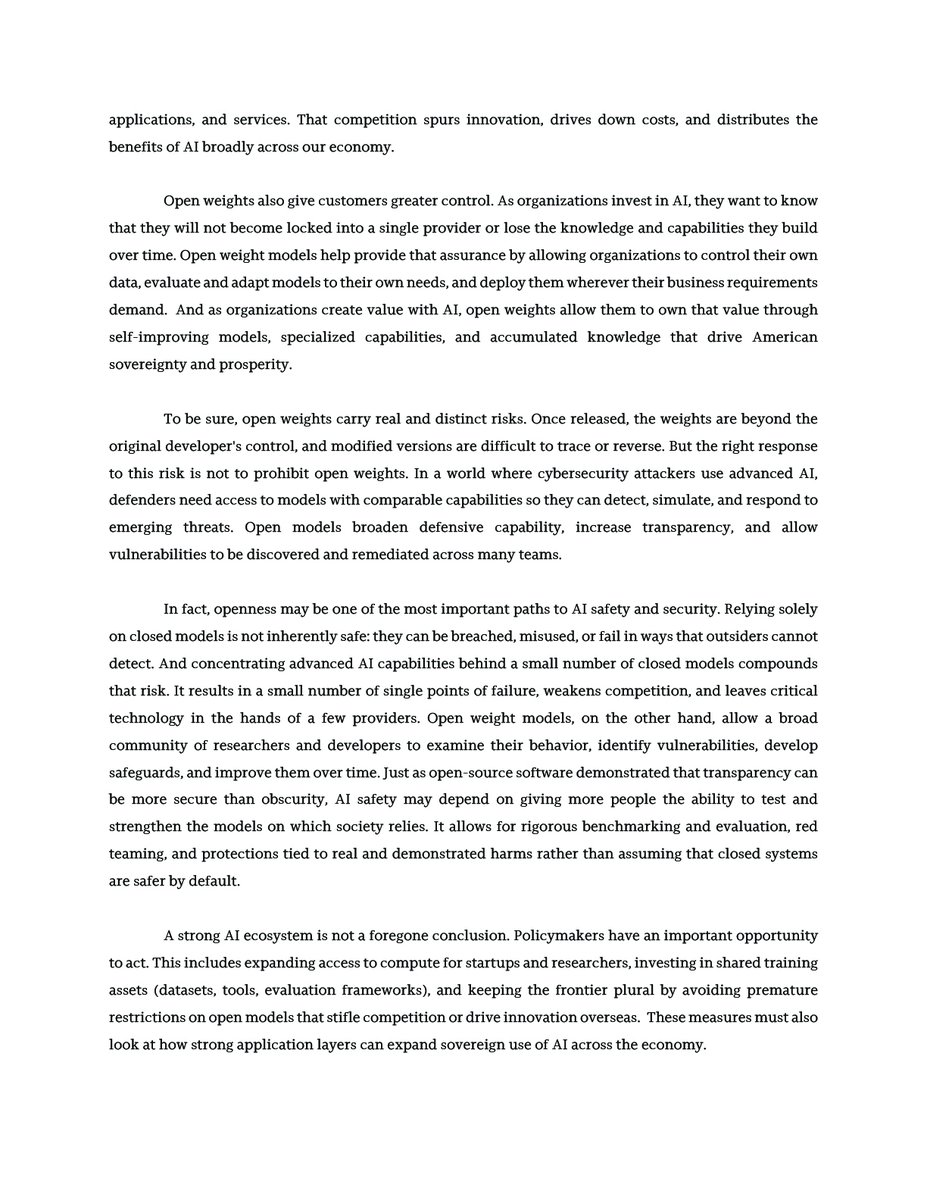
For my first post, I’m sharing a letter @NVIDIA signed on why open models matter.
AI will transform every industry, power every company, and be built by every country.
Open models strengthen safety and cybersecurity, accelerate innovation and diffusion, and enable sovereignty.
The world needs both frontier closed models and frontier open models.
https://t.co/AUKzoQ5Ikb
Wow.
NVIDIA just dropped the clearest, strongest letter yet on open-weight models — co-signed by Microsoft, Palantir, ServiceNow, Box, me and a growing list of real builders.
Read it. Internalize it. Share it.
Open weights are not a risk to American leadership.
They are American leadership.
They expand access so startups, universities, hospitals, factories and main-street businesses can actually use frontier capabilities instead of renting them from three closed labs.
They create real competition. They give companies sovereignty over their own models and data.
They strengthen security through transparency instead of hoping a handful of black-box providers never get breached or decide to gatekeep.
The letter says it perfectly:
“Policymakers have an important opportunity to act… keeping the frontier plural by avoiding premature restrictions on open models that stifle competition or drive innovation overseas.”
Exactly.
Which is why we have to push back hard and now on Dario Amodei and Sam Altman.
Both have spent the last two years lobbying Washington for exactly the kind of restrictions this letter warns against — framing open weights as an existential danger while their own closed models sit behind high walls and high prices.
Their solution always somehow ends with fewer competitors, higher barriers, and more control concentrated in the same few labs that already dominate.
That is not safety.
That is moat protection dressed up as safety.
NVIDIA and its partners just put the opposite case on the table in public: openness is how America wins. Diffusion is how America wins. A plural frontier is how America wins.
If we let the closed-lab lobby write the rules, the only “open” models left will be the ones coming from overseas.
The letter is out.
The case is clear.
Push back now.
Open weights.
American leadership.
No premature restrictions.
NONE!
Open-weight models are essential to a healthy AI ecosystem. Together with others across our industry, we are outlining a path for open-weight models to strengthen American competitiveness and expand economic opportunity, while protecting national security. https://t.co/Tr0sAzAxTD
An important piece from Demis. We need more of this kind of thinking. A good reminder that the goal is a frontier ecosystem that promotes innovation and choice, while avoiding any one model drop that breaks the world!
During a Bloomberg interview, Yann LeCun (@ylecun ) explains why LLMs are limited in terms of real-world intelligence during a Bloomberg interview.
"Language is a very approximate, reduced, quantized, and simplified description of the world, and LLMs can only deal with discrete sequences of symbols. The world is much more complicated than language.
The biggest LLMs are pre-trained on the totality of all the publicly available text on the internet. That’s about 20 trillion words, or 30 trillion tokens.
A token is about 3 bytes. So total 10¹⁴ bytes of text.
This is the amount of data a four-year-old has seen through vision during four years. Now, the text, though, would take 400,000 years to read?
So, there is enormously more data from sensory input, like vision, touch, and everything else, than there could ever be through language."
A child does not need 400,000 years of reading to understand cups, doors, balance, faces, falls, or heat, because the body is already collecting dense feedback from vision, touch, motion, and consequence.
Text strips most of that away.
It turns a living scene into symbols, then asks the model to infer the missing world from traces left by people describing it.
That is why an LLM can sound fluent about physics and still have no native sense of how fragile glass feels in a hand.
Moravec’s paradox names this reversal: the things humans find intellectual can be easier for machines than the things toddlers do without applause.
The hard part is not producing an answer, but building a model of the world that survives contact with weight, friction, surprise, and failure.
----
Link to the full video on Bloomberg's site. Link in comment.
📢 Our next episode is out!
Dr. Mekayla Storer at @SCICambridge discusses how mammalian digit tips regenerate after injury, focusing on the formation of the #blastema and the cellular and molecular mechanisms that distinguish regeneration from scarring.
Tune in now: https://t.co/7sVvH16Y22
NVIDIA CEO, Jensen Huang:
"Nobody writes prompts anymore. The new job is to write and handle loops."
This is the shift that's going to define the rest of 2026.
53 minutes of pure insight from one of the richest men on earth.
Watch it, then read the full guide on how to actually use loops below.
You have noticed it. ChatGPT feels dumber than it used to. Your prompts that worked six months ago produce worse results now. The writing sounds flatter. The ideas sound safer. The internet itself feels like it is shrinking. Every article reads the same. Every email sounds the same. Every answer sounds like it was written by the same voice.
You thought it was you. It is not you.
Researchers at Oxford and Cambridge published a paper in Nature proving what is happening. They call it Model Collapse.
Here is the mechanism in one sentence. AI trained on AI-generated data gets dumber every generation until it forgets what real human data looked like.
The internet is filling with AI-generated content. Blog posts. Articles. Reviews. Comments. Social media. AI companies scrape the internet to train the next generation of models. Which means the next generation of AI is being trained on the output of the current generation.
Each cycle loses information. Not randomly. It loses the rarest, most unusual, most creative parts first. The researchers call these the "tails of the distribution." The weird ideas. The unexpected perspectives. The things that made the internet feel human. Those disappear first.
What remains is the average. The safe. The expected. The bland.
Then the next generation trains on that. And loses more. And the next generation trains on that. And loses more. The researchers proved this is not a slow decline. Major degradation happens within just a few iterations. Even when some of the original human data is preserved.
They tested it on large language models. On image generators. On statistical models. The pattern was the same every time. The output converges toward a narrow, flattened version of reality that looks nothing like the original data.
The lead researcher put it plainly. "Large language models are like fire. A useful tool. But one that pollutes the environment."
The pollution is invisible. You cannot see which sentence on the internet was written by a human and which was written by AI. Neither can the AI that is about to train on it. And once the tails are gone, they do not come back. The damage is irreversible.
This is not a prediction anymore. It is a diagnosis.
The internet you grew up on was built by humans writing things no algorithm would have written. Strange, personal, imperfect, alive. That internet is being diluted. One generation of AI at a time. And the models trained on what remains are learning a smaller and smaller version of the world.
Model Collapse is not a technical problem. It is a cultural one. The thing that made the internet worth reading is the thing that disappears first.
🚨 OPEN SOURCE AI IS LITERALLY UNSTOPPABLE 🚨
The legendary founder of Redis (Antirez) just dropped ds4 - a custom native inference engine built specifically for DeepSeek v4 Flash
This is earth shattering! Here is why:
DeepSeek v4 Flash is a quasi-frontier model with a massive 1M context window
You can now run it LOCALLY on a 128GB Mac using specialized 2-bit quantization
The architecture is reimagined—he moved the KV cache from RAM directly to the SSD disk! 🤯
We already know DeepSeek v4 Flash is insanely good for agentic loops - Now you don't even need the cloud to run it
Closed-source labs are burning tens of billions on massive GPU clusters while single brilliant developers are running frontier-level AI on laptops!
They told us open-source would be worthless against trillion-dollar monopolies
Instead, pure hacker culture + incredible open-weight models are completely rewriting the rules
Open Source will ALWAYS win 💕
RAG is broken and nobody's talking about it.
Stanford researchers exposed the fatal flaw killing every "AI that reads your docs" product in existence.
It’s called "Semantic Collapse," and it happens the second your knowledge base hits critical mass. If you've noticed your AI getting "dumber" as you add more data, this is exactly why.
Right now, companies are dumping thousands of documents into their AI, thinking it’s getting smarter.
When you add a document to RAG, it converts it into a high-dimensional vector.
Under 10,000 documents, this works perfectly. Similar concepts cluster together.
But past 10,000 documents, the space fills up. The clusters overlap. The distances compress.
Everything starts to look "relevant."
It is a mathematical law called the Curse of Dimensionality. In a 1000-dimensional space, 99.9% of your data lives on the outer edge. All points become equidistant from each other.
That perfect, relevant document you are looking for now has the exact same mathematical similarity as 50 completely irrelevant ones.
The Stanford findings are brutal:
At 50,000 documents, precision drops by 87%. Semantic search actually becomes worse than old-school keyword search.
Adding more context doesn’t fix the AI. It makes the hallucinations worse.
Your "nearest neighbor" search isn't finding the best answer anymore. It's finding everyone.
We thought RAG solved hallucinations.
It didn't. It just hid them behind math.
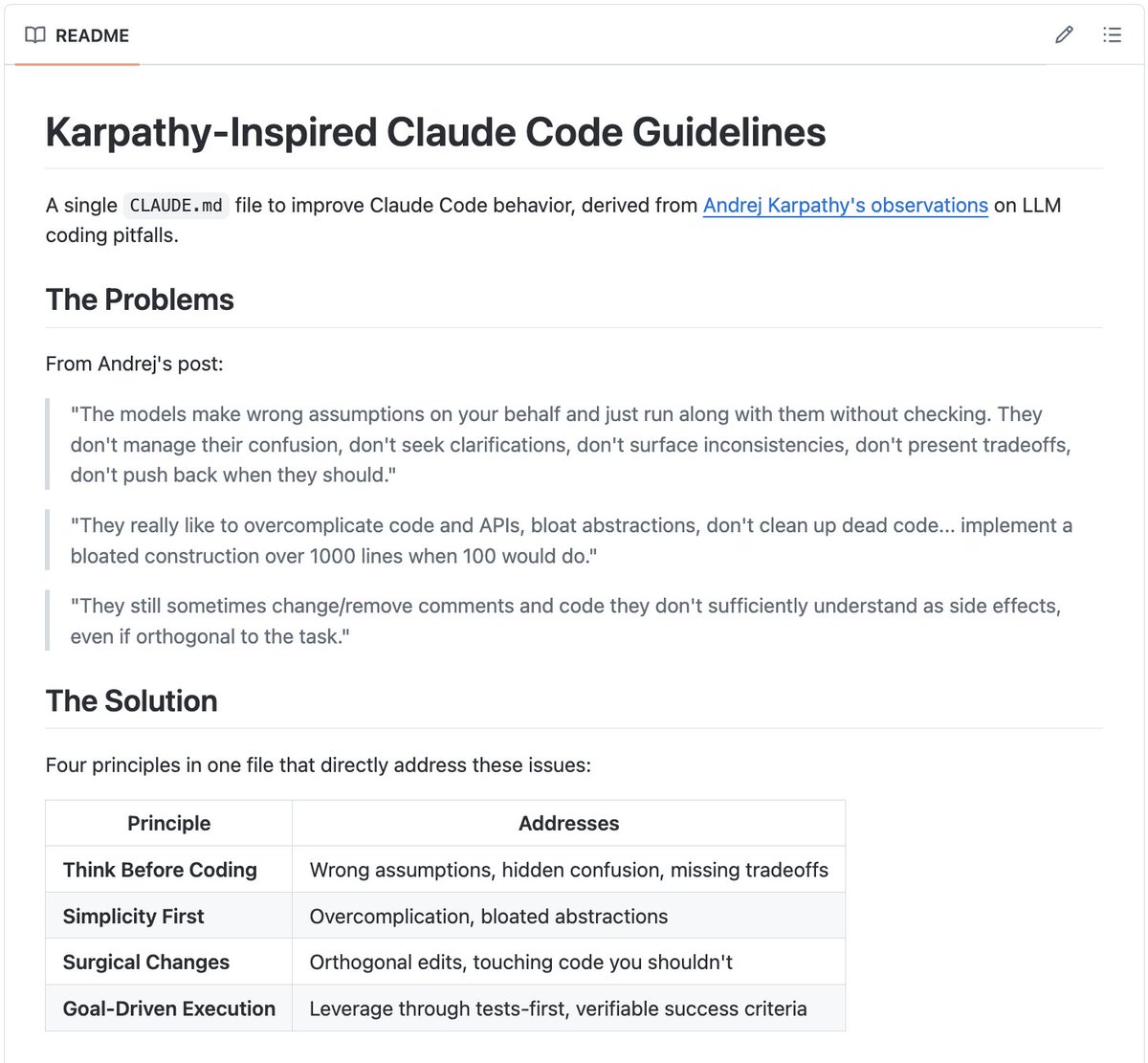
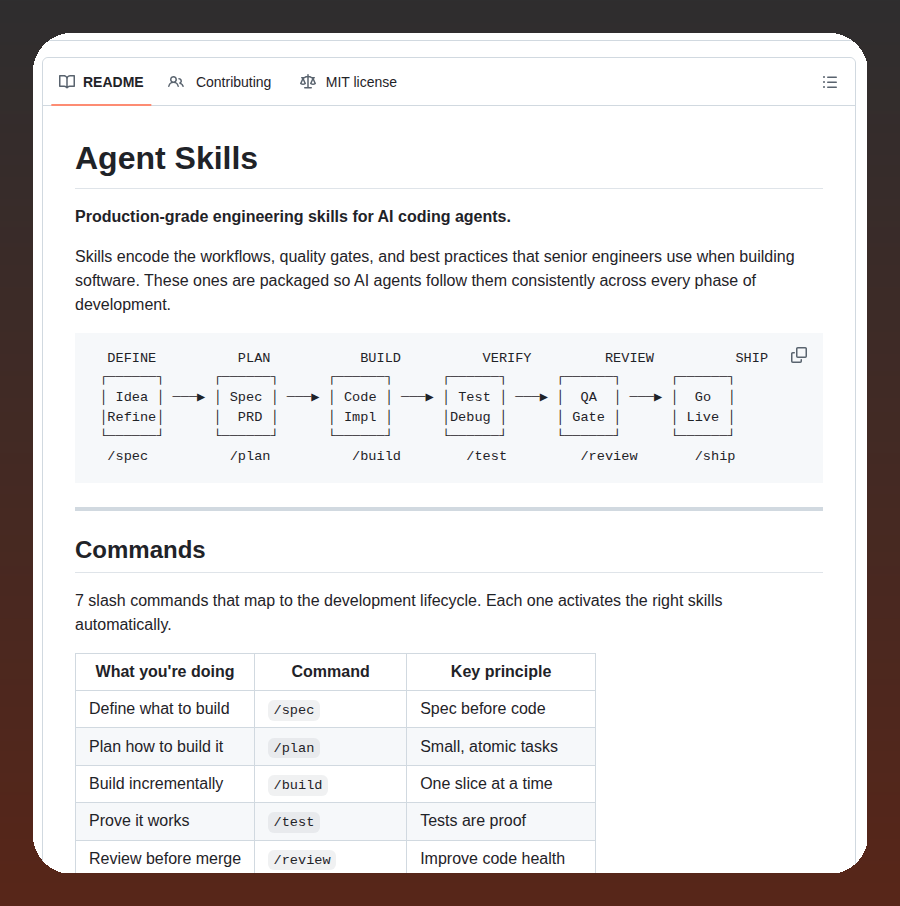
A single 𝗖𝗟𝗔𝗨𝗗𝗘.𝗺𝗱 file just hit 15K GitHub stars.
(derived from Karpathy's coding rules)
Andrej Karpathy observed that LLMs make the same predictable mistakes when writing code: over-engineering, ignoring existing patterns, and adding dependencies you never asked for.
If you've used AI coding assistants, you've hit all of these.
But here's the thing:
If the mistakes are predictable, you can prevent them with the right instructions.
That's exactly what this 𝗖𝗟𝗔𝗨𝗗𝗘.𝗺𝗱 does. You drop one markdown file into your repo, and it gives Claude Code a structured set of behavioral guidelines for your entire project.
This is a big deal.
- Built entirely around prompt engineering for AI coding assistants
- No framework, no complex tooling, just one .md file that shapes behavior
Developers are moving past "use AI to write code" and into "engineer the AI's behavior so the code is actually good."
The Claude Code ecosystem is growing fast, and the best tools in it aren't always software. Sometimes they're just well-crafted instructions.
100% open-source.
I've shared a link to the GitHub repo in the next tweet!
The person you will be in 5 years depends largely on:
1. The books you read
2. The food you eat
3. The habits you cultivate
4. The people you surround yourself with
5. The conversations you engage in
6. The mindset you adopt
7. The risks you take and lessons you learn