MD, MHS. Neurology Resident at Yale New Haven Hospital, Yale University. Focused on personalized medicine of brain health and neurology using genetics.
Excited to share our new work in Neurology: Does intensive BP lowering differ in deep vs lobar ICH? https://t.co/IFeVQKqFSF
Signals of heterogeneity across 3 ICH trials suggest location-specific effects.
IPD meta-analyses and targeted trials are needed.
@mxhawkes@GuidoFalconeMD
A new study led by @SanticlocMD, a resident in the Department of Neurology, demonstrates how a genotype linked to Alzheimer's disease can also increase an individual's risk of intracranial hemorrhage, when prescribed a common anticoagulant.
https://t.co/s8S50S2uQw
Very happy to share our new paper looking at polygenic resistance to blood pressure treatment and risk of stroke. Clinically meaningful … and ACTIONABLE!
Thank you @shufanhuo for leading the charge!
Paper
https://t.co/q2dJu7aSmi
@NeurologyYale@YaleNeuroICU
New study out: 📊
In neurointerventional surgery, women remain only 1 in 10 authors.
First authorship ↑ (10%→17%), but senior/last authorship barely moved (6%→9%).
Progress is happening, but equity in leadership is still far away.
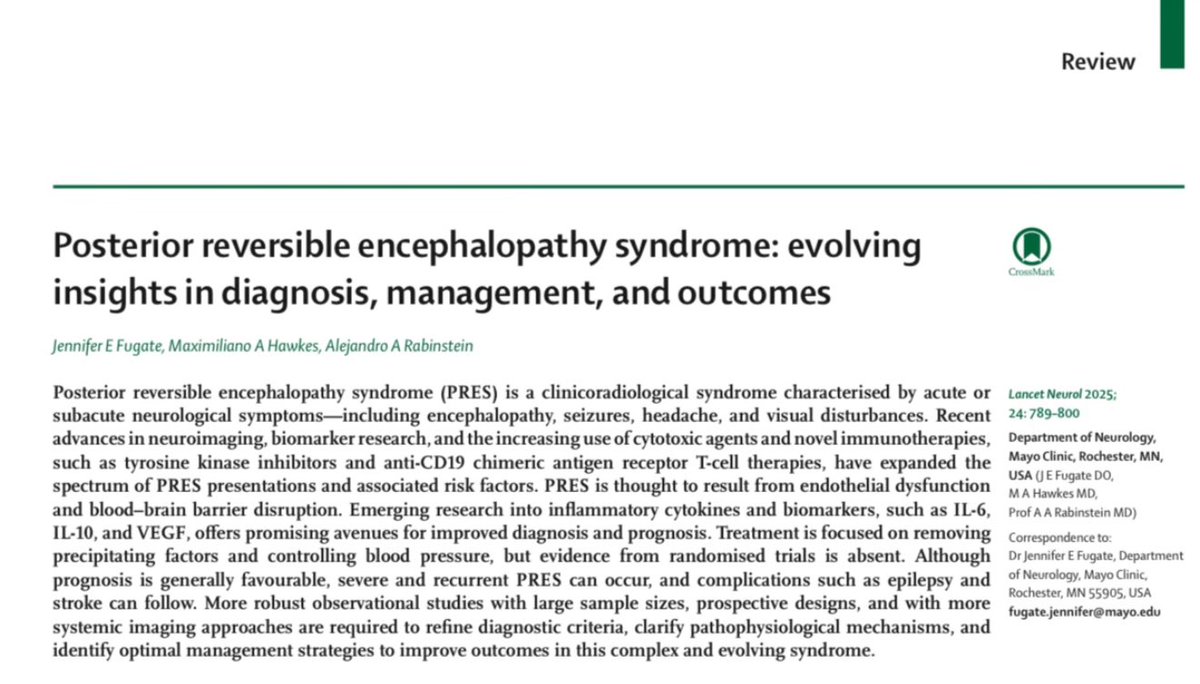
Check out our latest article exploring the advances in posterior reversible encephalopathy syndrome: pathophysiology, diagnosis, and treatment.
https://t.co/ljp992u2Bn
Genetic information can both inform pathophysiology and guide patient selection.
Happy to share our new study on APOE e4 and risk of intracranial hemorrhage in AF patients anticoagulated with apixaban.
Take a look!
https://t.co/PkTnsRXOcT
@NeurologyYale@YaleNeuroICU
Having an APOε4 allele may be risk factor for brain hemorrhage with apixiban, a commonly used blood thinner for atrial fibrillation
https://t.co/SmIqMiSdDt
Beyond excited to see our paper online! @JAMANeuro
We show how genetics (APOE ε4) may help us manage the complex balance of bleeding and thrombotic risk in atrial fibrillation patients on apixaban.
Huge thanks to @GuidoFalconeMD and @MrDisability for their mentorship.
APOE epsilon ε4 is a significant risk factor for intracranial hemorrhage in patients with atrial fibrillation on apixaban. https://t.co/WdEGPe62BN @sheth_kevin@MrDisability
Thrilled to see our new paper in print! 🧠📄
While intensive BP lowering helps in ICH, it’s unclear if both deep and lobar bleeds benefit equally. Take a look:
https://t.co/4f0v26tPEo
Immensely thankful to my mentors @GuidoFalconeMD and @mxhawkes