(2/2) I not only learned the four forms of Negation (auxiliary, adverbial, morphological, negation with no) but also understood that we can even express negation without "no". This got me thinking about how to say "no" in an easier way in the future #ling107f22#finalthoughts
The most memorable thing I've learned in LING 107 is Negation. I'm a person who has a hard time rejecting others because I am always afraid that my rejection will hurt others' feelings. In this class #finalthoughts#ling107f22 (1/2)
There is a saying that children are more likely to be influenced by older siblings. This is the case in our family, my daughter loves to imitate her old brother's (my son's) way of speaking. So I often tell my son to try to set a good example for his sister. #ling107f22
My language role model is my older sister, Jocelyne. When she started kindergarten, she had a difficult time adjusting because my parents mostly spoke in Spanish at home. Joce is the oldest out of the 3 of us (her, my younger sister, and me)... #ling107f22 (1/3)
@SJSUDave He was talking about the Irvington community park near my house, and I guess the neighbor thought the same thing. Because we didn’t drive either :)
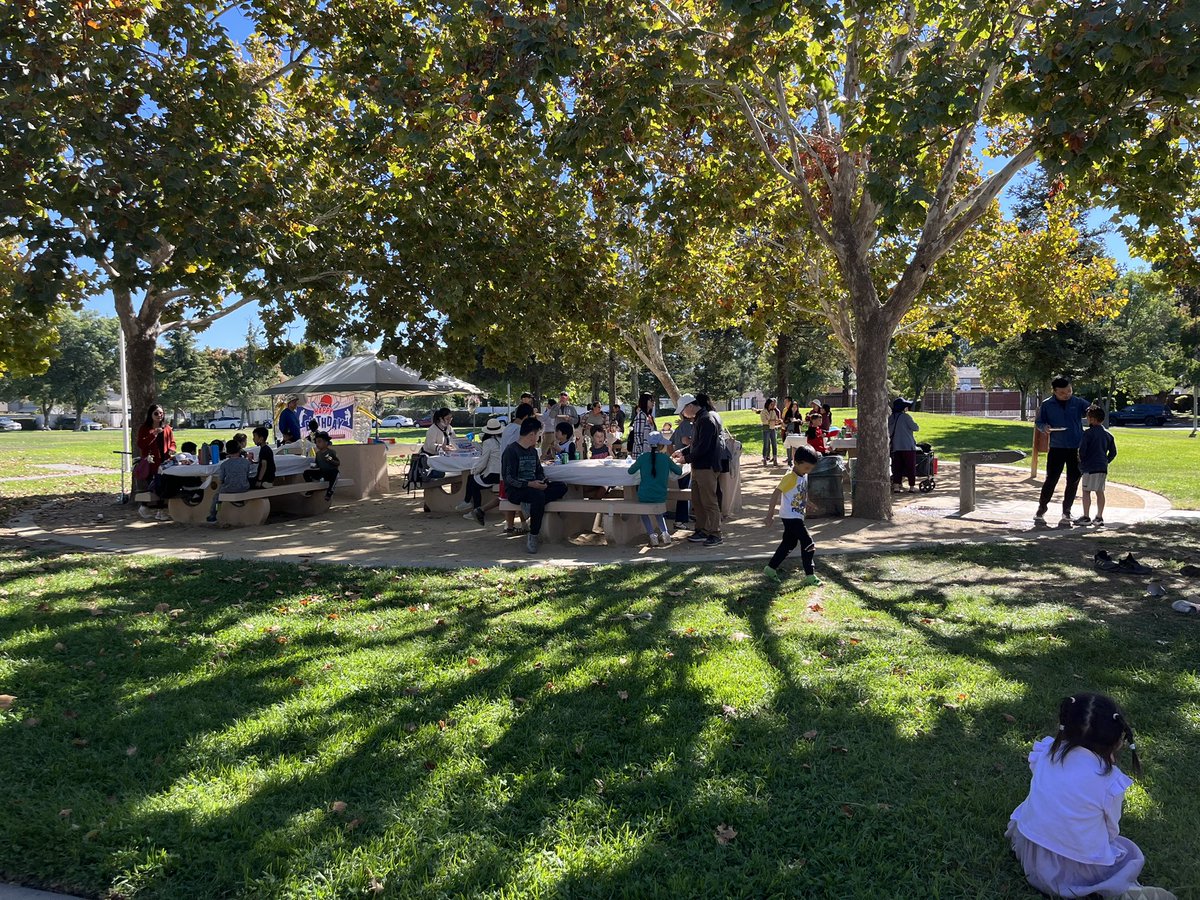
On Saturday two weeks ago, as we were heading out to a party, a neighbor asked, “Hey, where are you going?” “We’re going to the park, my friend is having a birthday party there today!” My son replied. He didn’t name the park because he assumed the neighbor knew it. #ling107f22
@OscarLing107 Hi, Oscar: I think the most common way to borrow words is transliteration, which is to use foreign words by transferring them to similar pronunciations in the native language. For example 沙发(sofa), 麦克风(microphone) in Chinese, and Kungfu (功夫), wonton (馄饨) in English.
@KylaPrince8 Hi Kyla, I think "to" is mostly used as a preposition to express a direction, a purpose, or an infinitive, such as "he's going to school". And "too" is an adverb meaning "also" --I'm going to school, too, or “to an excessive degree” --too much (because it has two 0's, haha).
and there is no difference between the verbs following singular or plural subjects. If your first language is not English, I wonder if there is a change in the verb form? (2/2) #Ling107f22
The different forms of verbs challenged me when I first started learning English. For example, "I'm eating now", "I've already eaten", or "I'm going to eat". In Chinese, the verbs are the same at different times, (1/2) #Ling107f22
" Would you close the door, please?" I continued. She replied, "Of course!" It's very interesting, even a three-year-old wants to be treated politely. (2/2) #ling107f22
Modals have a magic power that makes your request easy to accept. Yesterday I said "close the door" to my three-year-old daughter, who came back from preschool. She didn't seem to hear and went straight to the living room to play. (1/2) #ling107f22
I can easily understand what my instructors (Dr. Malinowski, and Dr. Spitzer) are talking about. They speak slowly and clearly. This inspired me to change the way I speak. (3/3) #ling107f22
The first to influence the way I speak is my cousin. She is pretty and polite and is always praised by my family. To me at 8 years, Everything about her at 16 was amazing. Including the way she speaks-fast and loud. So I began to consciously speed up my speech.(1/3) #ling107f22
This effect is even reflected in my learning of English, which makes my accented pronunciation more difficult to understand. I've recently found that while I often have trouble following the conversations of native speakers, (2/3) #ling107f22
They say happiness is in a beautiful house, on a high-quality island. But, I found that it was hidden in the corner of the two quietly blooming flowers. #cnftweet#ling107f22
(2/2)the sign is very effective as no cars can be seen on the street. When accidents and disasters occur, it is very important to keep the road clear, because every minute on the road is a fight for life. So, it's necessary to leave the fire lane in the community. #ling107f22
Negation with "no" is a more common expression on prohibition signs. I took this picture when I was walking through the block in the morning. It tells that parking is not allowed here because it's a fire lane. Otherwise, the car may be towed away. Obviously... (1/2)#ling107f22
I was confused when the professor in my ECE class asked us to give a ‘take away’ for a book. I thought about it for a long time and also asked my classmate. I later put it in context and speculated that perhaps my instructor was asking what I had learned from the book #Ling107f22