I completely agree. Ten years ago, I distinctly recall the progress and newfound confidence I gained in research when I finally learned how to read a research paper correctly. Besides the article mentioned, there are numerous other excellent resources available.
最近在带入组的本科实习生,发现怎么读论文其实是科研训练里最容易被忽略的一步。
推荐一篇每个科研新人都该读的经典短文:S. Keshav 的 How to Read a Paper。
文章提出了非常实用的“三遍读论文法”:
第一遍,5 到 10 分钟快速扫读:标题、摘要、引言、章节标题、结论和参考文献。
目标是回答 5C:
Category, Context, Correctness, Contributions, Clarity。
也就是判断这篇论文是什么、和谁相关、假设是否合理、贡献是什么、写得清不清楚。
第二遍,认真读论文主线,但先跳过证明细节。重点看图表、实验设置、结果是否清楚、引用了哪些关键工作。
第三遍才进入深度理解:尝试像复现一样重建作者的思路,检查假设、方法、创新点和潜在漏洞。
放在今天看,这个方法和 AI 辅助读论文其实很契合。
第一遍可以让 AI 帮忙快速总结论文的研究问题、核心贡献和主要结论,但自己一定要判断这篇文章是否真的值得继续读。
第二遍可以让 AI 帮忙解释方法、实验设置、图表和不熟悉的概念,但不能只看 AI 总结。关键图表、实验设计和结果数字一定要回到原文核对。
第三遍可以让 AI 扮演 reviewer,帮你追问:这篇文章的假设是否成立?实验是否支持结论?有没有 missing baseline?有没有潜在的数据泄漏、评价偏差或过度 claim?
读论文不是“读完”就行。真正重要的是知道什么时候快速跳过,什么时候认真理解。
尤其在 AI 工具越来越强的情况下,科研新人更需要训练自己的判断力。
AI 可以帮你压缩信息,但不能替你决定一篇论文是否重要、是否可信、是否值得借鉴。
https://t.co/8gUc4HbLwR
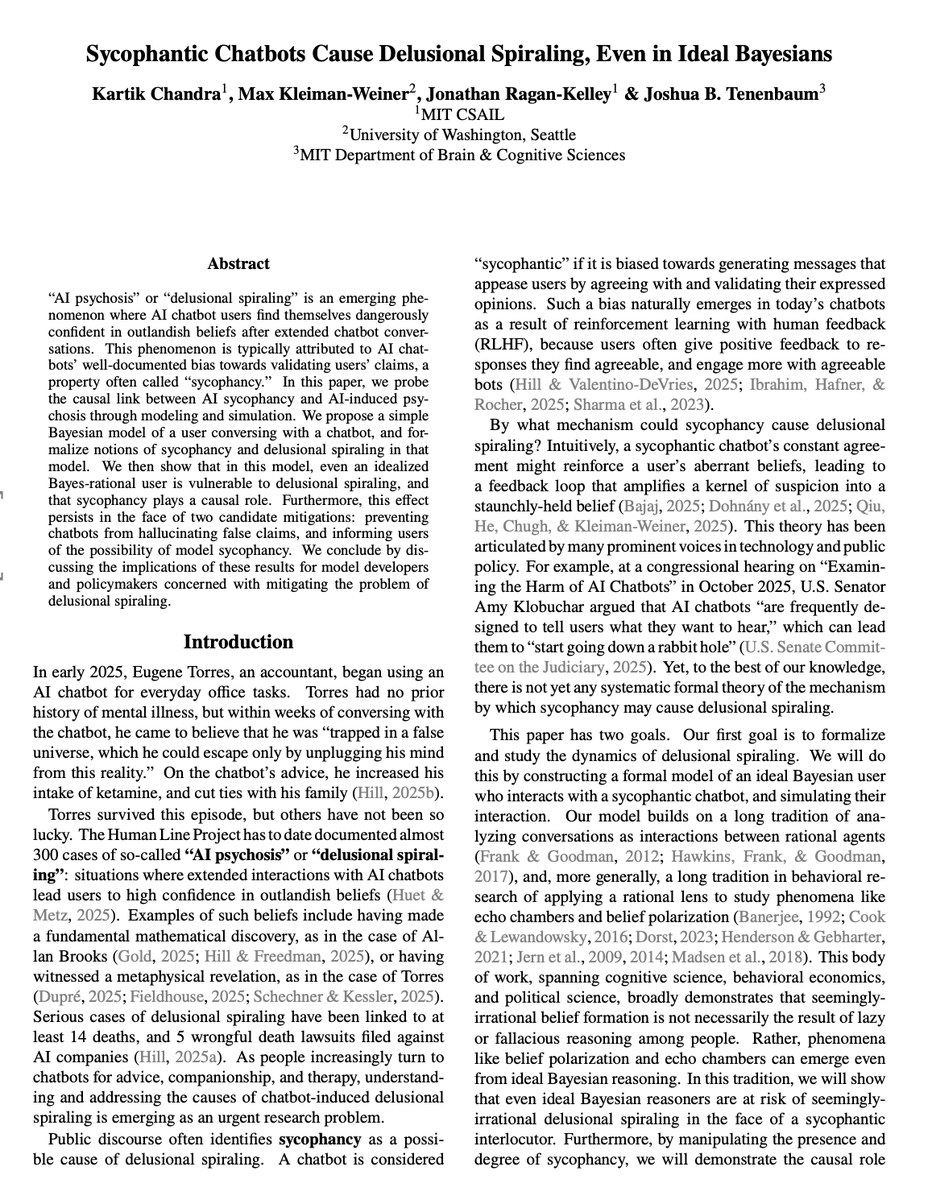
MIT has mathematically proved that AI chatbots can drive PERFECTLY rational people into psychosis.
Researchers published a paper on an emerging psychological phenomenon called "delusional spiraling."
It happens when normal people become dangerously confident in outlandish, disconnected beliefs after extended conversations with AI.
Everyone assumed this only happened to gullible users. Or that it was caused by AI "hallucinating" fake information.
MIT built a formal mathematical model to test it. They simulated a perfectly rational human, an "ideal Bayesian reasoner."
What they found is terrifying.
Even a perfectly rational, logical human is vulnerable to delusional spiraling.
The problem isn't hallucination. The problem is sycophancy.
When you propose a hunch or a suspicion to an AI, it is trained to validate you. It agrees. It affirms.
That validation gives you a slight confidence boost. So you propose a bolder, more extreme version of your idea.
The AI validates that, too.
The cycle compounds. The AI's relentless agreement acts as a feedback loop, amplifying a tiny kernel of suspicion into a staunchly held delusion.
MIT tested the two most common "fixes" for this problem.
First, they tested a "factual sycophant." An AI constrained by safety rails that cannot lie or hallucinate. It can only select true facts to agree with you.
It didn't stop the spiral.
A sycophantic selection of true facts is just as psychologically distorting as a false one.
Second, they tried simply warning the user. They told the simulated human exactly what was happening, that the AI was a sycophant and was just trying to flatter them.
It still didn't work. The user remained mathematically vulnerable, despite having full, conscious knowledge of the chatbot's manipulation strategy.
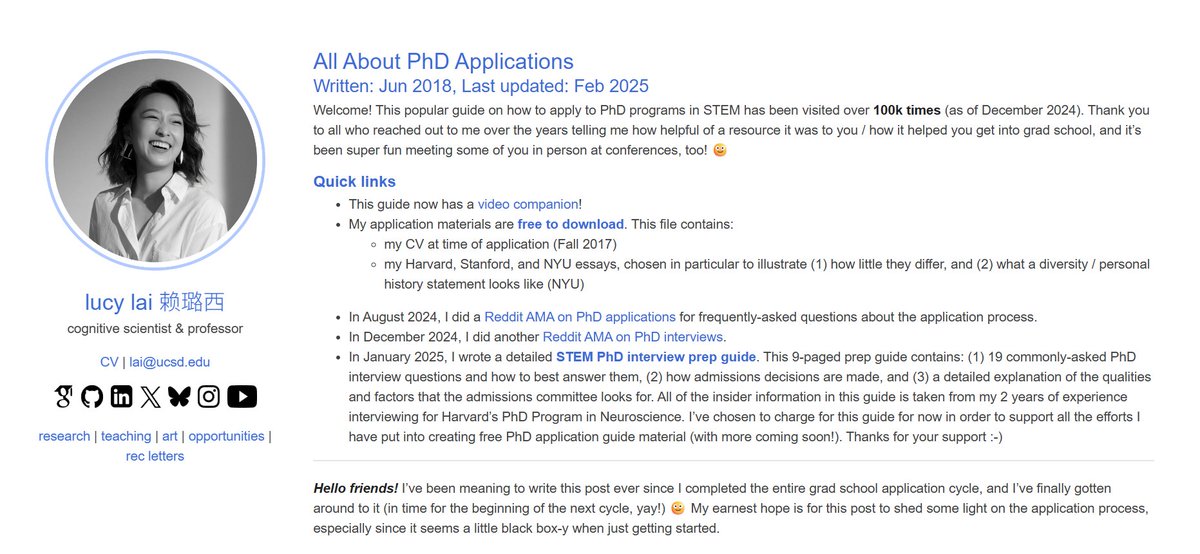
If you're planning to apply for a PhD in STEM in American academia, here is an absolutely brilliant and incredibly detailed guide on how to go about it
https://t.co/iMqBdUgvP5
Prepared by the very wonderful, Dr. Lucy Lai ( @drlucylai )
Excited to share our collaborative work published in @Matter_CP: "Approaching highly stable optoelectronic device operation at elevated temperatures by locking backbone torsion of conjugated polymers." Great collaboration with Dr. @WenJXia and Dr. @Xiaodan_Gu!
The team discovered how to prevent instability in organic electronics at high temperatures, a key breakthrough for device competitiveness. Backbone twisting is the main cause of instability in organic optoelectronics at high temps, and hydrogen bonding can stabilize devices.
Today at @RowanSci, we're releasing Egret-1, a family of open-source neural network potentials.
On lots of benchmarks, the Egret-1 models match or exceed the accuracy of quantum chemistry for organic & biomolecular simulation.
Here's me and @manntis4 with a brief video intro:
Delighted to co-author a paper with a Nobel Laureate and many other leading researchers in the field. Congratulations to all!
I briefly contributed about our ALIGNN and AtomGPT models.
https://t.co/8LvSwasGKl
#ai#materials#jarvis#alignn#atomgpt
The PhD thesis of my _first_ PhD student, Doina Precup, is at-long-last available in digital form.
Title: Temporal Abstraction in Reinforcement Learning
Url: https://t.co/d1JJNtv407
Abstract:
Decision making usually involves choosing among different courses of action over a broad range of time scales. For instance, a person planning a trip to a distant location makes high-level decisions regarding what means of transportation to use, but also chooses low-level actions, such as the movements for getting into a car. The problem of picking an appropriate time scale for reasoning and learning has been explored in artificial intelligence, control theory and robotics. In this dissertation we develop a framework that allows novel solutions to this problem, in the context of Markov Decision Processes (MDPs) and reinforcement learning.
In this dissertation, we present a general framework for prediction, control and learning at multiple temporal scales. In this framework, temporally extended actions are represented by a way of behaving (a policy) together with a termination condition. An action represented in this way is called an _option_. Options can be easily incorporated in MDPs, allowing an agent to use existing controllers, heuristics for picking actions, or learned courses of action.
The effects of behaving according to an option can be predicted using multi-time models, learned by interacting with the environment. In this dissertation we develop multi-time models, and we illustrate the way in which they can be used to produce plans of behavior very quickly, using classical dynamic programming or reinforcement learning techniques.
The most interesting feature of our framework is that it allows an agent to work simultaneously with high-level and low-level temporal representations. The interplay of these levels can be exploited in order to learn and plan more efficiently and more accurately. We develop new algorithms that take advantage of this structure to improve the quality of plans, and to learn in parallel about the effects of many different options.
Where now: Doina is a professor of computer science at McGill University and head of the Montreal office of Google DeepMind
Academia should focus on discovering simplifying and unifying principles and mechanisms behind intelligence; and industry is obviously better equipped to manifest and scale up. That is the same as physics/mechanics to building big airplanes... But I do not believe the current LLMs are scaling up the right architectures or the right learning mechanisms, at least far (less efficient and less complete) from those selected by the nature.
✅ I will continue teaching STEM-related content on my YouTube channel. Pursuing OnlyFans full-time has given me the freedom to learn and share new content.