90% cheaper tokens sounds like a pricing story.
I think it’s actually an infrastructure story.
Anthropic just launched Haiku 5.5 at 90% lower per-token pricing for prompts under 100K tokens. But Anthropic also says the average cost reduction is closer to 75%, partly because the new tokenizer uses more tokens to complete the same work.
That distinction matters.
We’re entering an era where the economics of AI are increasingly defined by tokenomics. The question isn’t simply which model is smartest or which API is cheapest. It’s how many tokens your application needs to accomplish a task, how often it needs to call a model, how much context it carries forward, and how much work it can now afford to delegate to an agent.
And when tokens get cheaper, usage tends to go up.
That means more agents. More generated code. More autonomous workflows. More software dependencies. More opportunities for vulnerable code to make its way into production.
For security teams, this creates an interesting second-order effect.
The cost of AI is falling faster than the cost of managing the complexity AI creates.
We’ve spent a lot of time asking whether AI can write code well enough to replace parts of the development process.
I think the more important question is becoming whether our security infrastructure can keep up with the amount of code AI makes economically possible to produce.
Tokenomics is going to be a security conversation, whether security teams are ready for it or not.
I'm working on a new AI list for @Forbes, and I'm looking for surprising ways people are using AI agents. It could be a startup or an unusual way you're using AI to run your personal or work life. No coding agents; I'm looking for out-of-the-box use cases. Please reach out!
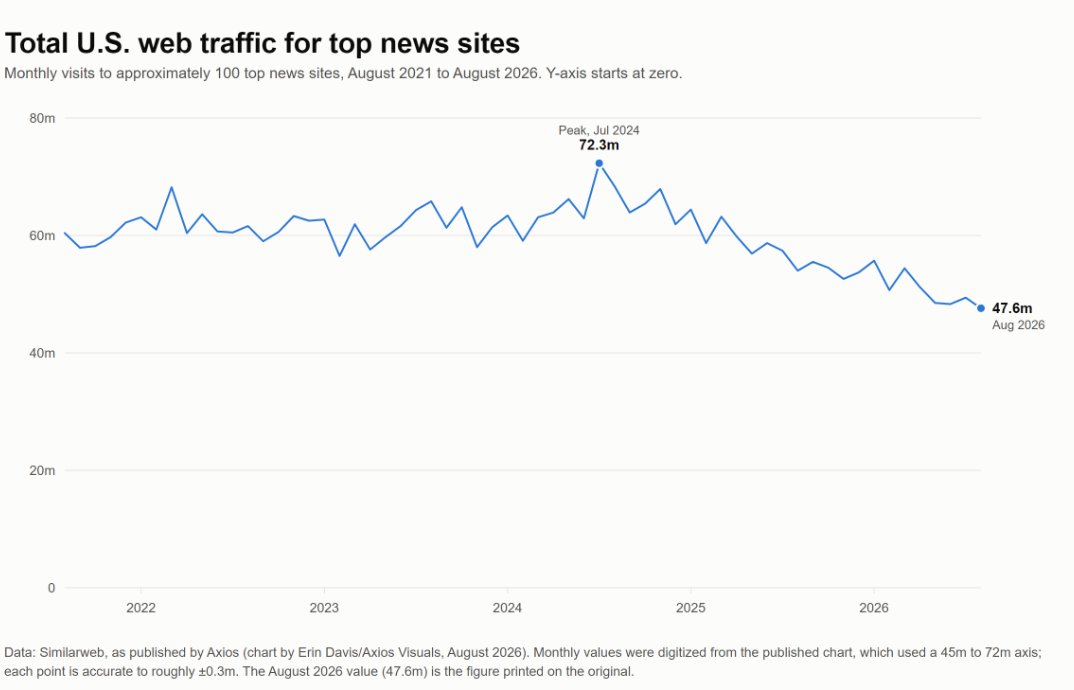
@ChrisCillizza@axios OK but I fixed the chart. Also if this is total US web traffic & not organic search traffic, it's hard to say whether search has collapsed as a traffic driver. (Did paid search decline? social referrals? Paywalls increase bounce? Orgs stop paying writers and start using AI?)
PR people get a lot of hate, and the bad ones are certainly frustrating to deal with sometimes, but great PR people are truly a godsend. They are brilliant and helpful and play such a valuable role in the media ecosystem these days as it becomes more and more of a nightmare to navigate. So shout out to the great PR people out there and I’m sorry for the times I’ve ever besmirched the profession!!
Google has Career Dreamer, an AI tool that suggests career paths based on your work experience, education, and skills.
It can also help generate a resume and cover letter tailored to those roles.
https://t.co/wE6WnJ03Tk
Palo Alto Networks warned customers that suspected state-sponsored hackers have been exploiting a PAN-OS firewall zero-day vulnerability for nearly a month.
https://t.co/P90Nmeu0wi
this is pretty cool
some MIT students turned a building into a giant playable game of Tetris on Saturday at midnight
rigged each window with LEDs
MIT students are on a diff level
@Reuters is hiring a media/social media editor. Biz, politics, culture. Reports to me. Drop me a line if you're interested or know of someone I should hit up.
Hey X! I'm a senior writer at WIRED and I'm shifting beats to cover the tech I'm most obsessed with right now—PREDICTION MARKETS.
Eager to hear tips on the industry at [email protected]
A cyber company used the government shutdown as content for a cheeky social post. Idk why I need to write this in 2025, but if any clients or other companies are reading this - please don't do this. That is all.