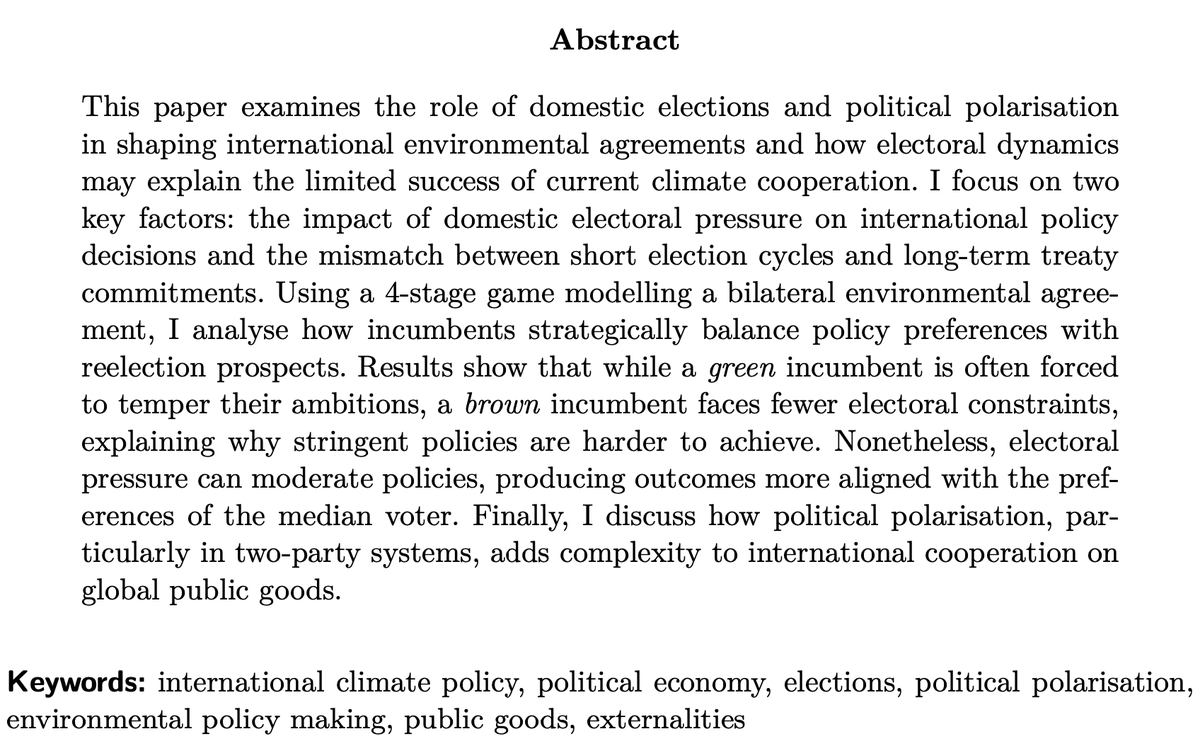
This asymmetry offers a possible explanation for the limited success of climate cooperation: In polarised settings, electoral pressure compels green incumbents to weaken their climate goals, while brown incumbents can keep their low ambition with minimal electoral cost. (8/8)
This political constraint means that ambitious agreements are systematically limited by the need to appeal to a median voter. Without concessions, the green party risks losing office, not only stalling progress but also potentially reversing it. 📉 (7/8)
The model reveals a key asymmetry: a brown incumbent can secure consensus treaties under a wide range of polarisation without needing to raise their climate ambition, while a green incumbent must invariably reduce their goals to remain competitive in polarised environments. (6/8)
This results in two treaty types: consensus🤝treaties, crafted for ratification across parties, and differentiation🙅♀️ treaties, supported only by one party, giving voters a clear policy choice. (5/8)
Incumbents face a trade-off between aligning treaties with their party's policy preferences or appealing to the median voter to improve reelection prospects, shaping the treaty’s ambition. (4/8)
I model a 4-stage game between two countries considering an emissions reduction agreement, with political competition between a “green” 🌿party and a “brown”🏭party in one of the countries. (3/8)
In this paper - which is more timely than I had hoped - I examine how elections in politically polarised settings affect climate cooperation. Electoral pressure can lead to "suboptimal" treaties, as governments make strategic concessions to enhance reelection chances. (2/8)
Interested in connecting with researchers thriving in diverse fields post-PhD/Postdoc? Join the Global SNSF Fellows Summer Meet on June 17. Engage in dialogue and network with fellow researchers. Register now: https://t.co/9VXmEnganI
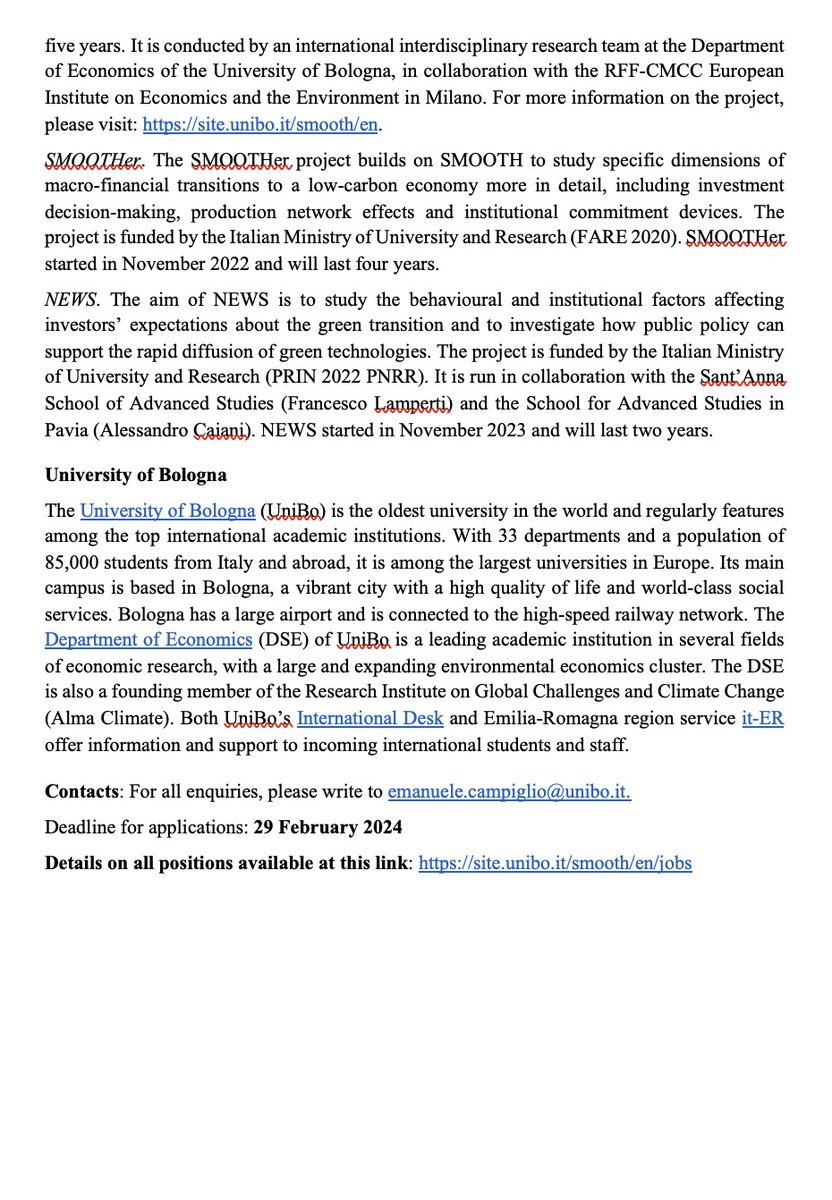
3 post-doc and 1 pre-doc positions open at @Unibo! Please circulate to anyone interested. All the info available here: https://t.co/c0OLj9Cq1X. Deadline for applications: 29 February 2024
The microeconomics group at the Uni Bern🇨🇭 is looking to recruit a new PhD student. We are a small but very active group and we offer quite good conditions.
Interested? Check out the ad at the link below and apply by 15. January 2024:
https://t.co/h80P92bGXk
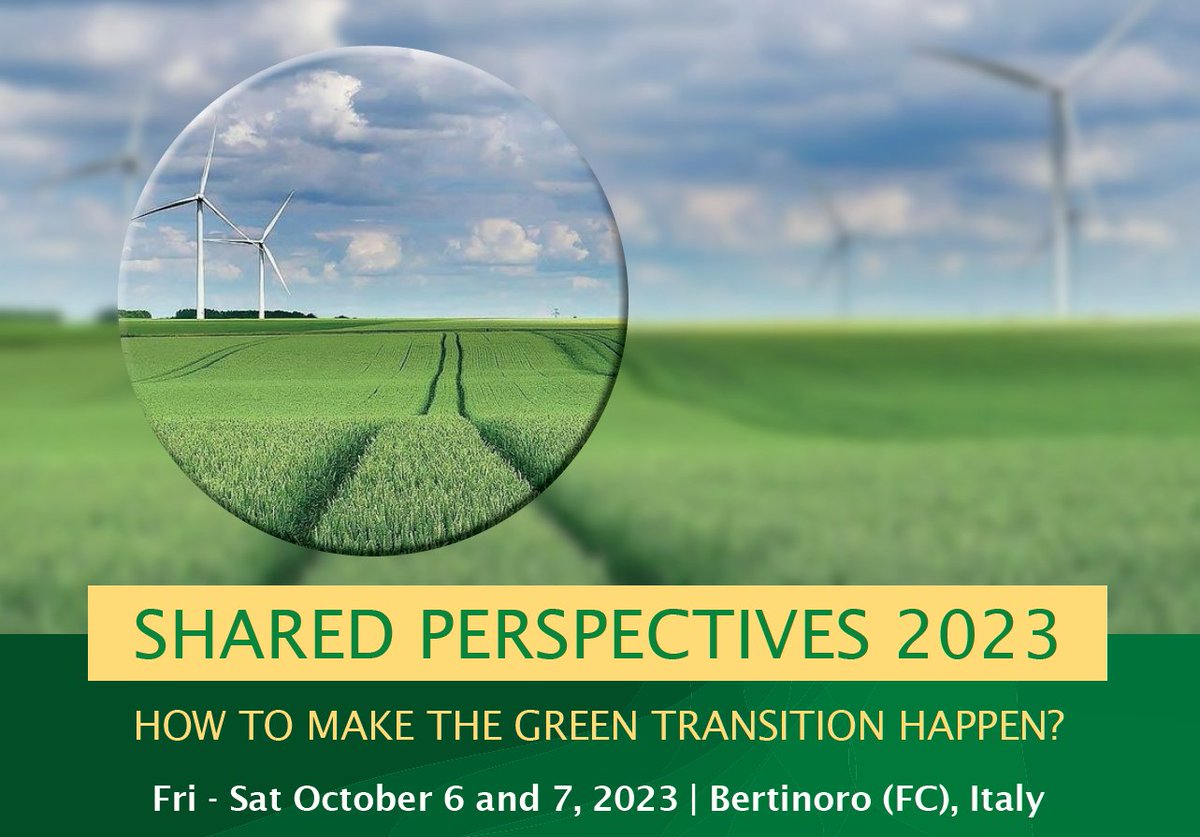
This happens next week!
SHARED PERSPECTIVES 2023
How to make the green transition happen?
Fri 6th & Sat 7th Oct
ONLINE PARTICIPATION POSSIBLE
Register at https://t.co/ne0diedX23
For more details, see ⬇️
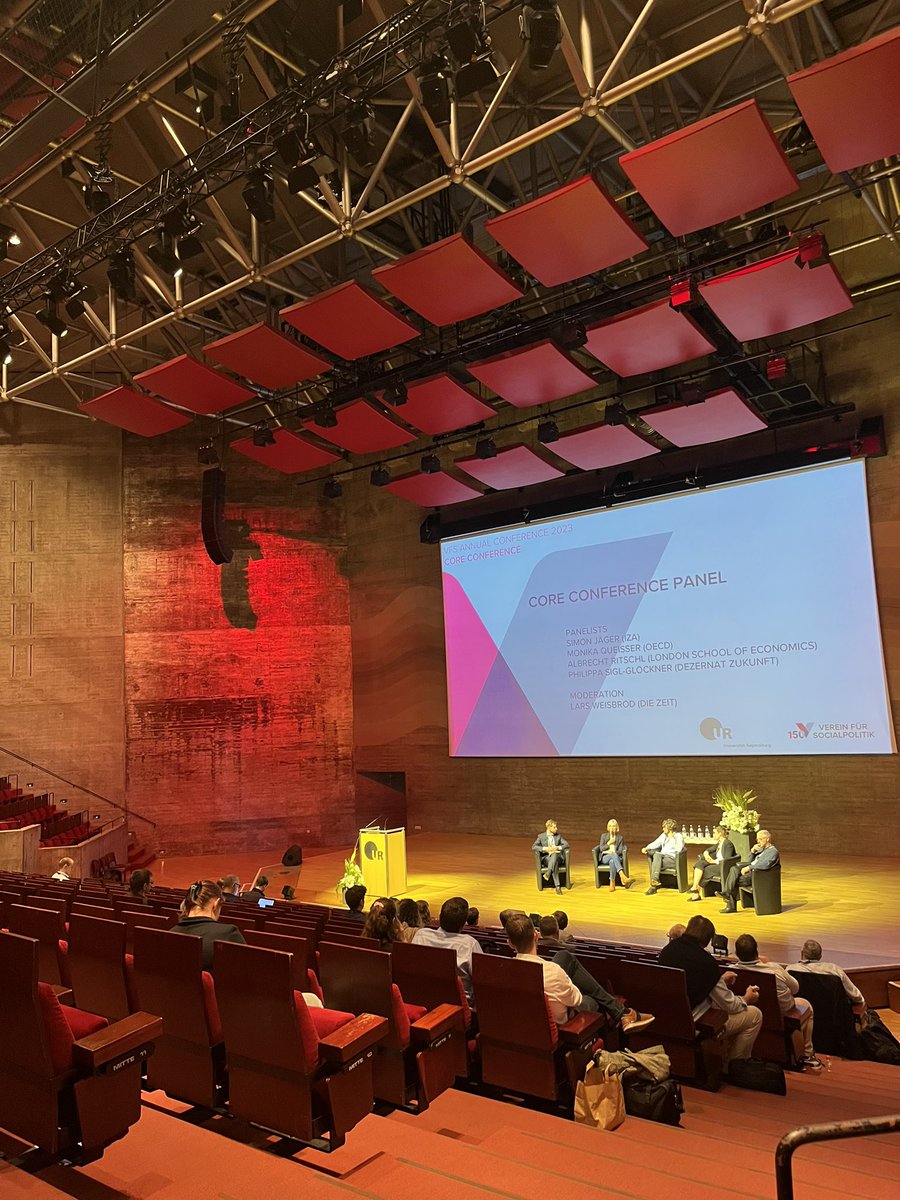
very interesting panel discussion on inequality and ‚the social question‘ in today’s society, concluding three intense & insightful days at the #VfS_conference2023#VfS_150
what an interesting day and great networking opportunity at the global snsf fellows summer meet at the @snsf_ch in bern today - discussing a more sustainable and equitable future for young researchers in swiss academia
Swiss-based academics: Here is a wonderful event opportunity coming up for past, current, and prospective SNSF fellows! Please mark August 29th in your calendar for the first summer meet of the Global SNSF Fellows in beautiful Bern #IchbinHannahCH https://t.co/NLuxr9hVAl
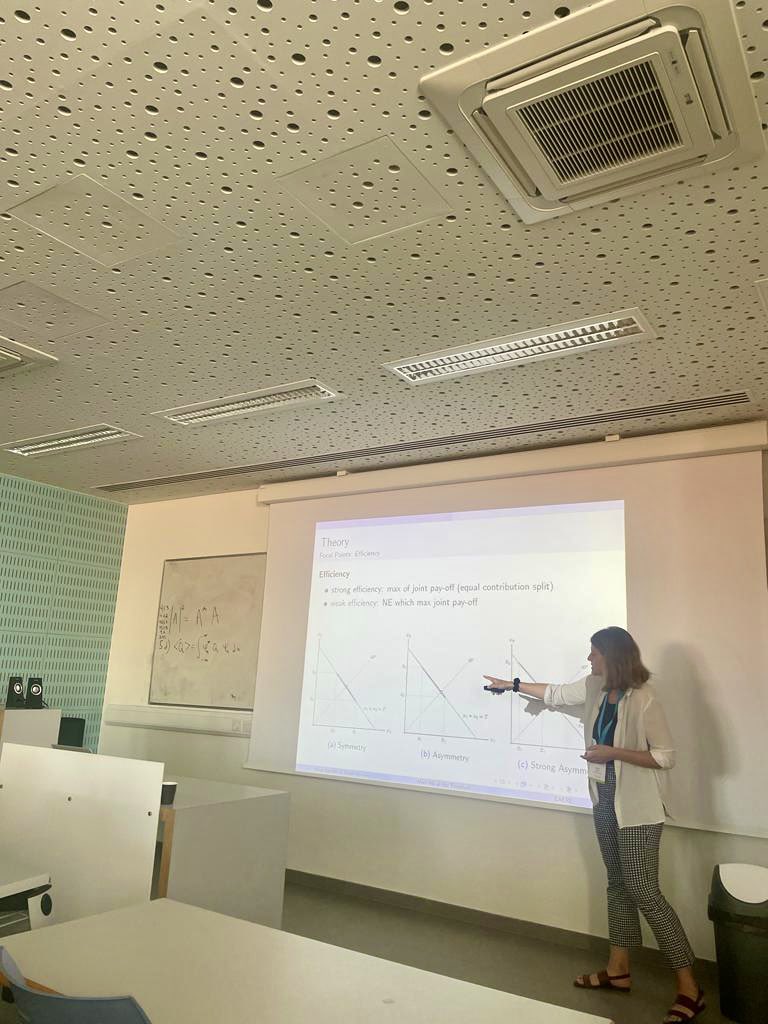
lovely first day at #EAERE2023 where I presented my newest experimental project in the ‚political economy of climate policies‘ session - from now on I can just sit back and enjoy😊
JOBS AVAILABLE! PLEASE SHARE!
Unibo is looking to hire associate / full professors in economics (any field). Expressions of interest deadline: JUNE 30TH.
We have a GREAT environmental / resource economics group -- embedded in an *excellent* department!
https://t.co/o6pIDEovYU
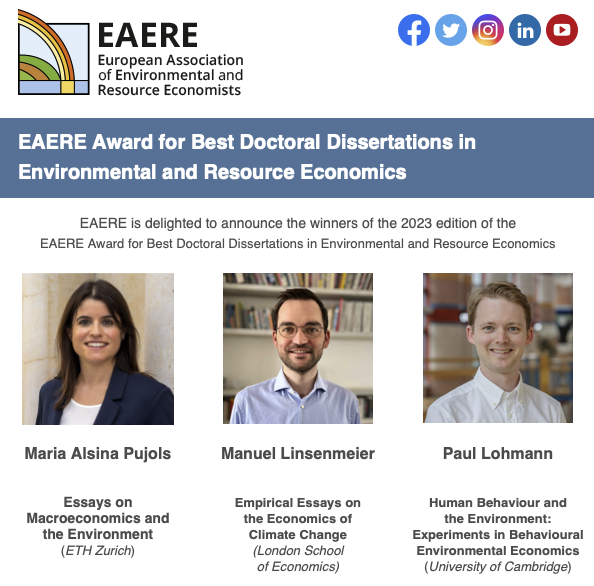
EAERE is delighted to announce the winners of the 2023 edition of the EAERE Award for Best Doctoral Dissertations in Environmental and Resource Economics: Maria Alsina Pujols @ETH Manuel Linsenmeier @LSEnews and Paul Lohmann @Cambridge_Uni
Warm congrats to all!👏🏻
Curious about Social Tipping Interventions? Check out the new website of the recently awarded ERC Consolidator grant GREEN TIPPING: https://t.co/X2QZqBzIEk @DSE_Unibo@Unibo
my work will revolve around political economy challenges of environmental policy, both from a theoretical and experimental perspective. happy to get in touch with anyone working on related topics🙂