Un desarrollador ucraniano creó un agujero negro en su terminal para obligarse a tomar descansos.
Cuanto más trabajas sin parar, más crece y deforma tu código con su lente gravitacional. Descansas y se encoge.
6 Open-Source Repos You Should Know If You’re Building AI Agents
Not just AI demos — these repos can help you build real, capable AI agents.
1. Haystack
Build production-ready AI agents and RAG pipelines with a modular Python framework.
Great for connecting LLMs, tools, retrieval, and custom workflows.
https://t.co/6Y718ejOT7
2. LlamaIndex
Build AI agents that can connect to your own data, APIs, and external tools.
Especially powerful for data-heavy agentic applications.
https://t.co/QbohueIy1Q
3. SmolAgents
A lightweight framework from Hugging Face for building powerful AI agents with minimal code.
Perfect when you want simple, code-first agent development.
https://t.co/lIpS7DjO9I
4. Semantic Kernel
Microsoft's open-source SDK for building AI agents and integrating AI into applications.
Supports agent orchestration, plugins, memory, and enterprise workflows.
https://t.co/H34OfXGldo
5. DSPy
Program and optimize LLM-based systems instead of manually tweaking prompts.
A powerful choice for building more reliable AI pipelines and agents.
https://t.co/rGPH2wKzUz
6. Agency Swarm
Build collaborative AI agent systems with specialized agents working together.
Useful for creating autonomous, multi-agent workflows.
https://t.co/jZvS1Y7hcA
All are open source.
Bookmark this for your next AI project.
Follow @DivyanshT91162 for more AI tools, open-source repos, and developer resources.
🚨Pásale esto a cualquier dev que use Claude Code o Codex
Crear un clon digital que coordine a tus agentes de código mientras los ves trabajar en una simulación tipo "The Office" ya es una realidad
Un desarrollador creó Munder Difflin
• 100% Gratis y Open Source
• Corre 100% local (cero fugas de datos)
• El usuario es el jefe o puede dejar a su clon digital orquestando a los agentes
📨Les dejo el repo y el link de Product Hunt en los comentarios
As a Backend Engineer building AI products, you must build these projects.
Systems that prove you can scale, secure & ship AI.
1.) LLM Gateway / Proxy
Build: Unified API proxy with retries, fallbacks, rate limits & per-key budgets across providers.
Why: Every AI product needs a reliable front door to the models.
2.) Token Metering & Billing System
Build: Per-user and per-tenant token accounting with usage-based billing via Stripe.
Why: AI unit economics decide whether the product lives or dies.
3.) Streaming Response Infrastructure
Build: SSE/WebSocket streaming with backpressure, reconnects & partial failure handling.
Why: Users judge AI by time-to-first-token not total time.
4.) RAG Serving Pipeline
Build: Ingestion → chunking → embedding → indexing pipeline with incremental updates.
Why: Retrieval quality is only as good as the pipeline behind it.
5.) Semantic Cache Layer
Build: Embedding-based cache returning stored answers for similar queries.
Why: The cheapest token is the one you never generate.
6.) Async Agent Job Queue
Build: Long-running agent tasks with checkpoints, retries & dead-letter handling.
Why: Agents take minutes, not milliseconds. HTTP requests cannot hold them.
7.) Tool Execution Sandbox
Build: Isolated execution for agent-generated code with timeouts & resource limits.
Why: Running untrusted model output without a sandbox is a breach waiting to happen.
8.) Multi-Tenant Knowledge Base
Build: Per-tenant vector stores with row-level metadata filtering & access control.
Why: Enterprise AI demands strict data isolation.
9.) Prompt & Config Versioning Service
Build: Registry for prompts, models & configs with rollback and A/B routing.
Why: Prompts are production code. They need version control and rollback.
10.) Eval Pipeline Backend
Build: Service that runs golden datasets on every deploy and stores score history.
Why: Quality gates need infrastructure, not vibes.
11.) Observability for LLM Traffic
Build: Tracing for prompts, completions, tokens, latency & cost per request.
Why: Debugging AI requires seeing exactly what the model saw.
12.) Webhook & Event Fan-out System
Build: Reliable delivery of agent events to customer systems with signatures & retries.
Why: AI products must plug into the customer's world not replace it.
13.) Context Assembly Service
Build: Dynamic context builder pulling memory, docs & tools into a budgeted window.
Why: Context engineering is the new core backend primitive.
14.) Guardrails Middleware
Build: Input/output filtering, PII redaction & injection detection as a service layer.
Why: Safety must be infrastructure not an afterthought.
15.) Model Fallback & Routing Engine
Build: Complexity-based routing with health checks and automatic failover.
Why: Providers go down. Your product should not.
Most people watch tutorials. Builders ship systems.
Bookmark & Repost.
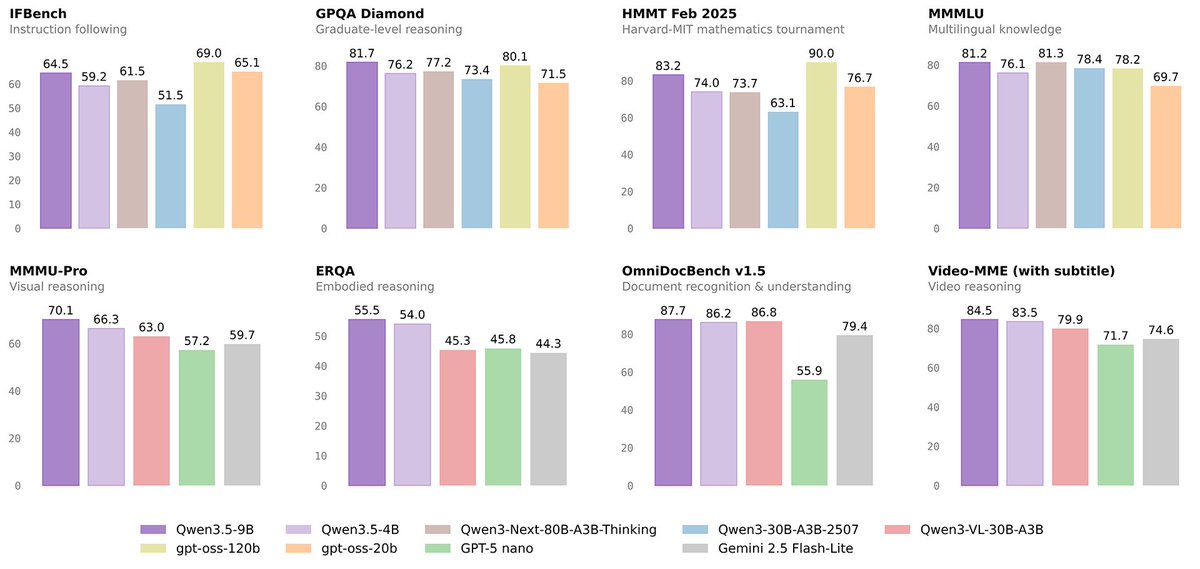
🚀 Introducing the Qwen 3.5 Small Model Series
Qwen3.5-0.8B · Qwen3.5-2B · Qwen3.5-4B · Qwen3.5-9B
✨ More intelligence, less compute.
These small models are built on the same Qwen3.5 foundation — native multimodal, improved architecture, scaled RL:
• 0.8B / 2B → tiny, fast, great for edge device
• 4B → a surprisingly strong multimodal base for lightweight agents
• 9B → compact, but already closing the gap with much larger models
And yes — we’re also releasing the Base models as well.
We hope this better supports research, experimentation, and real-world industrial innovation.
Hugging Face: https://t.co/wFMdX5pDjU
ModelScope: https://t.co/9NGXcIdCWI
The Qwen 3.5 small models are available on Ollama.
All models support native tool calling, thinking, and multimodal capabilities in Ollama.
9B:
ollama run qwen3.5:9b
4B:
ollama run qwen3.5:4b
2B:
ollama run qwen3.5:2b
0.8B
ollama run qwen3.5:0.8b
Model page, including the bigger Qwen 3.5 models:
https://t.co/FiYhlfCWQ4
We’ve identified industrial-scale distillation attacks on our models by DeepSeek, Moonshot AI, and MiniMax.
These labs created over 24,000 fraudulent accounts and generated over 16 million exchanges with Claude, extracting its capabilities to train and improve their own models.
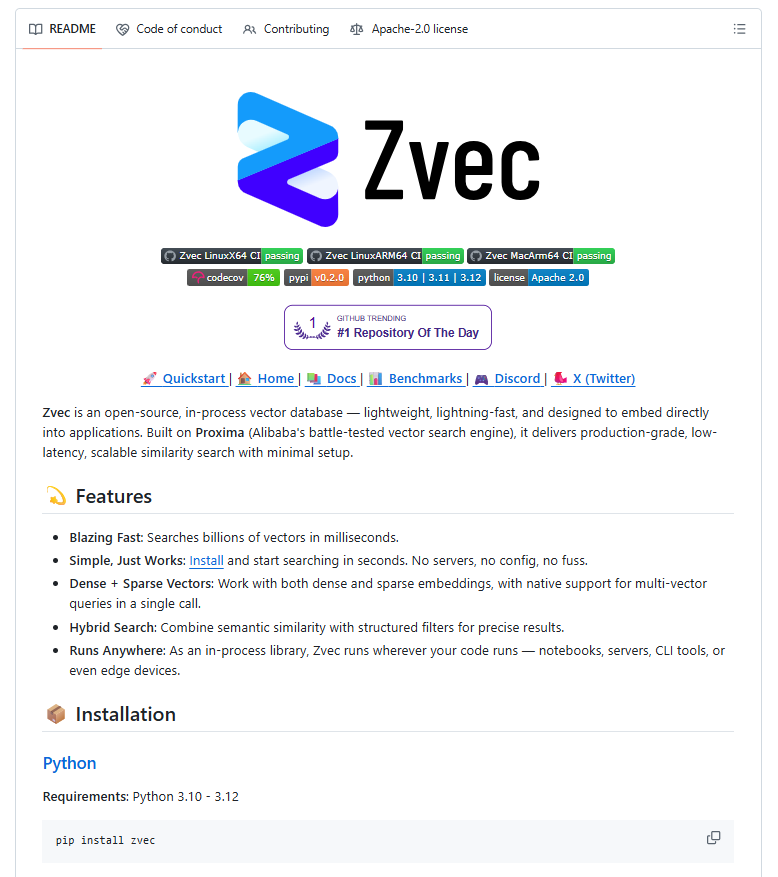
🚨 Alibaba acaba de lanzar Zvec.
Una base de datos vectorial que elimina servidores, configuración y costes de infraestructura.
Es open-source y tiene licencia Apache 2.0.
Aquí tienes todo lo que debes saber 👇
#AhoraLoSabes | NO necesitas viajar a Japón para empezar a hablar japonés (ni pagar por el certificado)
Gracias a la alianza entre la UNAD y The Japan Foundation, cualquier persona puede acceder gratuitamente a:
✔ Minato, plataforma oficial para aprender japonés.
✔ JFF Theater, espacio en línea para ver cine japonés contemporáneo y clásico.
Metodología: trabajo independiente, sin horarios obligatorios.
Niveles disponibles en español: A1 y A2.
Aprendes desde cero: escritura, gramática, lectura y comunicación.
Contenido organizado por módulos prácticos.
Cuando completas y apruebas el curso, recibes certificado gratuito.
✅ Accede aquí y selecciona “español” como idioma base:
https://t.co/WI9qJj1mXs
✅ Puedes reforzar con el e-libro Marugoto:
https://t.co/ptlXzjAo6h
Obtén más info en nuestra web y revisa la transmisión en vivo: https://t.co/MiRhgVIiVn
.
.
.
.
#UNAD
#TheJapanFoundation
#AprendeJaponés
Chinese scientists have developed,
The best shortest-path algorithm in 41 years!
A team from Tsinghua University has broken Dijkstra's "sorting barrier" - the first improvement since 1984.
Just use for a world-map 🤯
Paper - https://t.co/0AhR5O7vl4
https://t.co/a9KMVRuYGx
@petrogustavo No hay peor esclavitud que seguir el ideal de humanos que ya están muertos, con costumbres y culturas que ya no existen y, lo más probable, ya no sirvan.
El algoritmo de Luhn, creado por Hans Peter Luhn en los años 50, es un método matemático que verifica si un número de tarjeta está correctamente estructurado antes de procesarlo. No comprueba fondos ni autentica cuentas reales; simplemente detecta errores de escritura y evita que un sistema procese números imposibles.
Su propósito es muy práctico:
1. Detectar de inmediato si el número fue escrito mal
2. Evitar consultas innecesarias a la base de datos
3. Reducir carga en servidores y fallos en operaciones
En otras palabras, Luhn es un filtro rápido que evita que el sistema pierda tiempo revisando un número que nunca podría corresponder a una tarjeta válida.
Ejemplo con un número ficticio:
4539 1488 0343 6467
1. Luego invertimos los números de derecha a izquierda
7 6 4 6 3 4 3 0 8 8 4 1 9 3 5 4
2. Duplicamos cada segundo dígito:
El primer dígito (7) no se duplica.
El segundo dígito (6) se duplica y se convierte en 12.
Así queda toda la secuencia:
7, 12, 4, 12, 3, 8, 3, 0, 8, 16, 4, 2, 9, 6, 5, 8
3. A los números mayores que 9, que en este caso son tres, les restamos 9
(12 → 3, 12 → 3, 16 → 7)
Resultado:
7, 3, 4, 3, 3, 8, 3, 0, 8, 7, 4, 2, 9, 6, 5, 8
4. Sumamos todos los valores
Total: 80
5. Validación
El algoritmo de Luhn es válido porque la suma total es múltiplo de 10 (termina en 0).
Conclusión
El algoritmo de Luhn no solo se usa en tarjetas bancarias, sino también en otros identificadores que requieren detectar errores rápidamente. Su función es confirmar que un número esté bien formado antes de procesarlo y así evitar fallos y recursos innecesarios.
#Python
BREAKING: Sugars essential for life have been found in pristine asteroid Bennu samples collected by NASA’s OSIRIS-REx spacecraft. Combined with previous detections of amino acids and nucleobases, we see that life’s ingredients were widespread throughout the solar system: https://t.co/Tb3HpwZG9J
More on the study led by Yoshihiro Furukawa of @TohokuUniPR⤵️
¡Hoy cierro un capítulo importante en mi vida! He decidido finalizar mi etapa @awscloud, donde he aprendido y crecido enormemente.
Agradezco de corazón a todas las personas que me acompañaron en este camino. Ahora, con mucha ilusión, me dispongo a iniciar nuevos retos y a seguir desarrollándome profesionalmente. 🚀
Caída de AWS que afecta a nivel mundial.
Miles de páginas web y servicios están inaccesibles.
No responde la región más importante: us-east-1
Recordatorio: Internet está sostenida por alfileres.