90% do varejo está sendo engolido vivo hoje,
porque tenta adivinhar o mercado olhando pelo retrovisor.
Gráficos poluídos com MACD, RSI e médias móveis são armadilhas institucionais. Enquanto você olha para o passado.
O Fluxo de Capital (CVD) está jorrando para o Bitcoin.
🧵👇
Notícia muito boa para #Bitcoinmeme e #Runes e para nossa $Dog, @coingecko criou uma seção de memecoins na rede do #bitcoin, isso ajuda na visibilidade e adoção.
$MIM
$BDC
$PUPS
Bitcoin has gained 4.66% in the last few hours after the peace deal, will $BTC reach $70K and above this week?
Meanwhile After receiving SEC approval on June 12, the iShares Bitcoin Premium Income ETF (BITA) is expected to launch as early as June 19. The fund is designed to generate income by selling covered call options on Bitcoin exposure or shares of BlackRock’s IBIT ETF, which has already grown to nearly 49 billion in assets under management.
I'm watching BTC next move closely on BingX
#Bitcoin
🚨 BREAKING: For the first time, we can now show exactly where the #Binance solana:dog1viwbb2vWDpER5FrJ4YFG6gq6XuyFohUe9TXN65u cluster sits inside the total supply picture - and what happened to that position after we exposed them.
Most people know about the #Binance cluster by now. 158 wallets. 13.69 billion solana:dog1viwbb2vWDpER5FrJ4YFG6gq6XuyFohUe9TXN65u. Accumulated since day one of the April 2024 airdrop.
But here's what nobody has shown you until today.
That entire 13.7% position is classified as Short-Term Holder supply. Not because they're new. Not because they're weak hands. But because their wallets never stop moving. Every internal transfer, every wash trade, every shuffle between their 158 wallets resets the UTXO clock back to zero. They have held solana:dog1viwbb2vWDpER5FrJ4YFG6gq6XuyFohUe9TXN65u for over two years but on-chain they permanently read as short-term holders.
Why does that matter?
Because when you strip them out of the STH bucket, the real picture becomes undeniable:
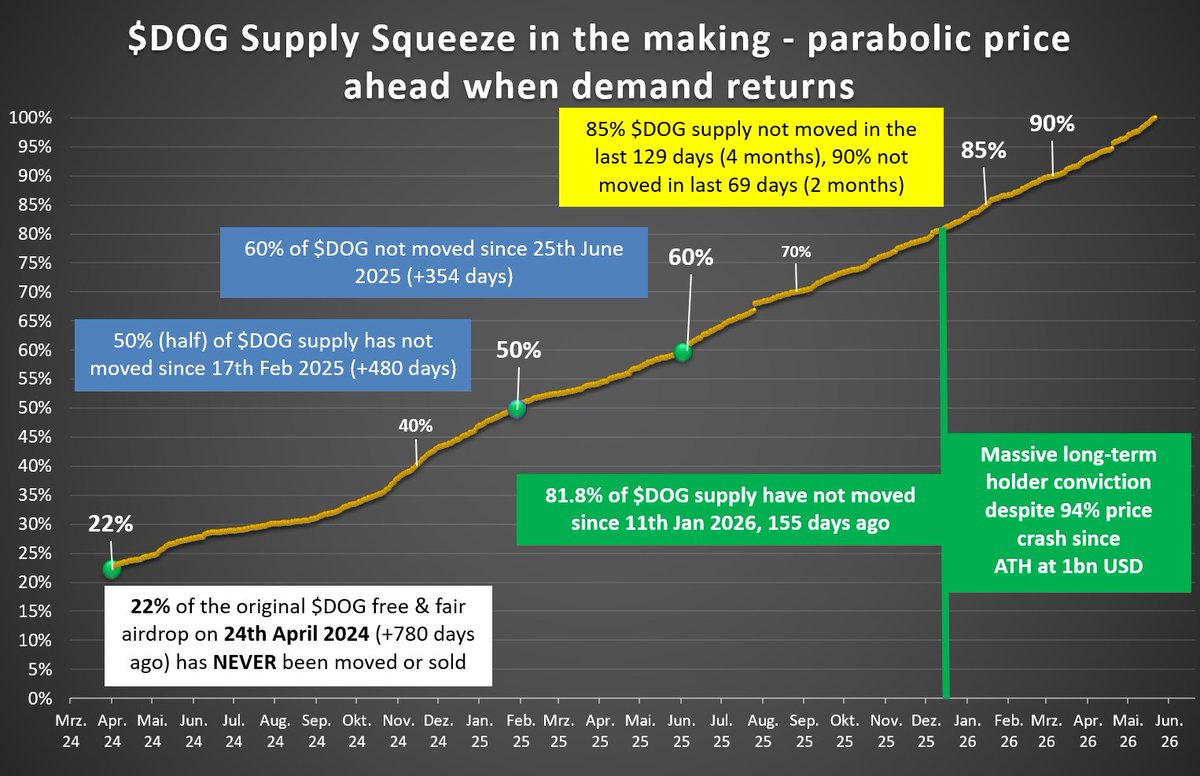
▪ 81.8% - genuine long-term holders. 84,700 wallets. Didn't sell through a 94% crash.
▪ 13.7% - #Binance cluster. Classified STH but not going anywhere.
▪ ~4.5% - actual free-floating supply available to anyone.
Four point five percent (4.5B solana:dog1viwbb2vWDpER5FrJ4YFG6gq6XuyFohUe9TXN65u). That is the entire open market for solana:dog1viwbb2vWDpER5FrJ4YFG6gq6XuyFohUe9TXN65u right now.
Now here's where it gets interesting.
After we publicly exposed the #Binance Ordinal Hot Wallet on April 13th 2026 and confirmed wallet network accumulating solana:dog1viwbb2vWDpER5FrJ4YFG6gq6XuyFohUe9TXN65u, something changed. The cluster's holdings dropped noticeably. Not dramatically - but measurably. And since then? On-chain activity shows mostly internal reshuffling. Wallets moving tokens between each other quietly at near all-time low prices around $60M market cap.
Ask yourself why a sophisticated institutional-level operation would be reducing holdings and moving bags around internally at the exact bottom of the market.
One possibility: they're not selling to exit. They're selling to shake. Distributing just enough into the open market to spook retail into panic selling their solana:dog1viwbb2vWDpER5FrJ4YFG6gq6XuyFohUe9TXN65u at the lowest prices possible - then quietly buying those same bags back through different wallets at a discount.
It's one of the oldest plays in the book. Create fear at the bottom. Accumulate what falls.
But there's a second possibility that nobody is talking about - and it's even more explosive.
Look at what's actually been building here. 81.8% of supply locked by holders who won't sell. A free float of only 4.5%. And a coordinated entity that has spent two years accumulating a 13.7% position now quietly repositioning at the bottom.
This isn't just a supply squeeze setup. This could be the foundation for a SHORT SQUEEZE 😱🧨
Here's how it works. When a token has almost no available supply and someone - or something - starts aggressively buying into that thin market, anyone who has shorted expecting it to go lower suddenly can't find tokens to cover their position. There's nothing to buy. So they have to bid higher. And higher. And the price moves faster than almost anyone anticipates because the math of 4.5% float simply doesn't allow for an orderly move.
A coordinated entity sitting on 13.7% of supply understands this better than anyone. If they choose to stop selling and start buying instead - even a small amount - into a market with 4.5% float, the effect is disproportionate. They don't need to spend much. The structure of the supply does the work for them.
We are not financial advisors. We are not predicting what happens next. We are reading publicly verifiable data on Bitcoin's blockchain and reporting what we see.
What we see is this: a historically thin float, a two-year accumulation by a sophisticated actor, a retail shakeout playing out at the bottom, and a supply structure that could turn any meaningful demand event into something violent to the upside.
The squeeze was already set up. Now watch who pulls the trigger.
Full on-chain forensic data below 👇
New $DOG data: nobody is selling.
82% of supply hasn't moved in 5 months. 90% in 2.
The float is vanishing — and it's not coming back.
One spark (OKX / Binance listing) or just time. When demand hits a supply this thin, there's nothing left to buy.
Parabolic is inevitable. 🐶🚀
@koop0x KOOP, my fren, please study and share info on #Bitcoin#Memecoin $DOG & $MIM with your community. Give them a chance to get in early and an opportunity for generational wealth going into the new cycle. First time ever that Bitcoin has #Memecoins
Mercado Financeiro e Bitcoin
O X (Twitter) está LOTADO de bobagens (por toda a semana passada até agora)
A única avaliação sensata que vale a pena considerar.
🚨 EVERYTHING THAT COULD GO WRONG FOR MARKETS WENT WRONG TODAY.
S&P 500 down -1.65%, wiping out $1.14 trillion.
Nasdaq down -2.60%, wiping out $1.11 trillion.
Gold down -3.38%, wiping out $1 trillion.
Silver down -6.9%, wiping out $280 billion.
Bitcoin down -6.31%, wiping out $80 billion.
In total $2.5 TRILLION wiped out in a single session. These were not isolated moves. Everything started breaking at the same time.
It started with the jobs report this morning.
The US economy added 172,000 jobs in May. Wall Street expected 88,000. That is almost double.
On any normal day, strong jobs is good news. But inflation is already at 3.8% and oil is sitting at $90. A labor market this strong tells the Fed it cannot cut interest rates and may actually need to raise them.
The probability of a rate hike this year went from 40% to 57% in a single day. That spooked every investor holding tech and growth stocks because higher rates mean those stocks are worth less today.
Then the AI trade started cracking.
Yesterday Broadcom reported record earnings: revenue up 48%, AI chip sales up 143% and the stock still crashed 12.6%. The reason was simple.
Broadcom did not raise its AI revenue targets for the year. Investors had expected it to. That single miss made people ask a question they had been avoiding for months: are we paying too much for AI stocks?
That question got louder today when a research firm called SemiAnalysis revealed that Nvidia's next-generation AI chips will need significantly less memory than everyone assumed, roughly half of what the market was pricing in.
Memory chips are what companies like SK Hynix and Samsung make. SK Hynix fell nearly 10% today. Samsung fell over 6%.
South Korea's entire stock market crashed 5.5% in a single session. Japan's semiconductor stocks did the same.
And then Anthropic added fuel to the fire by publishing a report warning that AI is getting close to the point where it can improve itself without human help and calling for a global pause in AI development.
Coming on the same day as the memory demand news and Broadcom's miss, it fed a single growing fear across the market: what if the AI boom is moving faster than the business models can keep up with?
Underneath all of this, there is a liquidity problem nobody is talking about.
SpaceX goes public next week at a $1.75 trillion valuation. Anthropic just filed to go public. OpenAI is next.
These three companies together are worth $4 to $5 trillion. Fund managers need cash to buy into these listings.
But cash levels are already at their lowest since early 2024. The only way to raise cash is to sell what they already own. That selling is happening right now.
The new Fed Chair Kevin Warsh will also hold his very first policy meeting in 11 days. He was appointed by Trump with the expectation of cutting rates.
He is now walking into a situation where inflation is high, oil is high, and the job market is running hot. Investors do not know what he will do.
When nobody knows what the most powerful central banker in the world will decide in less than two weeks, the safest move is to reduce risk today.
Everything that could go wrong, went wrong at the same time. A hot jobs report, a collapsing ceasefire, a crack in the AI trade, a trillion dollar liquidity drain, and a Fed meeting with no clear outcome.
OUR GREATEST GLORY IS NOT IN NEVER FALLING BUT IN RISING EVERY TIME WE FALL
THESE ARE THE MOMENTS WE WILL LOOK BACK ON WITH THE GREATEST PRIDE
HODL YOUR solana:dog1viwbb2vWDpER5FrJ4YFG6gq6XuyFohUe9TXN65u!!!!!!!!!!!!!!!!
OUR GREATEST GLORY IS NOT IN NEVER FALLING BUT IN RISING EVERY TIME WE FALL
THESE ARE THE MOMENTS WE WILL LOOK BACK ON WITH THE GREATEST PRIDE
HODL YOUR solana:dog1viwbb2vWDpER5FrJ4YFG6gq6XuyFohUe9TXN65u!!!!!!!!!!!!!!!!