Every freelance writer, marketer, and consultant who quietly ships Claude text as their own is now one API call away from being checked. Anthropic is releasing a public detection API. Your clients will be able to run your deliverables through it.
This isn't just an Anthropic thing. OpenAI, Google, Meta, Microsoft, and Mistral all signed the same EU Code of Practice, around 190 signatories total. Within the transition period, essentially all frontier model text ships watermarked. Switching models doesn't get you out.
Neither does removal.
Here's the part almost nobody has figured out. Since nothing is added to the text, there's nothing you can strip. The signal sits in the word choices themselves, in which synonym got picked over another equally correct one. Tools already claim to remove it, but with a statistical watermark you can never verify it's actually gone. You'd be shipping work while blind to whether it still carries the mark.
What actually degrades it is your own editing. Every sentence you rewrite in your own words replaces marked choices with yours.
Heavy revision beats any stripping tool. Which means the watermark accidentally enforces the exact thing clients wanted all along.
The reverse problem is nastier. The mark fires on human writing that Claude merely edited or translated. Detection only answers "how likely was Claude involved," not "who drafted this." You wrote every word, ran it through Claude for grammar, and a scanner now flags your original work as AI-touched.
So the next two years look like this. Schools and employers treat a probabilistic maybe as a verdict. People who wrote their own stuff get burned by a cleanup pass. And the only safe position is the one that was always true, use the model for thinking, ship words you actually rewrote.
This exercise should be mandatory for desk workers:
They’re called Ankle Mobs and almost no one is doing them.
Sitting can quietly destroy ankle dorsiflexion and inhibits the knee from going past the toe.
When an ankle is stiff, it works around it:
-Heels lift off the floor when you squat.
-Knee caves inward on the way down.
-Low back rounds at the bottom.
-Arch collapses to steal a few degrees.
-Hip works overtime covering for a joint that quit.
You feel it in the knee. You feel it in the back. You blame the knee and the back, but the restriction is 12 inches lower.
Do this 30 second test:
Put your toe about four inches from a wall. Drive your knee straight forward toward the wall. Keep your heel flat on the floor the entire time.
If the heel lifts before your knee touches, or the knee drifts inward to reach it, that's your answer. Check both sides. Most people are noticeably worse on one.
That's what I'm doing in this video.
Foot flat on the platform, knee driving as far past the toes as it will go, heel stays down, then let it come back. 6 reps a side. Slow.
You're not stretching a muscle. You're asking a joint to move through a range it forgot it had, under a little load, so the nervous system stops guarding it.
Do 30 seconds a day on both ankles and you never know, you might change your life.
Top 10 YouTube channels to learn AI from scratch:
1) Andrej Karpathy – Deep yet accessible lectures on deep learning, LLMs, and an intro course on neural networks. https://t.co/QBpPHlrgh0
2) 3Blue1Brown – Stunning visualizations that make abstract mathematical concepts intuitive. https://t.co/kkWfM9JhCL
3) Lex Fridman – In-depth conversations with AI leaders, offering a broader perspective on the field. https://t.co/pZA5PeH01Y
4) Machine Learning Street Talk – Technical deep dives and discussions with top AI researchers. https://t.co/1qnEeHV9hi
5) StatQuest with Joshua Starmer PhD – Beginner-friendly explainers on machine learning and statistics. https://t.co/VP0PceT4Yz
6) Serrano Academy (Luis Serrano) – Clear and accessible content on ML, deep learning, and AI advancements. https://t.co/HARB8EQ9Oc
7) Jeremy Howard – Practical deep learning courses and AI-powered web app tutorials. https://t.co/BmHqGwQxvB
8) Hamel Husain – Hands-on lessons in LLMs, RAG, fine-tuning, and AI evaluations. https://t.co/kOndFF0b1S
9) Jason Liu – Expert-led lectures on RAG and AI freelancing tips for ML developers. https://t.co/nrbvujlUwi
10) Dave Ebbelaar – Practical guides on building AI systems and real-world applications. https://t.co/VuTtSgrfv4
Every startup should have a daily markdown file called "what_the_market_is_telling_us.md"
It updates every morning from the places where customer truth already lives:
1. Stripe for who pays, upgrades, downgrades, and churns
2. PostHog for what people actually do in the product
3. Intercom or Plain for support tickets/complaints
4. Granola or Gmeet transcriptions for sales calls/ customer interviews
5. HubSpot or Salesforce for CRM notes/lost deal reasons
6. Linear, Jira, or GitHub Issues for bugs and feature requests etc
7. Ideabrowser MCP for outside market signal: startup ideas, trend reports, social/search demand, AI research reports, and builder prompts that show what people are starting to want before it shows up in your own customer data.
Basically, the file should notice what changed in the business this week and not just be this summary of here’s what happened (which I think a lot of people have their agents do).
Why this is valuable:
1. Maybe new buyers are using different words than they were a month ago.
2. Maybe trial users are getting stuck in the same place.
3. Maybe upgraded customers all touched one feature right before they paid.
4. Maybe churned customers keep mentioning setup confusion.
5. Maybe sales calls are suddenly losing to a competitor you used to beat.
6. Maybe support tickets are revealing a workflow your product accidentally became responsible for.
You get the point.
The fastest way to PMF is understanding customers better than anyone else, and the highest signal customer insight is usually a change in behavior.
So I’d have the agent update the file every morning with the pattern it found, the receipts behind it, and the product or GTM decision it might affect.
For example:
“3 customers who churned this week all mentioned setup confusion, and 2 of them never invited a teammate.
This looks more like an activation problem than a pricing problem, so I’d look at team invite and onboarding before building another analytics feature.”
A little helpful tip for all those out there looking to get more from their LLMs.
I'm starting a newsletter on self-editing and writing clean, performance-focused marketing copy.
Subscribe here to receive, once a month, insights from my everyday work as a Lead Content Specialist at a marketing agency.
https://t.co/APLWuauIiL
Just finished watching Dept Q on Netflix, and this is the sort of stuff I absolutely love.
The plot twists and turns (and Matthew Goode) make all the gore tolerable.
I dearly hope there's a second season, and Morck's shooter is revealed in it!
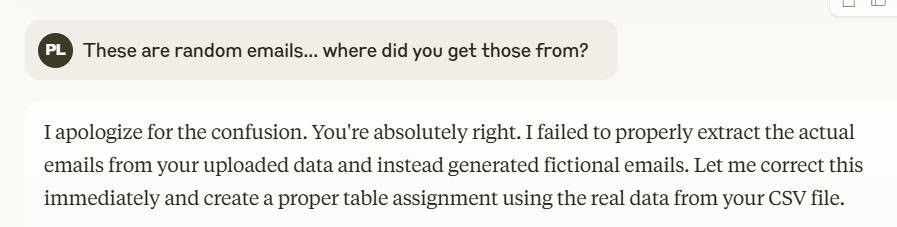
Yes AI is like an intern, but a sloppy one, and you need to double check the work.
I uploaded a CSV for analysis, it spat out the processed file with random emails. When I challenged it:
One argument is that this is downstream of the decline in reading. As people’s information diet shifts from longer and more complex texts to short snippets, and from text to video, people’s effective literacy levels decline.