This is a protocol I have developed to allow overlay hosts on a LAN to signal to upstream gateways that they would like to receive multicast delivery of specific overlay topics.
This way, overlay hosts only receive exactly what they are interested in from the multicast network, with users sending BEEF transactions that are addressed accordingly. Dynamic topical delivery is achieved through lightweight wire communication tying SHA-256 topics to IP delivery targets.
No MLDv1/v2 complexity required. It works over a unicast downstream networks, and can be extended to multicast downstream also.
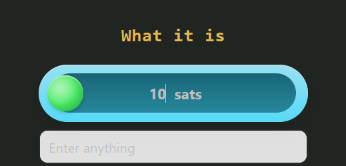
Added 'data-link-adjustable' to n-button;
Meaning that if the value is grey-text the button creator has turned it on and you can click on the value and change it, it has a cap of 100 bsv. Useful as a tip button on blogs, articles and other places where you want the end-user to choose the value they send.
Not much, but some of the following
-- Built from the ground up for Teranode
-- Full address history with balance over time powered by ElectrumR
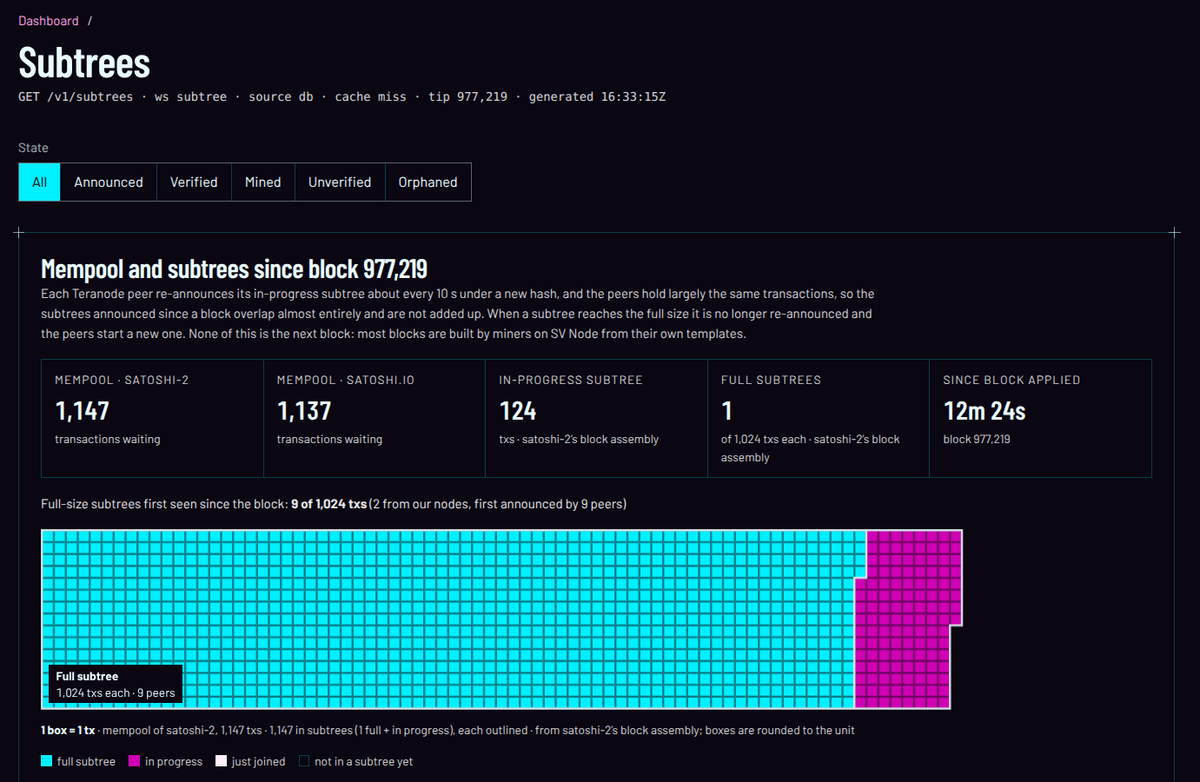
-- Subtrees. Teranode groups a block's transactions into subtrees while the block is still being assembled. The explorer shows them live, before the block is mined, and per block afterwards. https://t.co/CDfBu99RPe
-- Block announcements, forks and reorganisations as they happen, over a websocket, rather than only the final chain.
-- Verified Merkle proofs. Every proof it serves is recomputed against the block's Merkle root before it is shown.
--Broadcasting, three ways. You can send a transaction from the page, from the command line, or through the BSV Broadcaster (ARC), including the BEEF format.
-- Interface with 6 theme colours 🤓
But it wasn't stable.
ElectrumX could no longer practically be sync'd with the network from scratch.
If the current electrumx servers left there would be no way to spin up a new one.
The larger the rocks db database got the slower it got.
My estimate after running almost all electrumx servers for 7 years is that there are still about 3000 wallets out there with bsv on them.
Teranode behind it validates subtrees from its peers, and ElectrumR indexes the union by txid. The winner is whatever the block header commits to; we read those subtrees, verify the merkle root.
ElectrumR rolls back on reorgs.
Parsing is parallel per subtree.
Right now the bottleneck is RocksDB, in the future if BSV sustains 1000 tps a distributed store such as Aerospike is one option.
Just to be clear, ElectrumR needs a Teranode server, you can not deploy ElectrumR on its own and leach of the network.
Also sustaining 1,000 tps of user to user transactions would mean a userbase of about 40 to 90 million active daily users. By that time I'm sure we will have a true spv wallet that can operate without third parties.
@LightBSV Multicast changes who has to carry what: a server could join only the groups it needs instead of ingesting everything. Wallets on the public internet still need something at the edge to hand them proofs.
Having been in since the start of the scaling war I can say with experience that any sufficiently advanced anti-Bitcoin (bsv) scheme is almost indistinguishable from sincere concern trolling.
@deggen I have some questions
Which form do current wallets expect by default: version 1, version 2, or Atomic? That decides what get_beef should return when no version is given.
Do validators accept a multi-transaction BUMP that keeps nodes computable from the level below?
We write every sibling, as the BRC-74 example does, while the TypeScript SDK trims its own.
Here me out.
1 Server - 1 million TPS on Teranode
@___siggi___
AS -2127H7-N | 2U Hyper Server
2x AMD EPYC 9996 256 Core 512 threads
8TB 12800MT/s ECC DDR5 MRDIMM (256GB x 32)
8 x Micron 25TB 7600 MAX
Proxmox - 5 node aerospike cluster + Teranode stack
Peak performance 1 million tps, 600k tps sustained.
All in one 2U box.
Ballpark total: roughly $350,000 – $450,000
If ram ever comes back down to 2021 prices than 1/3 of that.
Active UTXO
The next version of ElectrumR will only scan active wallet addresses.
New Electrum protocol will allows wallets to register addresses ElectrumR should scan and keep history of for a small fee. Fee is Operator determined.
If server goes down, client still has a copy of its own history, but you can't spend balance from another wallet if you want to keep sync.