If you are at the #ACSSpring2025 in San Diego, go see Julian von Hofe share new insights on physico-chemical organization in biomolecular condensates
🧪✨in the Frontiers in Coherent Nonlinear Spectroscopy & Hyperspectral Microscopy session at 11:00 AM
#spectroscopy#condensates
Great paper led by @teleanuflorin and Oscar (Zhiyuan): figuring out dynamics of different solution shells in ionic liquids by NMR and MD sim. JPCL journal cover coming up. https://t.co/fHcZvlRqO3 #nmrchat
A lens can perform the Fourier transform! 🔍
This is the 4F system: the first lens converts an image into its frequency components, and the second lens reconstructs it. By adding an aperture at the Fourier plane, we can filter out high frequencies.
#Optics#Physics#b3d
ÅNGSTRÖM-RESOLUTION IMAGING OF CELL-SURFACE GLYCANS 🧬🎨🍬
The glycocalyx, our cells' sugar coat, holds secrets in immunology, cancer, viral infections, and more. Visualizing its molecular architecture was impossible… until now. #glycotime#microscopy
https://t.co/ukJcD7aZsE
Proud to share a new manuscript:
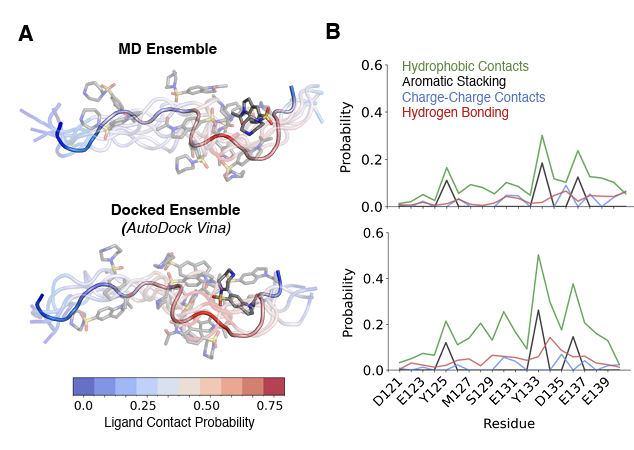
"Ensemble docking for intrinsically disordered proteins"
from @DartmouthChem undergrad Anjali Dhar 24' and grad student Tommy Sisk. We present ensemble docking strategies for IDPs that, remarkably, seem to work!
(Links in thread below)
Our work using thermodynamic principles to link in vitro TF affinities and kinetics to single-molecule chromatin states in cells is now on bioRxiv! Amazing effort by first author @juliaschaepe in @WJGreenleaf lab:
https://t.co/NG2bXd8SfJ
@Stanford@scilifelab@Stockholm_Uni [1/9]
There's more to SOS response timing than the LexA repressor. In our preprint from the Anjana Badrinarayanan @anjbadri Lab, we uncover a new regulatory layer that imparts temporal structure to the bacterial SOS response.
https://t.co/wmqlMD5nNg
While teaching biophysics, I introduced Aves Thermodynamicsus (a.k.a. the drinking bird) to demonstrate an important concept. Somewhere along the way, I might’ve, uh, slightly scorched its tail feathers. Science demands sacrifices… even from the bird.
Today in @Nature: Our MatterGen model represents a paradigm shift in materials design, applying generative AI to create new compounds with specific properties with unprecedented precision.
How did microtubules adapt to support life across 🐸species at divergent thermal niches?
Now online & OA @CurrentBiology
Thanks to @elladegaulejac @luca_troman@bis_was_here @CarolynMoores1 @mpiib_berlin@BirkbeckUoL 🙌
Enjoy reading! 👉 https://t.co/0HJ1bvIUcK
Really excited to share our latest preprint in collaboration with @Sandeep_IMSc's lab. Mycobacterium tuberculosis Nucleoid Associated protein Lsr2 and DNA undergo sequence-dependent co-condensation. Check it out here:
https://t.co/aqGTfpHzMG
🔬 The Shroff Lab & collaborators have developed a new AI method that produces sharp microscopy images throughout a thick biological sample without using adaptive optics, adding additional hardware, or taking more images.
🔗https://t.co/FugWwpP0Tq
Excited to share our article in @NatureComms describing a strategy to solve small #membraneprotein transporter structures using #cryoEM. We solved three structures of a 42 kDa efflux transporter from a single sample. Congratulations to the team and great collaboration w/@danengw
The application window for the Summer Undergraduate Research Program in Computational Physical Chemistry at NYU is now open. This is a a 10-week summer program with a stipend of $10,000. Open to all U.S. students who are not already at NYU. Details at https://t.co/zLT6o7FHn9