Composed in 1638, Allegri’s Miserere was originally intended to only be sung during Holy Week, and to never leave the Sistine Chapel in order to preserve the mystery of the music. Here it is performed by St Paul’s Cathedral Choir.
Cowardice asks "Is it safe?" Expedience asks "is it politic?"
Vanity asks "is it popular?"
There comes a time when one must take a position that is neither safe, politic, nor popular, but one must take it because it is right.
MARTIN LUTHER KING. JR.
GOD BLESS YOU SIR 🫵🏻🫡
My respect 96 years .
🇺🇸🇺🇸🇺🇸🇺🇸🇺🇸🇺🇸🇺🇸🇺🇸🇺🇸🇺🇸🇺🇸
AMERICAN MADE .
The GOAT !!
Clint Eastwood Said Something About Getting Old That Stopped Me Cold.
Aging is not gentle.
You are still here. Still present. Still watching the world move. But the body that carried you through everything - the wars, the work, the wildness of youth - begins to ask for more than you can give it. Joints that never complained now speak up in the morning. Eyes that once took in everything now flinch at the light. Breathing, which never required a single thought, starts needing little pauses.
But none of that is the hardest part.
The hardest part is the quiet.
At a certain age, you reach for the phone and remember there is no one left to call.
The people who knew you when you were young - who remembered the same summers, the same streets, the same faces
- are gone. One by one, then all at once, until the memories you carry have no one left to share them with.
So you tell the stories anyway.
To whoever will listen. With a little more color than perhaps the truth deserves. With a touch of pride you've earned and a grief you don't always name. You know the person across from you wasn't there. You know they can't quite feel it the way you do.
But you tell them. Because the telling is the holding on.
Those stories are not just memories. They are the proof that a life was lived. That people were loved. That things mattered.
And if no one asks for them - you offer them anyway, quietly, like setting something down on a table and hoping someone picks it up.
Old age is not simply what happens to a face or a body.
It is memory looking for a place to rest.
And what an older person needs - more than advice, more than solutions, more than someone telling them how to feel - is simply someone willing to sit down, be still, and listen.
Not to fix anything.
Just to be there.
That is the whole gift. And it costs nothing.
~Wild Whispers .
Andoni Iraola on why he chose Liverpool despite interest from multiple clubs:
🗣️ “I had many conversations with different clubs, very big clubs, very ambitious projects, all trying to convince me.
But for me, there was one decision that felt different from the beginning.
Liverpool is not just another job in football.
It is a club with identity, history, pressure, and emotion like few others in the world.
It has always been a dream of mine to manage at Anfield, even before I became a manager at this level.
And I have to be honest, one conversation changed everything for me.
I spoke with Jürgen Klopp.
He didn’t try to convince me in a normal way he spoke about the club, the fans, the responsibility, and what it means to lead Liverpool.
He told me: ‘If you ever get the chance, don’t think twice. At Liverpool, you don’t just manage a team… you carry a feeling.’
That stayed with me. After that call, my decision was made.
Other clubs offered projects, money, structure… but Liverpool offered something else. Belief. Expectation. Pressure.
And history that demands you give everything every single day.
I didn’t come here to take part. I came here because this is the club I always dreamed of leading.
And now that I’m here, I understand exactly what Klopp meant.”
Winston Churchill fought his depression with bricks. He'd lay them for hours at his country home in Kent. He joined the bricklayers' union. And in 1921 he wrote about why it worked. It took psychology another 75 years to catch up.
He called his depression the "Black Dog." It followed him for decades. His method for fighting it back was as basic as it sounds: laying brick after brick, hour after hour.
Churchill spelled out his theory in a long essay for The Strand Magazine. People who think for a living, he wrote, can't fix a tired brain just by resting it. They have to use a different part of themselves. The part that moves the eyes and the hands. Woodworking, chemistry, bookbinding, bricklaying, painting. Anything that drags the body into a problem the mind can't solve by itself.
Modern psychology now calls this behavioral activation. It's one of the most-studied depression treatments out there. Depression sets a behavior trap. You feel bad, so you stop doing things, and doing less means less to feel good about. Feeling worse makes you do even less. The loop tightens until you can't breathe inside it.
Behavioral activation breaks the loop from the action side. You schedule the activity first, even when every part of you doesn't want to. Doing it produces small rewards: a wall gets straighter, a painting fills in, a messy room gets clean. Those small rewards slowly rewire the brain. Action comes first, and the feeling follows.
Researchers at the University of Washington put this to the test in 2006. They studied 241 adults with major depression and compared three treatments: behavioral activation, regular talk therapy, and antidepressants. For the people who were most severely depressed, behavioral activation matched the drugs. It beat the talk therapy. A 2014 review of more than 1,500 patients across 26 trials backed up the result.
Physical work like bricklaying does something extra on top of this. It crowds out rumination, the looping bad thoughts that grind people down during the worst stretches of depression. Bricklaying needs both hands and gives feedback brick by brick: each one is straight or crooked. After an hour you can see exactly how much wall you built. No room left for the mental chewing.
The line George Mack used in his post, "depression hates a moving target," is good poetry. The science behind it is sharper. Depression hates a brain that has somewhere else to be.
A Persian scholar finished a single math book in 9th century Baghdad that quietly became the foundation for every line of code running on Earth today.
I started reading about him at midnight and could not believe how many things in my daily life trace back to one man.
His name was Muhammad ibn Musa al-Khwarizmi. The book is called The Compendious Book on Calculation by Completion and Balancing.
Every time you say the word algebra, you are saying his book title. Every time someone says the word algorithm, they are saying his name. Both English words come from him. Both are Latin transliterations of Arabic and of his own identity. The man did not just contribute to mathematics. He named it.
Here is the part almost nobody tells you.
Al-Khwarizmi was born around 780 CE in Khwarazm, in what is now Uzbekistan. He moved to Baghdad and worked at a research institution called the House of Wisdom, which during the Islamic Golden Age was the single most important center of learning on the planet. The caliph al-Mamun hired the best mathematicians, astronomers, and philosophers from across three continents and put them in one building with one job. Translate, study, and produce new knowledge.
Al-Khwarizmi finished his book on algebra around 820 CE. The Arabic title contained the word al-jabr, which referred to one of the two operations he used to solve equations. When the book was translated into Latin in the 12th century, the Latin world did not have a word for what he had built. So they kept his Arabic word. Al-jabr became algebra. The discipline was named after a single Arabic word in the title of a single book by a single man.
The deeper insight is what he actually changed about how humans think.
Before al-Khwarizmi, mathematical problems were solved geometrically. You drew shapes. You measured them. You compared areas. The Greeks had built an entire mathematical tradition on visual proofs and physical constructions. It was beautiful and limited. You could not solve a problem you could not draw.
Al-Khwarizmi did something nobody had done before him at this scale. He said you could solve any problem using abstract symbols and rules. You did not need a shape. You needed a procedure. You moved terms across the equation. You cancelled like terms on both sides. You isolated the unknown. He invented the idea that mathematics is a manipulation of symbols according to rules, not a study of physical figures.
That single shift made everything that came afterward possible. Calculus. Differential equations. Linear algebra. Quantum mechanics. None of it works if math is locked inside geometry. He pulled it out.
The second thing he did is the one that changed how the world counted forever. He took the Hindu numeral system from Indian mathematics, refined it, and wrote a book introducing it to the Arab world. That system included the concept of zero as a placeholder, and a positional notation where the value of a digit depends on its location. Roman numerals could not do complex calculation. Hindu-Arabic numerals could.
When his book on numerals was translated into Latin as Algoritmi de numero Indorum, the word Algoritmi was just the Latin spelling of his own name. Europeans started calling the new method "doing algorism," then "running an algorithm." The word for the most important concept in computer science is literally his name in Latin.
The third thing he did is the part that should haunt anyone who works in tech.
His method of solving problems was systematic. Step one, do this. Step two, check that. Step three, if condition A, then do X, otherwise do Y. He wrote down procedures that could be followed by anyone, anywhere, who knew how to read. The procedure did not depend on intuition or genius. It worked because the steps worked.
That is exactly what an algorithm is. A finite, deterministic procedure for solving a problem. He did not just give us the word. He gave us the entire concept of programming a thousand years before there was anything to program.
When Alan Turing built the first abstract model of computation in 1936, when John von Neumann designed the first stored-program computer in 1945, when every engineer at Google, OpenAI, Anthropic, and DeepMind writes code in 2026, they are working in a paradigm that started with one man in Baghdad twelve centuries ago.
The strangest part is what happens when you walk into any tech office in San Francisco or Bangalore or Lahore today. Engineers say the words algebra and algorithm hundreds of times a day. They do not know whose name they are saying. Almost nobody can spell al-Khwarizmi correctly on the first try.
His original Arabic manuscript is preserved at Oxford. His book on Hindu numerals survives only in Latin translation. The Latin version was the textbook that taught medieval Europe how to count.
The man who built the foundation of the AI revolution did not live to see a calculator. He died around 850 CE, a thousand years before the first electric current was sent through a wire. The civilization he built mathematics for collapsed. The library he wrote in burned. His own grave is unmarked.
But every algorithm running on every machine on Earth right now still answers to his name.
I shall pass through this world but once. Any good that I can do, or any kindness that I can show to any human being, let me do it now and not defer it. For I shall not pass this way again.
Attributed to STEPHEN GRELLET (adapted)
Did you know George Orwell warned that political language will be used to make lies feel true?
In Politics and the English Language, Orwell argues that vague and inflated language enables sloppy thinking.
He saw that once language is corrupted, reality becomes harder to defend.
If you can’t clearly name something, you can’t oppose it.
Modern discourse is full of euphemisms, slogans, and empty abstractions.
Orwell’s insight cuts deep: the decline of language is not a cultural accident but a political strategy, one that lowers the resolution of public thought so fewer people can perceive contradictions.
Because when words lose meaning, power gains freedom.
And a society that cannot speak plainly will eventually be unable to think clearly.
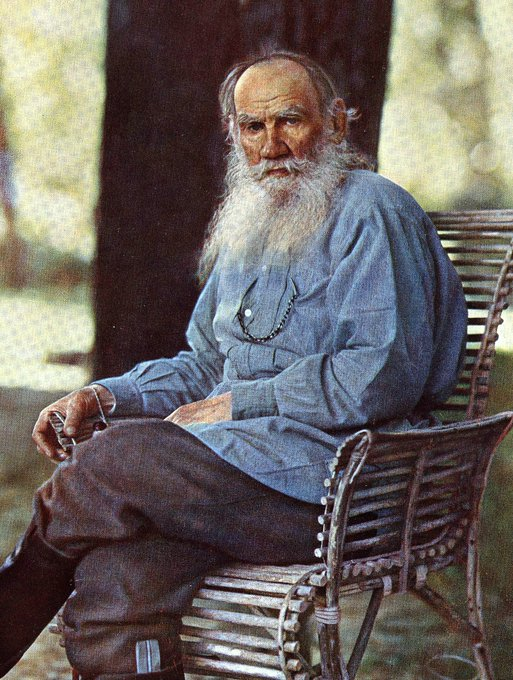
“Everyone thinks of changing the world, but no one thinks of changing himself. It is easier to wage a battle against distant abstractions than to fight the quiet war inside one’s own soul. Yet this is the only war that ever mattered.”
— Leo Tolstoy