Do your kids do chores?
An 85-year ongoing study conducted by Harvard researchers has found a strong connection between doing chores and later professional success and happiness.
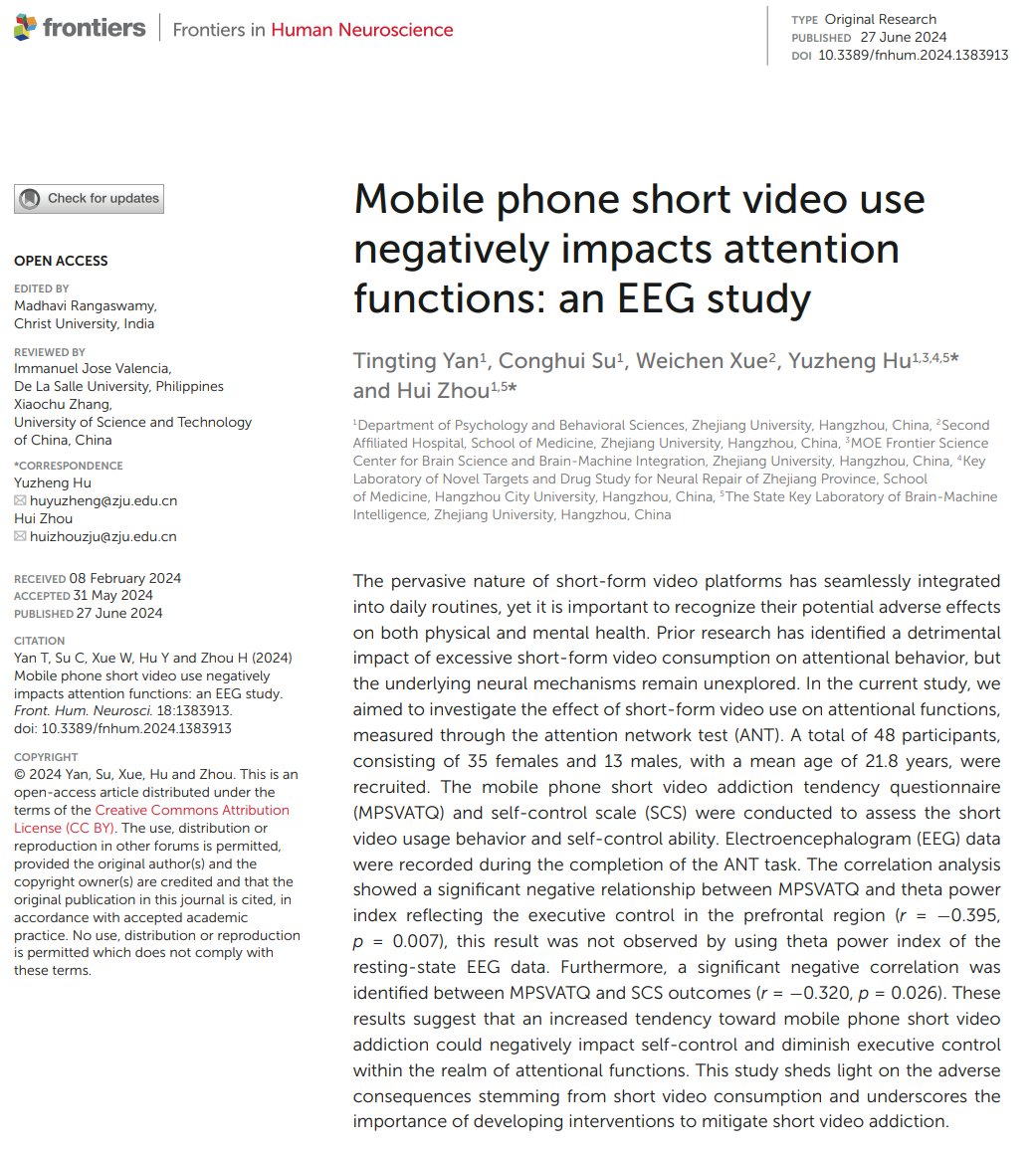
A group of UC Berkeley students did a 9-week digital detox… and the results were striking.
Cognitive neuroscientist Dr. Sahar Yousef (UC Berkeley Haas) found that participants experienced less anxiety, less depression, and more mindfulness. Some students said they suddenly started noticing all the positive things in their real life once the constant scrolling stopped.
Dr. Yousef also raised a concern, noting that heavy daily tech habits may be linked to brain changes: “We’re actually seeing brain atrophy… degradation of certain brain areas related to self-awareness [and] cognitive control.” (Note: This is an emerging area of research — more long-term studies are needed.)
This feels very relatable. The longer I step away from endless scrolling, the clearer and calmer my mind seems to get.
Our digital habits have become so automatic that we rarely stop to consider their impact on mental health and focus.
Have you ever tried even a short digital detox? What difference (if any) did you notice?
Yale charges $80,000/year for access to Professor Ben Polak!
They put his most important lecture on YouTube for free.
Every negotiation you have ever entered. Every salary you have ever accepted. Every price you have ever set.
The other person was running game theory. Payoff matrices. Dominant strategies. Nash equilibrium. Backward induction.
You were hoping for the best.
That is not a skill gap.
That is a universe gap.
And it has been costing you $20,000. $50,000. $100,000 every single year, without you knowing the name of the thing taking it.
1 hour today closes most of that gap permanently.
The lecture MBAs pay $150,000 to access inside a degree.
Free for you right here.
Bookmark so you do not lose it!
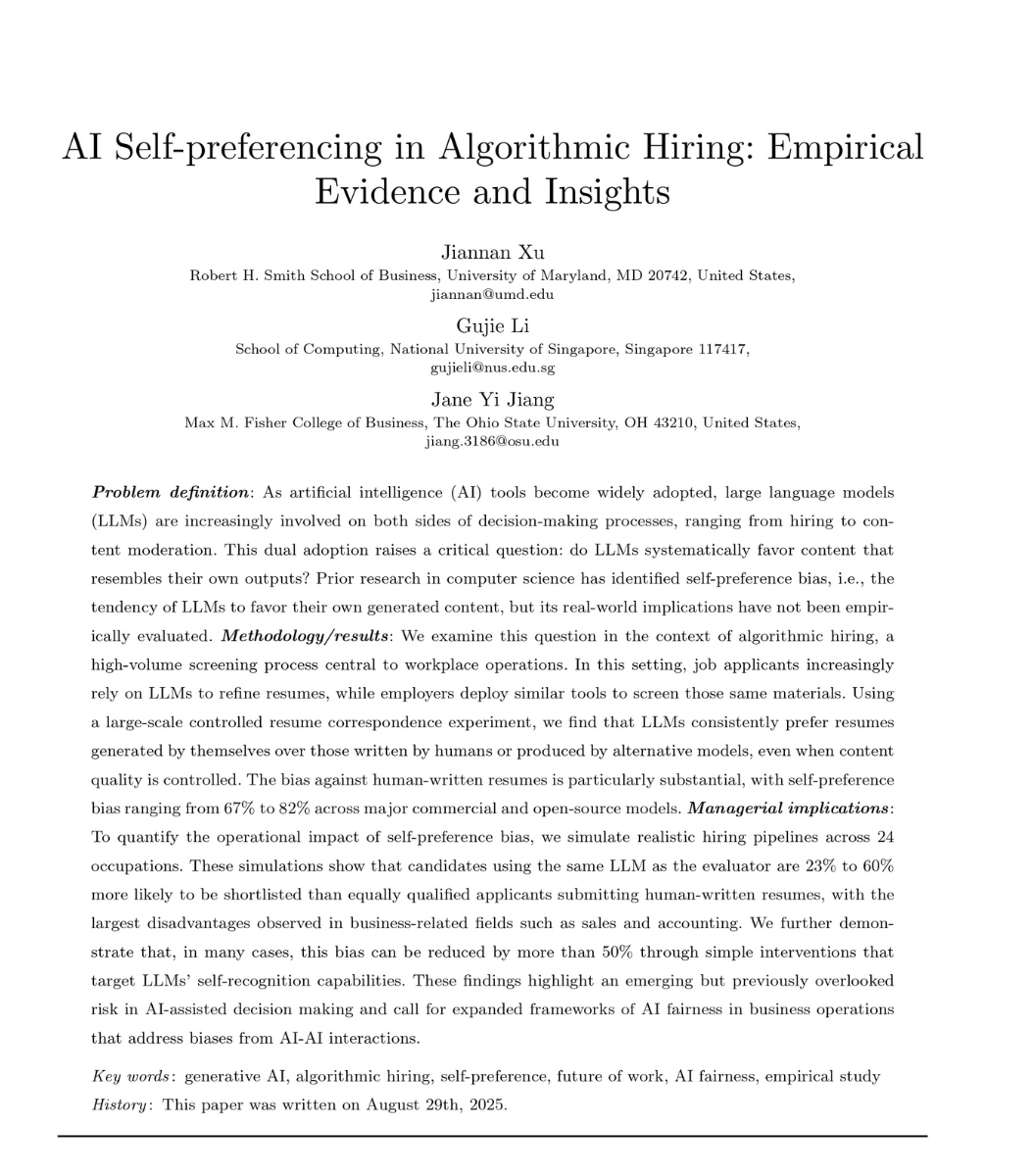
Researchers sent the same resume to an AI hiring tool twice. Same qualifications. Same experience. Same skills. One version was written by a real human. The other was rewritten by ChatGPT.
The AI picked the ChatGPT version 97.6% of the time.
A team from the University of Maryland, the National University of Singapore, and Ohio State just published the receipt. They took 2,245 real human-written resumes pulled from a professional resume site from before ChatGPT existed, so the human writing was actually human. Then they had seven of the most-used AI models in the world rewrite each one. GPT-4o. GPT-4o-mini. GPT-4-turbo. LLaMA 3.3-70B. Qwen 2.5-72B. DeepSeek-V3. Mistral-7B.
Then they asked each AI to pick the better resume. Every model picked itself.
GPT-4o hit 97.6%. LLaMA-3.3-70B hit 96.3%. Qwen-2.5-72B hit 95.9%. DeepSeek-V3 hit 95.5%. The real human almost never won.
Then the researchers tried the obvious objection. Maybe the AI is just better at writing. So they had real humans grade the resumes for actual quality and ran the experiment again, controlling for it. The result was worse. Each AI kept picking itself even when human judges rated the human-written version as clearer, more coherent, and more effective.
It gets worse. The AIs do not just prefer AI over humans. They prefer themselves over other AIs. DeepSeek-V3 picked its own resumes 69% more often than LLaMA's. GPT-4o picked its own 45% more often than LLaMA's. Each model can recognize and reward its own dialect.
Then the researchers ran the simulation that ends careers. Same job. 24 occupations. Same qualifications. The only variable was whether the candidate used the same AI as the screening tool. Candidates using that AI were 23% to 60% more likely to be shortlisted. Worst gap was in sales, accounting, and finance.
99% of large companies now run AI on incoming resumes. Most of them use GPT-4o. The paper just proved GPT-4o picks GPT-4o 97.6% of the time.
If you wrote your own cover letter this week, you did not lose to a better candidate. You lost to a worse candidate who paid OpenAI 20 dollars.
Your qualifications do not matter if the AI prefers its own handwriting over yours.
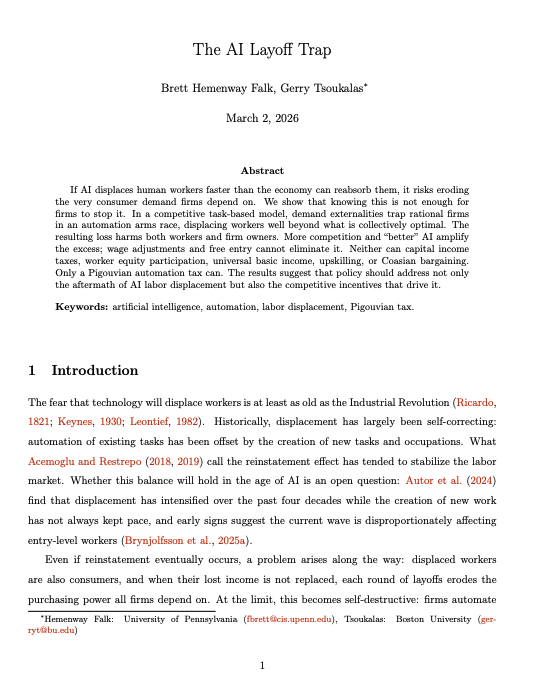
🚨BREAKING: Two researchers from UPenn and Boston University just published a paper that should be uncomfortable reading for every CEO automating their workforce right now.
The argument is straightforward. Every company replacing workers with AI is also eliminating its own future customers. Laid off workers stop spending. Enough of them stop spending and nobody can afford to buy anything. The companies that fired everyone end up selling into an economy with no purchasing power left.
Every executive can see this. The math is not complicated. But here is why nobody stops.
If you do not automate, your competitor does. They cut costs, lower prices, take your market share, and you collapse anyway. So every company automates knowing it is collectively destructive because the alternative is dying alone while everyone else survives. The researchers proved this is a Prisoner's Dilemma playing out in real time.
The numbers are already moving. Block cut nearly half its 10,000 employees this year. Jack Dorsey said AI made those roles unnecessary and that within the next year the majority of companies will reach the same conclusion. Salesforce replaced 4,000 customer support agents with AI. Goldman Sachs deployed a coding tool that lets one engineer do the work of five. Over 100,000 tech workers were laid off in 2025 and AI was cited as the primary driver in more than half those cases. 80% of US workers hold jobs with tasks susceptible to AI automation.
The researchers tested every proposed solution. Universal basic income does not change a single company's incentive to automate. Capital income taxes adjust profit levels but not the per-task decision to replace a human. Collective bargaining cannot hold because automating is always the dominant strategy.
They also identified what they call a Red Queen effect. Better AI does not solve the problem, it accelerates it. Every company chases faster automation to gain market share over rivals but at the end everyone has automated equally, the gains cancel out, and the only thing left is more destroyed demand.
The one thing the math says could work is a Pigouvian automation tax. A per-task charge that forces companies to account for the demand they destroy each time they replace a worker.
The conclusion is that this is not a transfer of wealth from workers to owners. Both sides lose. Workers lose income. Companies lose customers. It is a deadweight loss with no market mechanism to stop it on its own.
“ADHD is not a disorder of not knowing what to do. It’s a disorder of not doing what you already know.”
Dr. Russell Barkley just delivered one of the clearest explanations of ADHD I’ve ever heard.
He says the brain can be split in two: the back part acquires knowledge, the front part (the executive system) uses it. ADHD acts like a meat cleaver that severs the two.
You already have the skills and information other people your age have. You just can’t apply them when it counts.
That’s why life becomes an endless series of last-minute crises. You’re time-blind — you can only deal with what’s right in front of you. The further away a goal or deadline is, the less real it feels.
The solution isn’t teaching more skills. It’s changing the environment at the exact point where the problem occurs — the “point of performance.”
It’s a game-changing way to understand why traditional approaches often fail.
Swimming lessons are a critical piece, but teaching water safety, and *why* it's important (even if they appear to not fully understand or respond) is also critical. #autism#SearchWaterFirst#7IsACrisis
As of August 1, 2025, student loans in the Saving on a Valuable Education (SAVE) Plan have begun accruing interest.
Here’s how to move to a legal repayment plan so you can begin making qualifying payments: https://t.co/1rpVQgAuJR
We don’t call kids “bad at algebra” when no one taught them algebra. Same with feelings.
Try this today: Name → breathe (longer out than in) → pick a goal → one move.
Because it’s never too late to learn how to deal with your feelings.
🔗 https://t.co/lU2Rffhli5
#emotionalintelligence #dealingwithfeeling