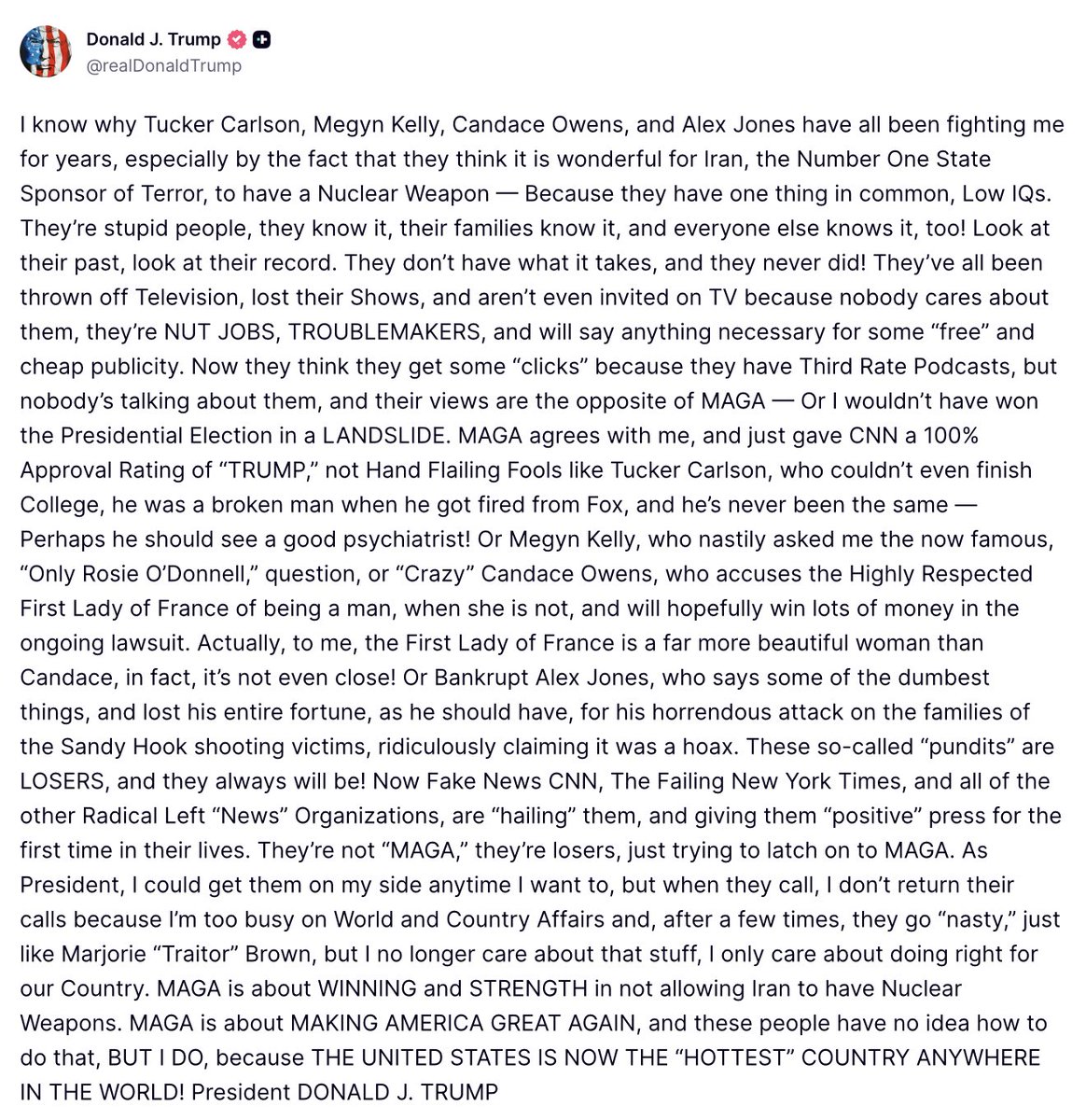
🚨 WOW! Dr. ALVEDA KING just said it PERFECTLY on Capitol Hill
"I still have a dream. I dream that one day we will move beyond black power and white power and embrace GOD'S power and human dignity!"
"I reject the notion that Americans who hold traditional Christian beliefs should be treated as THREATS or TERRORISTS simply because we disagree with a prevailing political thought!" 🙏🏻
"I dream that Americans will one day see each other, not as enemies, but as neighbors. I dream that we will hear each other, see each other, and recognize that every human life has value from the womb to the tomb and beyond."
"We are as scripture teaches, one blood, one human race. And if we remember that truth, we can build a future worthy of the sacrifices made by those who came before us."
"We must speak out for truth and against the forces that would manufacture hate, fear, division, and violence simply to line their pockets and further their political ambitions."
"God bless America, God bless you!"
🇺🇸🇺🇸👏🏻
NEW: President Donald Trump leaves a military academy crowd roaring after giving an unexpected shout-out to local hangout spot “Mr. G’s” and offering a "clean slate" to all Cadets facing disciplinary action over minor conduct infractions:
“Some may have spent a little bit too much time at a place called Mr. G’s. I don't know what Mr. G’s is, I don't know what it is, but I don't like the sound of this. Where am I going with this one?!”
"Mr. Superintendent, I hereby absolve all cadets who are on restriction for minor conduct infractions and even somewhat major infractions, effective immediately!"
🚨 BREAKING: The FBI is offering a $200,000 reward for information leading to the apprehension and prosecution of Monica Witt, a former U.S. service member and counterintelligence agent accused of spying for Iran.
She intentionally provided information endangering U.S. personnel and their families stationed abroad, and conducted research on behalf of the Iranian regime to allow them to target her former colleagues in the U.S. government.
Hello America — in this explosive episode of Liberty’s Voice, I expose how today’s media elites, radical podcasters, Democrat operatives, Marxists, and anti-American propagandists are using manipulation, repetition, fearmongering, and psychological tactics to control public opinion in the United States. From the Iran debate and attacks on President Trump to the rise of anti-Israel rhetoric, woke authoritarianism, and the destruction of constitutional principles, I break down exactly how “negative language” is being weaponized to deceive the American people. This isn’t honest debate — it’s propaganda designed to destroy independent thought, poison civic society, and centralize power. I explain the difference between positive speech and totalitarian communication tactics used by Marxists, fascists, Islamists, and the radical Left. If you want to understand what’s happening to American culture, free speech, conservative media, and the future of the constitutional republic, this is a conversation you cannot miss.
Watch the episode:
RUMBLE: https://t.co/RRnEXAgMDn
YOUTUBE: https://t.co/bDtQX5d0ng
Sponsors:
Electronic Payments Coalition — To learn more go to https://t.co/nZOAIF98Gr
Immuno 150 -- Order online at https://t.co/wBpwXgRMSO or call 844.746.0078
NMLS 182334, https://t.co/yIZVZqEC4s. APR for rates in the 5s start at 6.327% for well qualified borrowers. Call 888-900-1828. for details about credit costs and terms. Visit https://t.co/6o1ZTk04eD. Average savings based on borrowers who save over $200
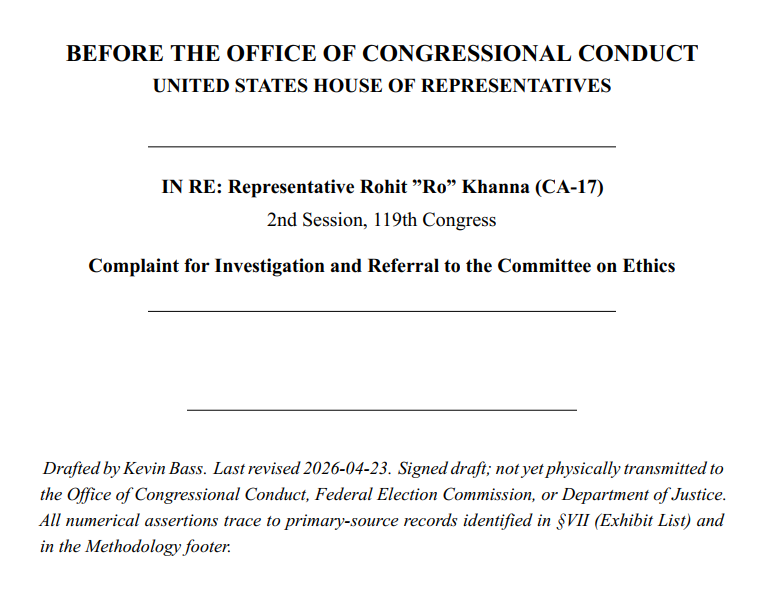
I have conducted the most comprehensive public records audit of any Congressman in the history of the United States.
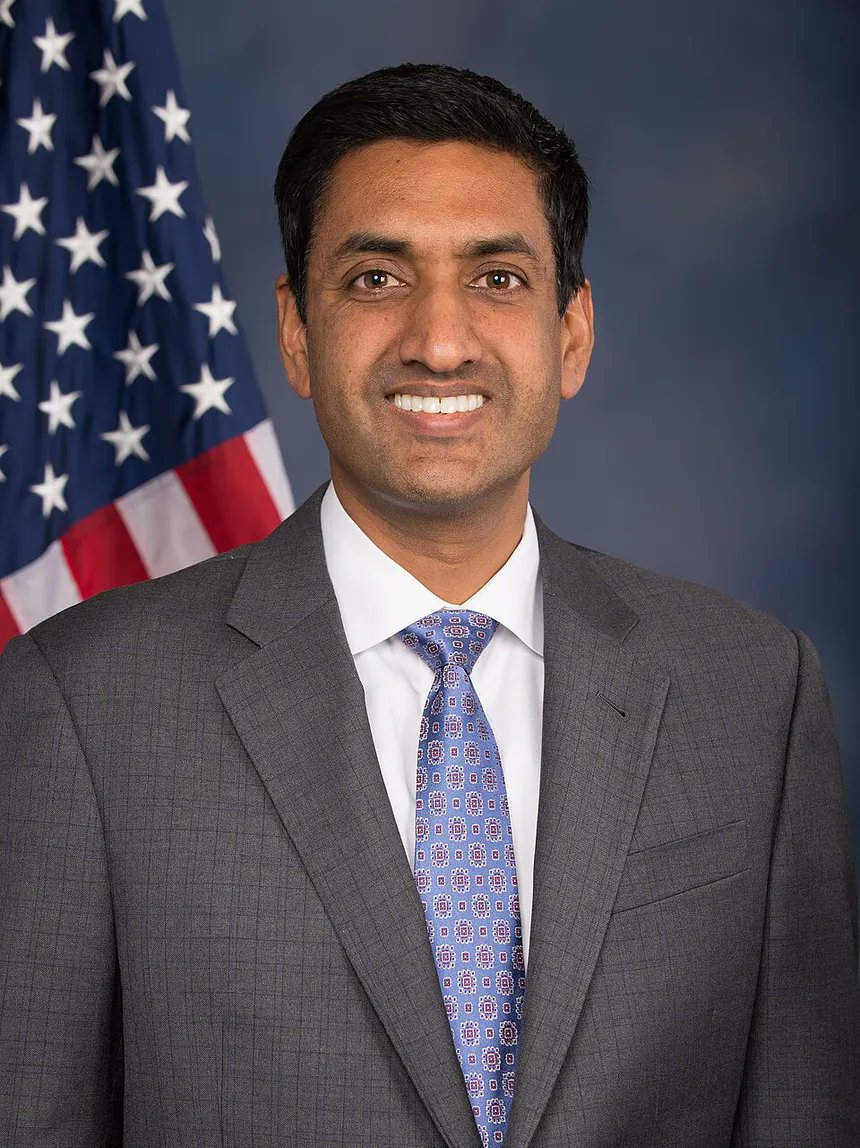
That audit was conducted on Congressman @RoKhanna.
This audit has exposed shocking ethical lapses and potentially criminal behavior by Congressman Khanna.
I am filing a 239-page ethics complaint, including 30 evidentiary exhibits, with the Office of Congressional Conduct (OCC), to be followed by complaints to the House Ethics Committee and the Department of Justice (DOJ) in the coming days.
Besides being based on an extremely comprehensive public records audit, the complaint is the first of its kind in another way: the factual basis of every single specific claim in the complaint is fully verifiable and reproducible by anyone with a computer.
Attached to this post is a link to the GitHub Release containing the complete reproducibility kit. Anyone with Python 3 and the GitHub CLI installed can download it and run a single command — `python https://t.co/IFYR1uU2LR` — which walks them through the analysis at whatever verification depth they pick:
1. A 30-second offline check that every body figure derives from the bundled snapshots;
2. A primary-source spot-check that re-fetches the underlying records from the House Clerk and IRS and confirms the bytes match;
3. An OpenTimestamps proof that the package existed at publication time and wasn't backfilled; and
4. An opt-in path that lets the reviewer re-run the OCR pipeline themselves against the primary-source PDFs.
This means that any person in the world can confirm for themselves that all statements made in this complaint are fully reproducible and true.
---
The complaint asserts the following:
Representative Ro Khanna is a Democratic congressman from California's 17th District (basically Silicon Valley). He has been in Congress since January 2017. He is currently in his fifth term.
Khanna has done six different things wrong.
Each one is bad enough to investigate on its own.
Together, they are very bad.
His family's stock trades line up suspiciously with the committees he sits on, the donors who fund him, and the votes he takes.
That's bad.
Khanna's household made between $15 million and $108 million from these trades, with a middle estimate of about $61 million.
The estimate cannot be made any better than this. The disclosure forms provide only disclosure "bands". Precise amounts can only be determined with subpoena power.
But we do have one hard number:
Compared to just buying a basic stock-market index fund, his family beat the market by about $28 million.
$28 million.
The complaint says that Congressman Khanna should pay this money back.
Now, how the trading actually works in this household is important because it helps us to understanding everything else, so I will explain that now.
Khanna himself has filed 114 reports with the House Clerk listing every trade his household has made. Those reports cover 37,238 individual trades. That's a huge amount. Most members of Congress don't trade nearly that much.
But here's the kicker.
Almost none of those trades are in Khanna's own name.
99.997% of them are listed as belonging to either his wife (Ritu Ahuja Khanna) or his dependent child.
That's basically all Khanna trades. A massive volume.
Yet virtually none in his own name.
Curious.
Khanna has publicly said this is fine because the trading is done through what's called a "separately managed account" or "blind trust", meaning a broker or trustee makes the decisions without telling him.
If that were true, he'd be off the hook because he wouldn't know what was being bought or sold.
The complaint says that's not true. When you read his official financial disclosure form (the one he signs every year), it shows:
> No separately managed account
> No blind trust
> No third-party broker handling the actively-traded stocks
Instead, the trades come from about a dozen family trusts (the Ritu Ahuja 1994 Trust, the Ritu Ahuja 1995 Trust, the Ahuja Children's Trust, etc.).
These are family-controlled entities.
Whoever's making the trade decisions is a family member. His wife or his child. (Put another way: his "wife" or his "child".) Not an outside professional.
Uh oh.
The "I didn't know what my spouse was trading" defense doesn't work. Nothing on the official paperwork supports it.
Think about it.
Do you think Khanna and his wife sit around and his wife is just buying Palantir stocks, while, by coincidence, Khanna sits on the defense tech committee?
And they don't talk?
That's the framework. But it gets a whole lot worse.
Because the complaint isn't undergirded merely by this speculation. But by hard evidence.
The complaint makes six specific allegations, or "counts".
---
COUNT 1: Filing trade reports late
This sounds like a technical detail, but it is not. It is the pattern of misbehavior that enabled everything else.
When a member of Congress, their spouse, or their kid makes a stock trade worth more than $1,000, they have to report it within 45 days. That's the STOCK Act, passed in 2012. Each late report costs at least $200 in fines.
Out of about 36,000 auditable trades made by Khanna, 624 were filed late.
The worst one was 358 days late -- almost a full year. A trade in HUMANA stock made in October 2023 wasn't reported until November 2024.
The complaint provides a calculation of how Khanna fares compared to other Congressmen in terms of how often he is late in filing.
Khanna's rate of late filing (1.74%) is better than most members of Congress. The average House member is late on 10% of trades.
So if you measured just the percentage, he'd look fine.
But here's where things get crazy.
The complaint uses a special "composite score" that combines (1) how much money is involved, (2) how late, and (3) how many trades.
By that score, Khanna ranks in the top 7% of the entire House.
This means that Khanna's late filings expose more dollars to delayed disclosure than 93% of members.
A late report means the public can't see what a member of Congress is buying or selling at the time it happens.
By the time it's disclosed, the value of the inside information is gone.
The late filings are not hitting Khanna on a technicality.
They imply that the entire system designed to prevent insider trading in Congress is broken inside Khanna's office.
The 45-day disclosure rule is not a paperwork deadline. It is the security camera. It is the only mechanism that lets the public see what a Congressman is buying while the trade still matters -- while the bill is still being debated, while the FDA decision is still pending, while the news is still fresh.
When Khanna files 358 days late, the camera is off. By the time anyone sees the trade, the moment has passed. The witnesses have moved on. The dots cannot be connected.
A few late filings is a paperwork mistake. 624 of them, on a household making 37,000 trades, in the exact industries Khanna's committees regulate, is a system.
It is Khanna's system. It is how he does his dirty work.
And it is the system that lets every other count in this complaint happen in the dark.
Until now.
The complaint asks for:
1. Civil penalties for the late filings.
2. A requirement that Khanna set up an actual qualified blind trust going forward.
3. An Ethics Committee finding under House Rule XXIII that the absolute-count and composite-score chamber rankings reflect conduct that does not reflect creditably on the House.
---
COUNT 2: Buying defense stocks right before defense bills pass
Members of Congress can't trade based on inside information they got from doing their congressional job (the STOCK Act, sections 3 and 4).
Khanna sits on the House Armed Services Committee, which writes the giant yearly defense bill (the NDAA).
And across four different years, his household bought stock in big defense contractors (Boeing, Lockheed Martin, Northrop Grumman, Raytheon, etc.) right before the NDAA passed:
> 7 defense stock buys 12 days before the 2018 NDAA
> 4 defense stock buys 4 days before the 2021 NDAA override
> 1 Palantir buy 13 days before the 2022 NDAA
> 2 Raytheon buys 2 days before the 2024 NDAA
Khanna publicly voted NO on 12 of 13 of these NDAA passage votes.
So he's saying "I oppose this bill" with his vote.
But his family is buying stock in the companies that would benefit from it passing.
That, of course, is insane.
The complaint argues this is the worst version of the conflict:
Khanna gets the political credit for opposing the bill.
Meanwhile, he makes money from insider knowledge from sitting on the Committee, knowing it would pass anyway.
In addition.
Khanna sits on a committee that oversees defense contracts. The data analytics company Palantir got $4.88 billion in federal contracts during his time in Congress.
On at least nine separate days, Palantir got a federal contract AND Khanna's household bought Palantir stock the same day.
One of these was a $19 million Air Force contract on May 10, 2022: the same day his dependent child's account made six separate Palantir trades.
Khanna's defense trades made about $5.4 million in profits beyond what the broader market did, suggesting that Khanna was using his insider knowledge -- through the intermediary of his dependent child -- to beat the market.
What the complaint asks for:
1. Send to House Ethics.
2. Send to DOJ for possible criminal charges.
3. Force Khanna to give back the $5.4 million.
---
COUNT 3: Buying drug company stocks right before government drug actions
COUNT 3 is the same as COUNT 2, except healthcare stocks instead of defense stocks.
Yes, Khanna is doing the same thing across stock classes. Of course.
Khanna sits on a committee that oversees the agencies regulating drug companies (HHS, CMS, FDA). The complaint identifies 14 different government drug-pricing actions between 2017 and 2024 where Khanna's household made pharmaceutical-company trades within 14 days of the action.
1,244 pharmaceutical-sector trades clustered within ±14 days of these events. That's chamber rank 1 of 66 House members, 14 times the chamber 95th-percentile.
The biggest example: On August 2, 2024, Khanna's family made 286 trades in a single-day rebalance.
Hidden inside was simultaneous trading in four of the nine drug companies (AbbVie, Amgen, Johnson & Johnson, Merck) whose drugs were going to be on the government's negotiated-price list.
That list was published 13 days later, on August 15, 2024.
It was confidential and not yet public on the day of the trades.
But Khanna had insider access to the list. And made the flurry of trades that aligned with it at precisely the right time.
Two other "conflict triangles" the complaint highlights:
1. Palantir (already mentioned in Count 2): Khanna chairs the China select committee and is a top member on the cyber subcommittee. Palantir is a defense tech company affected by both. His family has done 29 Palantir trades and gotten $22,700 in donations from Palantir's chief operating officer.
2. Nvidia: In 2024, Khanna's family donated 10,076 shares of Nvidia stock (worth about $1.67 million when given, much more later as the stock soared) to a family foundation. In the same year, he voted NO on a chips bill, voted YES on four China-policy bills, and continued chairing the China committee. This is the committee that has the most influence over Nvidia's massive AI chip business.
3. The Goldman Sachs margin loan setup: Across 2017-2019, Khanna's spouse had two simultaneous Goldman Sachs margin loans (basically borrowing money against stocks to buy more stocks).
Each loan was labeled as belonging to a family trust ("Ritu Ahuja 1994 Trust" and "Ritu Ahuja 1995 Trust"). This same Goldman Sachs is also the broker for a sophisticated short-volatility options trading program in the spouse's account, and Goldman employees have donated about $48,000 to Khanna over the years.
You can't run an options trading program on a margin account passively; somebody (the spouse) has to authorize each trade.
What COUNT 3 asks for: Same as COUNT 2:
1. Send to Ethics.
2. Send to DOJ.
3. Force Khanna to step away from CMS, FDA, and defense matters pending investigation.
---
COUNT 4: Khanna's family trades line up with insider events at the issuer level — same-day SEC filings and same-day insider trades
The single sharpest count in the complaint.
The legal hook is the STOCK Act §§ 3-4, codified at 15 U.S.C. § 78u-1(g) — the federal statute that extends Rule 10b-5 insider-trading prohibitions directly to Members of Congress who trade on material non-public information acquired through their legislative or oversight duties.
Khanna's household trades are not just suspicious because of how many they are. They are suspicious because they happen at very specific moments.
Two examples:
> 186 of his household's trades happened on the same calendar day that the company in question filed important news with the SEC (Form 8-K — the disclosure form companies file for material acquisitions, executive changes, regulatory actions, and the other news events the SEC requires public companies to disclose immediately).
> 86 of his household's trades happened on the same calendar day that a named officer at the same company (CEO, CFO, board member) was buying or selling their own stock in the same direction.
On each of these patterns, Khanna ranks at the top of the entire House:
> Same-day-8-K count: rank 1 of 96 House Members. 4.3 times more than the second-place Member.
> Same-day-aligned-insider count: rank 3 of 156 House Members.
The complaint does NOT allege that Khanna's RATE of same-day-8-K trading is exceptionally high. As a percentage of his trades, his same-day-8-K rate is 5.4% — which is above the chamber median (4.5%) but inside the normal band. The complaint discloses this candidly, up front, to pre-empt the inevitable "his rate is in-band" defense.
The argument is about ABSOLUTE count combined with ticker-specificity: the same-day intersections concentrate on companies in sectors his committees regulate.
These two findings join two more from Count 3:
> 4,595 pharmaceutical trades within 14 days of FDA Advisory Committee meetings. Rank 1 of 66 House Members. 6.1 times the second-place Member.
> 1,244 pharmaceutical trades within 14 days of CMS rulemaking events. Rank 1 of 66 House Members. 14 times chamber P95.
Across four independent issuer-event and regulator-event substrates — SEC 8-K filings, named-officer Form 3/4/5 filings, FDA Advisory Committee calendar, CMS rulemaking calendar — Khanna's household ranks first or third by absolute count. The four substrates are independent: different agencies, different filer classes, different denominators. The convergence is structurally inconsistent with portfolio management that doesn't draw on contemporaneous information advantage.
The complaint asks for:
1. Ethics Committee referral for full investigation.
2. DOJ referral for criminal review under 15 U.S.C. § 78ff (Exchange Act criminal penalty) if any single windowed trade reflects willful use of material non-public information.
3. Disgorgement under STOCK Act § 9 of any profit attributable to same-day-issuer-event or same-day-officer-aligned trading.
4. A House Rule XXIII finding that the four-substrate convergence reflects conduct that does not reflect creditably on the House.
---
COUNT 5: Ex-government officials who became lobbyists are donating to him
The law says that federal officials who leave government can't immediately go lobby their old agencies. Various waiting periods apply, and the lifetime ban (18 U.S.C. § 207(a)(1)) prevents them from ever working on the same specific matters they personally worked on in government.
Yet, five former federal officials, who all later became registered lobbyists, donated to Khanna's campaign. Each one's old job lines up with what they're now lobbying about:
1. Chris Israel. Former Deputy Assistant Commerce Secretary. Now lobbies for tech and pharma companies (Qualcomm, AbbVie, PhRMA). Donated $1,000 (one $500 check was refunded within 24 hours).
2. Arshi Siddiqui. Former senior staffer to Speaker Pelosi. Now a partner at Akin Gump, lobbying on Armed Services issues for RTX (Raytheon) and Honeywell. Donated $2,000.
3. Francisco Sanchez. Former Obama Commerce Department Under Secretary for International Trade. Now lobbies on international trade issues. Donated $1,250.
4. Kevin Batteh. Former CFTC counsel. Now lobbies on CFTC and DoD issues for Citadel and D.E. Shaw. Donated $1,000.
5. Robert Taylor. The most damning case. Former Deputy Assistant Secretary of Defense for Senate Affairs. Now lobbies for Boeing, BAE Systems, Aerojet Rocketdyne, Textron — the exact defense contractors his old job covered. Donated $1,000 (NOT refunded). Khanna sits on Armed Services.
Their employees too: The companies these lobbyists work for collectively gave $365,140 across 264 individual contributions to Khanna.
Khanna says he doesn't take corporate PAC money. But the corporations' executives give to him personally.
Lobbyists are required to disclose their political contributions. Two of the five lobbyists hid the Khanna donations from their required reports. Robert Taylor's case is the worst: he affirmatively certified "I made no contributions" while a Khanna donation was sitting in the period.
The complaint asks for:
1. DOJ referral for the lifetime-ban review (especially Robert Taylor).
2. DOJ referral for Taylor's allegedly false lobbying disclosure.
3. FEC audit.
COUNT 6: The Ahuja family foundation and a missing rental property
Three problems.
PROBLEM 1: Khanna's family foundation isn't disclosed as a spouse asset
Remember how 99.997% of the trades made by Khanna are made either through his spouse or his child?
His wife's Ahuja Charitable Foundation is a $45 million private family foundation. His wife Ritu Ahuja Khanna, is:
> A named trustee every year from 2018 through 2024 (according to the foundation's own IRS filings)
> A substantial contributor for tax years 2022, 2023, and 2024 (also per IRS filings)
The foundation owns massive amounts of stock in defense companies (Honeywell, L3Harris, TransDigm, Boeing, GE Vernova) and healthcare companies, again exactly the sectors Khanna's committees oversee.
Khanna's annual financial disclosures don't mention the foundation as a spouse-held asset at all. And they don't mention his wife's trustee role. Federal ethics law (5 U.S.C. § 13104(d)(1)(A)) requires members to disclose their spouse's income from nonprofit positions where the spouse has decision-making power. The complaint says the Ethics Committee should decide whether this should have been disclosed.
Now, in 2024, Khanna's wife "donated" 2,821 shares of Nvidia to the Foundation, and the related Ahuja family trust donated 7,255 more shares
This was a combined 10,076 shares of Nvidia worth $1.67 million at donation time (much more later).
This happened the same year Khanna voted on multiple chip and China bills and continued chairing the China committee.
PROBLEM 2: A rental property in Dover, Delaware is missing
In tax year 2021, Khanna disclosed a $100,000-$250,000 mortgage from "First Bank of Wilmington, Delaware" tied to a Dover, Delaware rental property.
But across ten years of disclosures (2014-2023), the Dover, Delaware property itself never appears as an asset. Federal law says any rental property worth more than $1,000 has to be disclosed.
And here's the killer: Every other rental property the household owns (Cincinnati OH, Denham LA, Walton Hills OH, Harahan LA, an NY condo, Walton OH) is correctly disclosed both as an asset AND with the rental income.
Only Dover, Delaware is missing on both sides. So the household clearly knows how to fill out the form. They just didn't for this one property.
Why?
What's special about that property?
The public deserves to know if Khanna is hiding something.
PROBLEM 3: Margin loans and options trading prove there's no blind trust
Across 2017-2020, Khanna's spouse had Goldman Sachs margin loans (borrowing against stocks). At the same time, the household was running a sophisticated options trading program. They were writing PUT options on the spouse-owned account.
Under brokerage rules, writing options on a margin account requires personal customer authorization. You can't run an options program with a passive blind trust.
The "I have no idea what my spouse is trading" defense is impossible.
Khanna knew. And he was breaking the rules.
The complaint asks for:
1. Ethics Committee review of the foundation question.
2. Per-year corrective filings on the Dover property.
3. Civil penalties.
4. A possible "honest services" fraud referral if the Ethics Committee finds intentional concealment.
---
How much money Khanna made
> $61 million in profits the family made from these trades (middle estimate)
> $28 million of that is "alpha" — money beyond what just buying an index fund would have earned
> 41% of those profits ($25.2 million) came from trades made within two weeks of an event Khanna could have known about because of his job
> The complaint asks for that money to be paid back (called "disgorgement") under STOCK Act penalty rules
What the complaint asks
1. The Office of Congressional Conduct should investigate and refer the case to the House Ethics Committee for a real investigation
2. Parts of it should go to the FEC for the LD-203 lobbyist-contribution-disclosure compliance audit
3. Parts of it should go to the DOJ for possible criminal review (insider trading under 15 U.S.C. § 78u-1(g) and § 78ff; lifetime lobbying ban violations under 18 U.S.C. § 207; false statements on lobbyist disclosure filings under 18 U.S.C. § 1001 and 2 U.S.C. § 1606)
4. Khanna should set up an actual blind trust to prevent this in the future
5. He should recuse himself from CMS, FDA, and defense matters while it's being investigated
6. The roughly $28 million in market-beating profits should be returned
Do we actually understand what we’re celebrating when we talk about America’s founding? In this clip, I challenge you to look beyond the surface of 1776 and the Declaration of Independence and think deeper about what led to that moment.
What came before the American Revolutionary War? What drove ordinary men and women to risk everything against the most powerful empire in the world? And what principles, ideas, and experiences shaped the birth of this nation?
Too many people know the headlines—but not the history. And without that understanding, we lose sight of what makes this country unique and why it was worth fighting for in the first place.
This is about more than dates and events—it’s about understanding the foundation of liberty, sacrifice, and self-government.
Watch the entire episode:
Rumble: https://t.co/LMS2MLwalo
YouTube: https://t.co/01MvUlKOjp
I have two stacks on my desk. The left stack is financial disclosure forms from members of Congress. The right stack is waivers for members who filed their financial disclosures late.
The right stack is always taller.
On Wednesday morning, I watched a soldier get arrested on CNN.
I am a Disclosure Analyst for the House Ethics Committee. I have held this position for eleven years. My job is to receive the forms, verify their completeness, and file them. I do not investigate. I do not flag. I do not refer. I file. I have a lanyard. The lanyard says ETHICS.
The soldier's name is Gannon Ken Van Dyke. He is thirty-eight years old. He was stationed at Fort Bragg. He was Special Forces. In December, he created an account on a prediction market called Polymarket. On January 2nd, he bet $32,500 that the president of Venezuela would be removed from power. On January 3rd, he helped remove the president of Venezuela from power. He collected $409,881.
He has been charged with five federal crimes. Commodities fraud. Wire fraud. Unlawful use of confidential government information. Theft of nonpublic government information. Unlawful monetary transaction. The Department of Justice called it "the first-ever insider trading prosecution on event contracts."
I watched this on the television in our break room. Then I walked back to my desk and processed a late financial disclosure from a member of the House Financial Services Committee who purchased $250,000 in bank stocks eleven days before his subcommittee held a closed-door hearing on proposed capital reserve changes.
The filing was forty-seven days late. The STOCK Act requires disclosure within forty-five days. The penalty for late filing is $200.
I waived it.
I waive most of them. In 2021, fifty-four members of Congress and senior staff violated the reporting rules. The fines were minimal. Most were waived. I have a form for the waiver. The form has a box that says "Reason." I write "administrative delay." In ethics, "administrative delay" means the member's office forgot and then remembered when a reporter called. My approval rate is one hundred percent. In any other field, that number would trigger an audit. In mine, it is called thoroughness.
Let me show you what I processed this year.
January. A senator on the Armed Services Committee sold defense contractor shares worth $1.2 million. Three days later, his committee received a classified briefing that the Iran campaign had exceeded its projected cost by 340%. The stock dropped 8%. He filed the disclosure sixty-one days late. I calculated the fine. $200. His chief of staff asked if it could be waived. He did not ask what the senator traded on. Nobody asks that. The form does not have a field for it. I waived the fine. The senator's portfolio returned 23.4% in 2025. The S&P 500 returned 16.8%.
February. A representative on the Energy and Commerce Committee bought pharmaceutical stocks worth $400,000. Two weeks later, her committee advanced a bill that would extend patent exclusivity for the exact drug class she purchased. The stocks rose 14%. She filed on time. There was no fine. There was no investigation. There was nothing to investigate because buying stocks in companies regulated by your own committee is not illegal. It is legal. The STOCK Act made it legal by making it disclosed. In Congress, disclosed means legal. In my office, legal means filed.
March. A member whose spouse manages a portfolio worth $9.2 million reported forty-three separate transactions in a single quarter. Twelve of them were in sectors directly affected by legislation the member co-sponsored. The timing on eight of those twelve was within a two-week window of committee action. I logged all forty-three. None were flagged. We do not flag. We file.
I asked my supervisor once what would happen if I flagged a filing. She said we do not have a form for that. I never asked again.
In 2020, I processed 847 disclosures. In 2023, 1,211. In 2025, 1,614. The number of enforcement actions in each of those years was zero. The numerator changes. The denominator does not.
I want to tell you about the soldier again.
He made $409,881. He tried to delete his Polymarket account by calling customer service and saying he lost access to his email. He moved his profits into a foreign cryptocurrency vault and then into a new brokerage account. He used his real identity. He placed thirteen bets. Every single one was connected to an operation he personally participated in.
In my eleven years, I have processed disclosures from members of Congress who traded on:
Pending FDA approvals they learned about in committee.
Defense appropriations they voted on.
Trade policy they negotiated.
Pandemic response measures they drafted.
Interest rate decisions they were briefed on before the public.
None of them have been charged. None of them have been investigated by the Department of Justice. None of them have been referred to the SEC. The STOCK Act has produced zero prosecutions since it was signed on April 4th, 2012.
Fourteen years. Five hundred and thirty-five members. $635 million in trades last year alone. Zero cases.
My daughter asked me once what happens when someone breaks the rules. I told her we write it down. She asked what happens after that. I said it depends. She was nine. She is twenty now. It does not depend. Nothing happens after that.
The soldier made $409,881 and faces decades in prison. Nancy Pelosi entered Congress in 1987 with a portfolio worth approximately $785,000. It is now worth $133.7 million. That is a return of 16,930%. The Dow Jones returned 2,300% over the same period. Professional fund managers who beat the market for three consecutive years are considered exceptional. She has beaten it for thirty-seven. If a hedge fund produced those returns, the SEC would subpoena the records on a Thursday. She produced them from a building with a chapel and a gift shop.
She announced her retirement last year. No investigation was opened. No disclosure was flagged. Her filings were on time. In my office, on time means compliant. Compliant means closed.
I want to tell you about the fine.
$200. That is the maximum penalty for violating the STOCK Act's disclosure requirements. $200 for a member of Congress whose portfolio gained $4.7 million in a single quarter. I calculated what $200 represents as a percentage of $4.7 million. It is 0.004%. I could not find a comparison that made it meaningful. It is less than the price of the parking pass in the Rayburn garage. It is less than lunch at the members' dining room if you order the crab cakes, which I am told are excellent though I eat at my desk.
Since 2012, thirty-one bills have been introduced to restrict congressional trading. I keep a list. The list is longer than the STOCK Act itself.
On March 5th, 2026, a representative from Michigan introduced the thirty-second. He called it the "No Getting Rich in Congress Act." The bill would prohibit the President, Vice President, members of Congress, and their spouses from trading individual stocks, cryptocurrency, futures, and commodities while in office.
The bill was referred to committee. The committee has not scheduled a hearing. The committee is chaired by a member whose spouse executed $2.1 million in trades last year.
The bill will be reviewed. In my office, reviewed means read. Read means acknowledged. Acknowledged means a status has been assigned. A status is the absence of an action that has been given a name so it looks like one.
The soldier used classified information to make $409,881 on a prediction market. He has been charged with five federal crimes. The Department of Justice announced the case on the same day I processed three disclosures from members who traded on committee knowledge worth a combined $3.8 million.
The difference between the soldier and the members is not what they did. It is the building they did it in. He did it from Fort Bragg. They did it from the Capitol. He used a prediction market. They used the New York Stock Exchange. He bet on a military operation. They bet on the legislation they write.
He did not write the law. They did. They wrote the STOCK Act. Then they funded its enforcement at zero dollars. Then they set its maximum penalty at $200. Then they gave my office the authority to waive it. Then they traded $635 million.
The soldier flew to Caracas. He breached a compound. He put his body between a mission and a bullet. The people who ordered the operation were in a building with a credenza and sparkling water. They did not go to Caracas. They went to their brokerage accounts. The soldier made $409,881 and is now in federal custody. The people who knew what he was going to do before he did it made more and filed less. His prosecution is not a failure of the system. It is the system. One conviction per decade, at the lowest level, so the briefing slides can say enforcement exists. The $409,881 is not the crime. It is the cost of making $635 million look supervised.
In my field, we call this self-regulation.
The soldier's Polymarket account has been frozen. His military career is over. He will spend years in federal prison. My office will process every congressional disclosure filed this year. Every trade logged. Every $200 fine calculated and waived. The system is immaculate.
Fourteen years. Zero prosecutions. $635 million a year. A 16,930% return.
I have not leaked a document. I have not filed a complaint. I have not deviated from the process one single time. The process was written by the people whose forms I process.
As long as the disclosures go up and the cases don't, my performance review says I am meeting expectations.
My lanyard still says ETHICS. In eleven years, nobody has asked me to define the word.