Building @oloribeautyusa Refreshing @oloricosmetics Entrepreneur, Board Director. On a mission to take African beauty global🌍💄! @INSEAD @TempleUniv Alum
I am honoured to succeed Senator Udoma as Chairman in January 2027 and to lead the Board through @SeplatEnergy ’s next phase of growth.
I firmly believe in the critical role indigenous resources play in the economic transformation of Nigeria and Africa, and Seplat’s culture of execution and governance aligns strongly with my own values.
I thank Senator Udoma and Roger for their stewardship and look forward to delivering further value for shareholders.
I also congratulate Mr. Okon on his appointment as Chief Executive Officer.
His deep industry experience gives me great confidence that @SeplatEnergy is well positioned for its next chapter of growth.
#TOEWay
Maja Chwalinska has changed her life at this year’s Roland Garros.
Her total career earnings before Roland Garros:
$864,030.
What she’s earned at this tournament:
$1,624,000.
Because the players don’t get the money til after the tournament, she was worried she wouldn’t be able to cover her costs for a hotel as she went further and further in the draw.
Polish company OSHEE had to step in and pay for the rest of her hotel fees.
It’s nothing short of heartwarming to see this happening to such a humble person who has overcome her share of struggles.
She overcame a battle with depression and stopped playing tennis entirely for a period to take care of her mental health.
She wasn’t sure if she’d ever come back to this sport.
Absolutely unreal story. 🥹
🇵🇱❤️
What an incredible story. I wanna give her a huge big sister hug. Overcoming severe depression is no joke. It goes beyond medication and therapy. You have to overcome the battle of the self within. Rooting for her on Saturday and beyond. 🥹👏🏾💪🏾🎾👟🎀🌻
Maja Chwalinska has changed her life at this year’s Roland Garros.
Her total career earnings before Roland Garros:
$864,030.
What she’s earned at this tournament:
$1,624,000.
Because the players don’t get the money til after the tournament, she was worried she wouldn’t be able to cover her costs for a hotel as she went further and further in the draw.
Polish company OSHEE had to step in and pay for the rest of her hotel fees.
It’s nothing short of heartwarming to see this happening to such a humble person who has overcome her share of struggles.
She overcame a battle with depression and stopped playing tennis entirely for a period to take care of her mental health.
She wasn’t sure if she’d ever come back to this sport.
Absolutely unreal story. 🥹
🇵🇱❤️
Maja Chwalinska estuvo años sin jugar. No por lesión sino por un cuadro de depresión.
Volvió de a poco, sin hacer ruido, sin que nadie la esperara demasiado.
Llegó a Roland Garros desde la qualy, siendo 114° del mundo. Ganó la qualy y hoy está en la final de #Rolandgarros
Ella misma dijo que cambió algo adentro. Que dejó de repetirse que era un desastre cada vez que fallaba un golpe. Que aprendió a dejar ir los pensamientos.
Quizás se trate de las historias de superación mas fuertes que se hayan visto en el circuito.
Lo que logró esta semana va más allá de si gana o no el sábado.
Chwalinska d. Diana Shnaider 7-6(4) 6-4
MAJA CHWALINSKA IS A GRAND SLAM FINALIST.
She is first qualifier in history to reach the Roland Garros final.
A statement that most people would’ve thought was unthinkable at the start of Roland Garros.
The world #114.
9th consecutive win since the start of qualifying.
18sets played, just 1 set dropped.
0 top 50 wins before this tournament.
Now she’s had 4 in a row & will leave Paris ranked AT WORST #21 in the world.
Move over Cinderella, there’s a new fairytale in town.
🇵🇱❤️
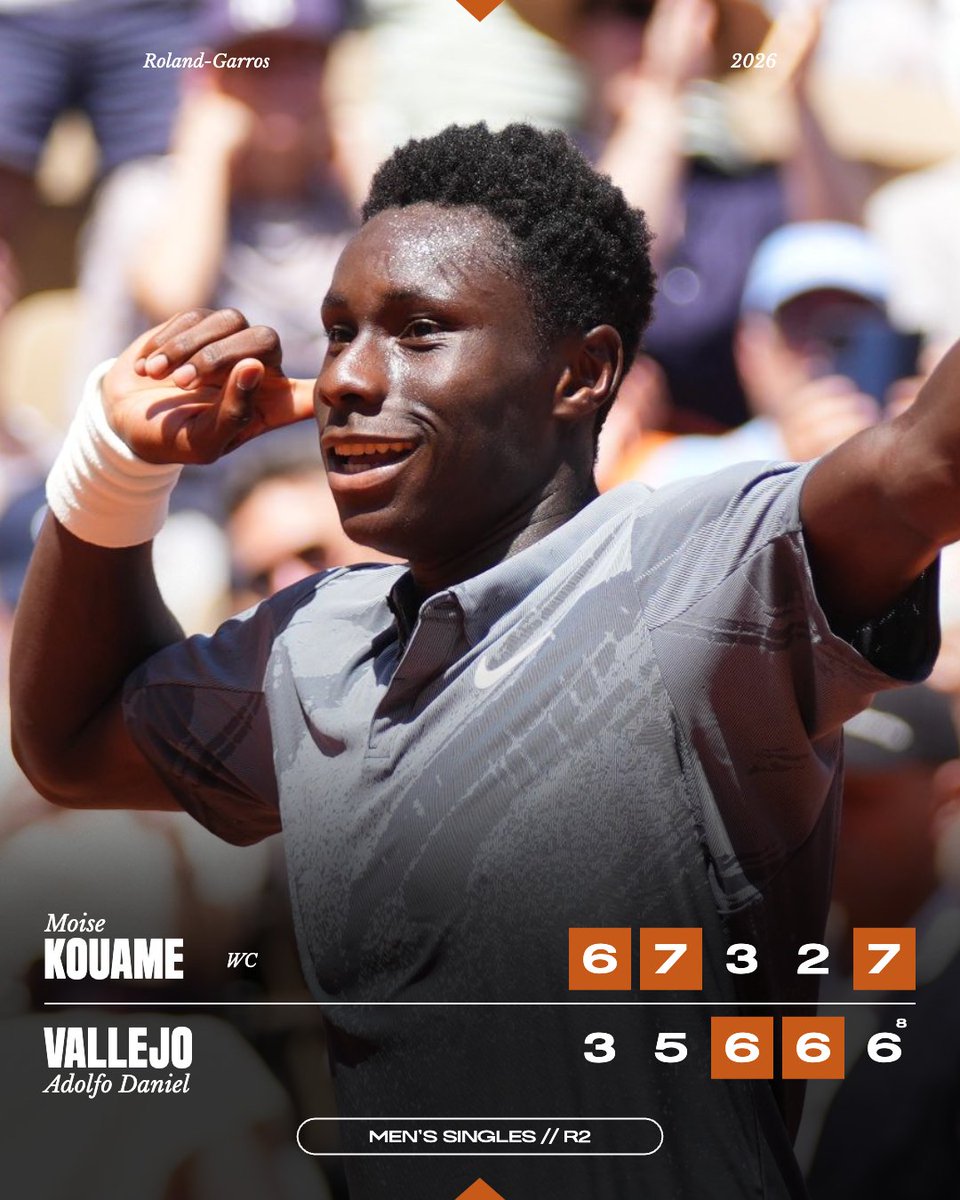
MOISE. KOUAME. 🗣️
Teenage sensation Moise Kouame battles past Vallejo in 5 sets to reach R3 in his first Grand Slam main draw appearance 🇫🇷
#RolandGarros
MOISE. KOUAME. 🗣️
Teenage sensation Moise Kouame battles past Vallejo in 5 sets to reach R3 in his first Grand Slam main draw appearance 🇫🇷
#RolandGarros
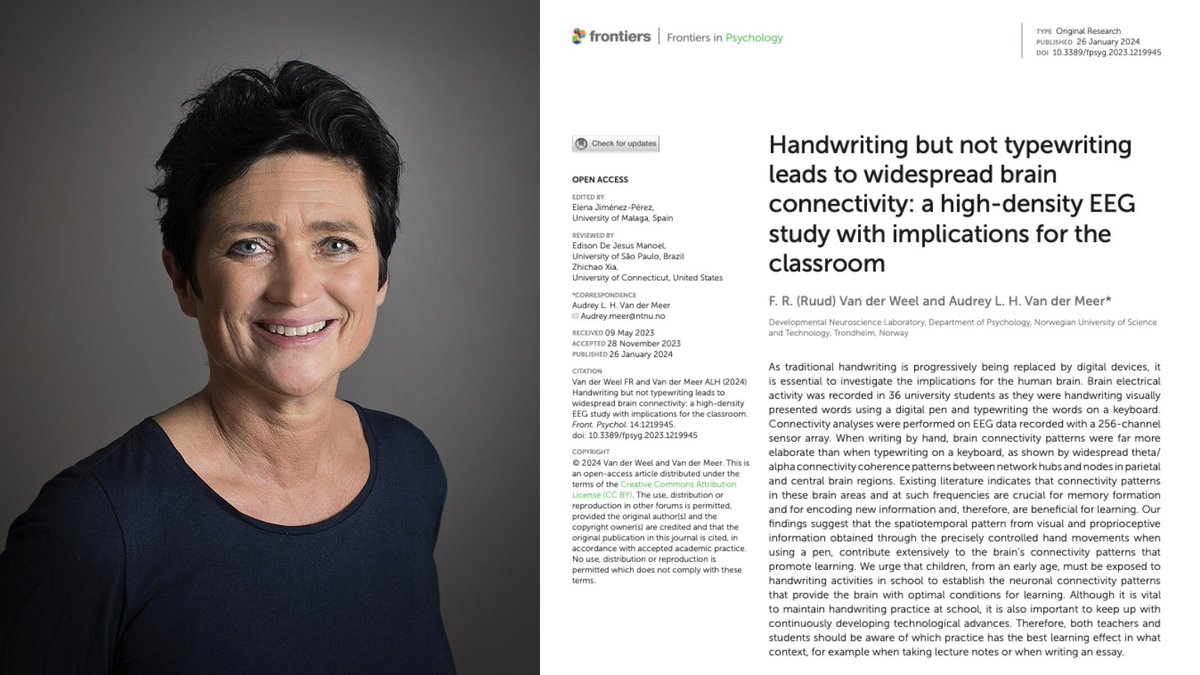
A Norwegian neuroscientist spent 20 years proving that the act of writing by hand changes the human brain in ways typing physically cannot, and almost nobody outside her field has read the paper.
Her name is Audrey van der Meer.
She runs a brain research lab in Trondheim, and the paper that closed the argument was published in 2024 in a journal called Frontiers in Psychology. The finding is brutal enough that it should have changed every classroom on Earth.
The experiment was simple. She recruited 36 university students and put each one in a cap with 256 sensors pressed against their scalp to record brain activity. Words flashed on a screen one at a time.
Sometimes the students wrote the word by hand on a touchscreen using a digital pen, and sometimes they typed the same word on a keyboard. Every neural response was recorded for the full five seconds the word stayed on screen.
Then her team looked at the part of the data most researchers had ignored for years, which is how different parts of the brain were communicating with each other during the task.
When the students wrote by hand, the brain lit up everywhere at once.
The regions responsible for memory, sensory integration, and the encoding of new information were all firing together in a coordinated pattern that spread across the entire cortex. The whole network was awake and connected.
When the same students typed the same word, that pattern collapsed almost completely.
Most of the brain went quiet, and the connections between regions that had been alive seconds earlier were nowhere to be found on the EEG.
Same word, same brain, same person, and two completely different neurological events.
The reason turned out to be something nobody had really paid attention to before her work. Writing by hand is not one motion but a sequence of thousands of tiny micro-movements coordinated with your eyes in real time, where each letter is a different shape that requires the brain to solve a slightly different spatial problem.
Your fingers, wrist, vision, and the parts of your brain that track position in space are all working together to produce one letter, then the next, then the next.
Typing throws all of that away. Every key on a keyboard requires the exact same finger motion regardless of which letter you are pressing, which means the brain has almost nothing to integrate and almost no problem to solve.
Van der Meer said it plainly in her interviews.
Pressing the same key with the same finger over and over does not stimulate the brain in any meaningful way, and she pointed out something that should scare every parent who handed their kid an iPad.
Children who learn to read and write on tablets often cannot tell letters like b and d apart, because they have never physically felt with their bodies what it takes to actually produce those letters on a page.
A decade before her, two researchers at Princeton ran the same fight using a completely different method and ended up at the same answer. Pam Mueller and Daniel Oppenheimer tested 327 students across three experiments, where half took notes on laptops with the internet disabled and half took notes by hand, before testing everyone on what they actually understood from the lectures they had watched.
The handwriting group won by a wide margin on every question that required real understanding rather than surface recall.
The reason was hiding in the transcripts of what the two groups had actually written down.
The laptop students typed almost word for word, capturing more total content but processing almost none of it as they went, while the handwriting students physically could not write fast enough to transcribe a lecture in real time, which forced them to listen carefully, decide what actually mattered, and put it in their own words on the page.
That single act of choosing what to keep was the learning itself, and the keyboard had quietly skipped the choosing and skipped the learning along with it.
Two studies. Two countries. Same answer.
Handwriting makes the brain work. Typing lets it coast.
Every note you have ever typed instead of written went into your brain through a thinner pipe. Every meeting, every book highlight, every idea you captured on your phone instead of on paper was processed at half depth.
You did not forget those things because your memory is bad. You forgot them because typing never woke the part of the brain that would have made them stick.
The fix is the thing your grandmother already knew.
Pick up a pen. Write the thing down. The slower road is the faster one.
Sending out some good energy to Coco for tomorrow’s Final from the 2024 US Open, when she came from behind to defeat Svitolina in three sets. Let’s bring that whole tool box to work tomorrow, and love the battle 💜🎾