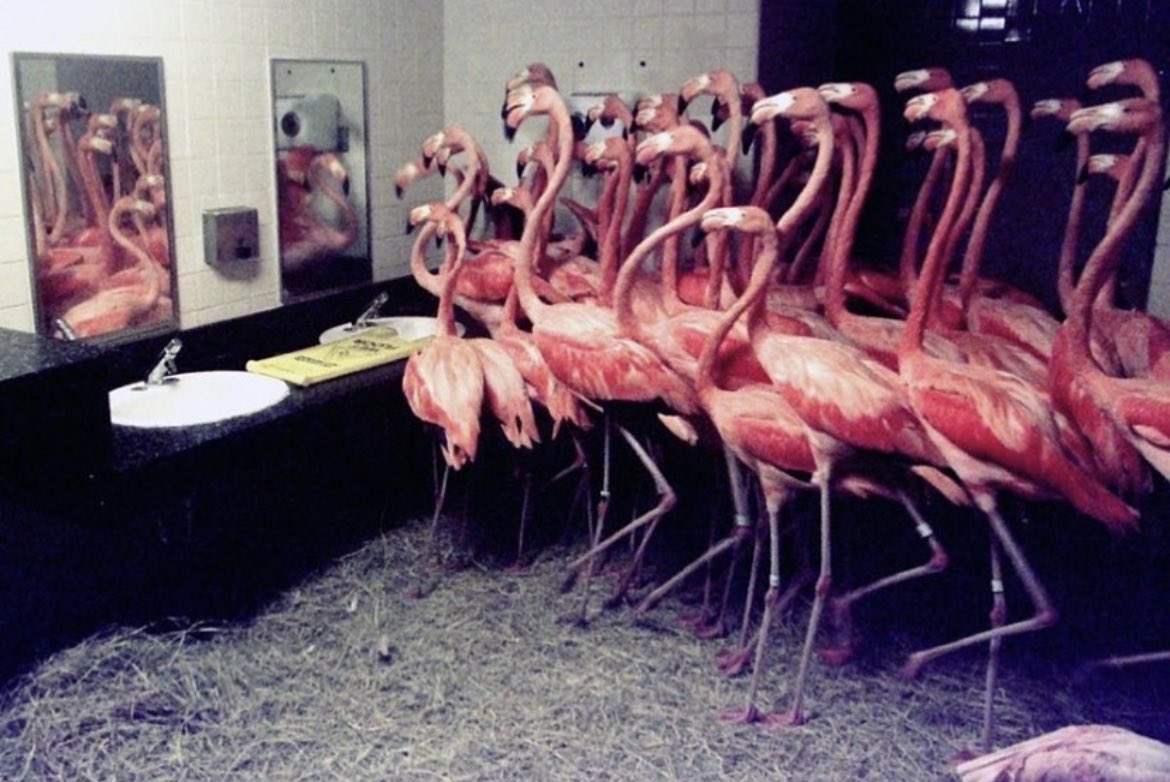
In 1992, when Hurricane Andrew was coming to South Florida, the Miami Zoo had to prepare.
Ron Magill, who was helping run the zoo then, had seen many hurricane warnings, but none had hit before.
Despite this, he and his team worked really hard to keep all the zoo animals safe.
They chose to move 30 flamingos into the zoo's bathroom. The bathroom was a safe spot because it had no windows, it was easy to clean, there was enough room to put down hay for the flamingos to sleep on, and they could fill the toilets with water for the birds to drink.
But moving the flamingos wasn't easy.
Magill remembers, "We were catching these birds while they were flapping around, and we were all getting wet and messy."
Despite that, they managed to get all the birds into the bathroom. When Magill was about to leave, he looked back and saw the flamingos posing close to a mirror and captured the perfect photo.
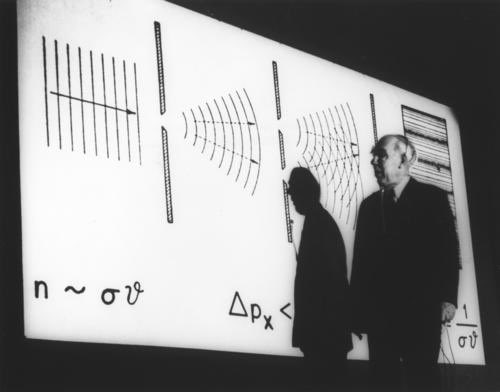
"An expert is a person who has found out by his own painful experience all the mistakes that one can make in a very narrow field."
-- Niels Bohr (1855-1962)
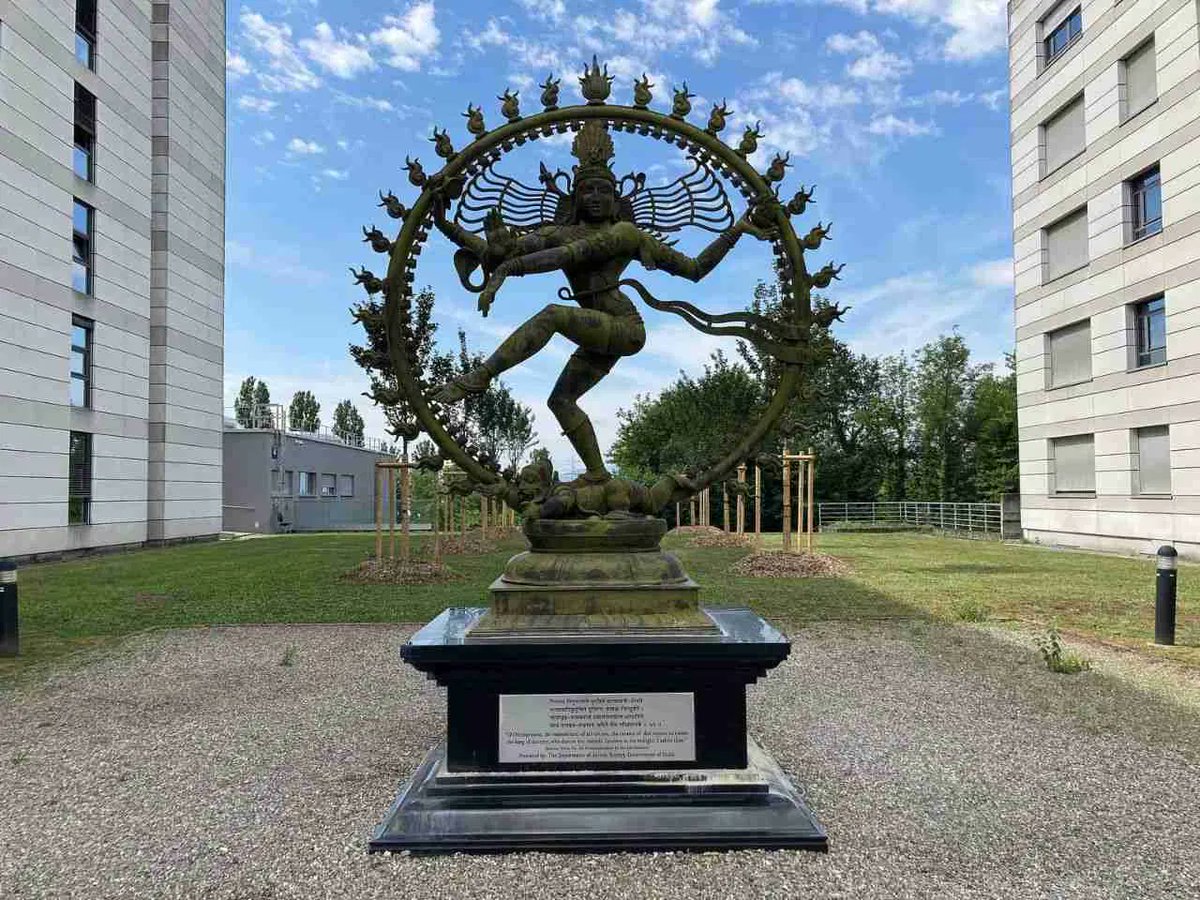
Lord Shiva's Nataraj statue at CERN 🌌
A 2m tall statue of the Indian deity Lord Shiva is kept on a permanent display between buildings 39 and 40 at CERN. The statue was a gift from India (2004), according to CERN, celebrating its long association with India which started in the 1960's.
The statue represents the cosmic dance of Shiva, which symbolizes the cycle of creation and destruction of the universe. Shiva is shown with four arms, holding a drum, a fire, a trident, and a gesture of fearlessness. He is surrounded by a ring of flames and stands on a dwarf, who represents ignorance. His dance is said to be the source of all movement and energy in the cosmos. The statue was made in India with wax and soil mould with liquid metal poured into it upon cooling.
The statue also has a connection to modern physics, as Shiva’s dance can be seen as a metaphor for the dynamic nature of subatomic particles. The physicist Fritjof Capra wrote about this analogy in his book The Tao of Physics, and his quote is inscribed on a plaque below the statue. The plaque reads,
"Ananda K. Coomaraswamy, seeing beyond the unsurpassed rhythm, beauty, power and grace of the Nataraja, once wrote of it ‘It is the clearest image of the activity of God which any art or religion can boast of.’ More recently, Fritjof Capra explained that ‘modern physics has shown that the rhythm of creation and destruction is not only manifest in the turn of the seasons and in the birth and death of living creatures, but is also the very essence of inorganic matter,’ and that ‘for the modern physicists, then, Shiva’s dance is the dance of subatomic matter.’ It is indeed as Capra concluded:
‘Hundreds of years ago, Indian artists created visual images of dancing Shivas in a beautiful series of bronzes. In our time, physicists have used the most advanced technology to portray the patterns of the cosmic dance. The metaphor of the cosmic dance thus unifies ancient mythology, religious art and modern physics.’"
📷commons
The Feynman point is the name given to the position in the decimal expansion of π where a sequence of six consecutive nines first appears. It is named after the physicist Richard Feynman, who allegedly joked that he would like to memorize the digits of pi up to that point and then say “and so on” as if π. were rational. The Feynman point occurs at the 762nd digit after the decimal point, which is much earlier than expected by chance.
Yifan Zhang's artworks are laden with themes inspired by mythology. He combines his own Chinese culture with Western culture to create his own unique and sophisticated style.
https://t.co/ScNLzFWgJa