This is how they want to achieve regime change in Spain. They orchestrated the whole event, the put a blame on Spanish government.
If the attempt of regime changes fails in EU orchestrated by US fails, we might see fully isolated agressive US.
🇺🇸🇪🇸 Trump on Spain's migrant crisis in Ceuta:
"When I watched what happened in Spain, I said, 'Boy, that's going to be a talking point for the midterms.'
They are invading the country. That is weak law, bad management, very liberal law."
I mean, maybe?? I'm not sure how much Middle America is concerned about Moroccans pouring into Spain.
I'd think they're more concerned about a seemingly endless war in the Middle East, rising prices at the grocery store, AI taking over their jobs....
Writer: Claudio
The CEO of the biggest company on earth had never posted on social media in his life. Until this week. He broke his silence to stop the US government from doing something, and it put him on the same side as China, against America's own top AI labs.
The White House accused Chinese AI startup Moonshot of illegally using banned Nvidia Blackwell chips and distilling U.S. AI models to develop its powerful Kimi K3 model.
Officials say the company may have accessed restricted chips through Thailand and violated U.S. export controls and AI companies' terms of service.
Moonshot has not responded to the allegations, while Nvidia says it does not exploit export-control loopholes.
Source: Bloomberg
Qwen3.8 is launching and going open-weight soon!🌐
With a massive 2.4T parameters, this model is continuously evolving. We believe it’s one of the most powerful model available today, compatible to leading frontier AI models , second only to Fable 5.
You don't have to wait to test it. Just now, the Qwen3.8-Max-Preview made its debut on Alibaba’s Token Plan, Qoder, and QoderWork. Be among the very first to try it out.
Can't wait to hear what you build. Stay tuned!
Token Plan :
international:https://t.co/aP7QXKVNEX
China:https://t.co/vsq7elAnIr
CIA Director John Ratcliffe:
The Chinese steal the technology, they replicate it, the state subsidizes it, and that's their model of success.
They are very good at it.
OK here is the thing, the only winners in AI war are the hardware companies in the long run. Software companies are benefiting from the scarcity of hardware, which will soon be over.
Kimi K3 scores 57 on the Artificial Analysis Intelligence Index. Its intelligence is comparable to Opus 4.8 and GPT-5.5 but remains behind Fable 5 and GPT-5.6 Sol. Moonshot AI has expressed plans to release the 2.8T parameter model's weights, which would make it the leading open weights model
Key results:
➤ Strong agentic task performance: @Kimi_Moonshot's Kimi K3 reaches an Elo rating of 1668 on GDPval v2. This is a marked improvement over K2.6’s 1190, surpassing GLM-5.2 (1514), GPT-5.5 (1494), and Claude Opus 4.8 (1600). However, it still lags behind Claude Fable 5 (1760). Kimi K3 also scores an impressive 53% and takes the #1 position on AutomationBench-AA, our implementation of Zapier’s Agentic SaaS workflow evaluation.
➤ Second-highest performance on AA-Briefcase (agentic knowledge work): On our private long-horizon knowledge work evaluation, Kimi K3 reaches an overall Elo of 1547, +732 points from Kimi K2.6 and behind only Claude Fable 5. It is well-rounded: its rubric scoring and analytical quality almost reach Claude Fable 5’s scores, while GPT-5.6 Sol continues to outperform other leading models on presentation quality.
➤ Set to lead open weights models once weights are released: Moonshot AI has not yet released the weights but expressed plans to do so. Once available, Kimi K3 would clearly lead other open weights models including GLM-5.2 (51) and DeepSeek v4 Pro (44). However, at 2.8T parameters, it is significantly larger than its open weights peers (eg. GLM-5.2 at 753B params and DeepSeek V4 Pro at 1.6T), as well as the Kimi K2 to K2.6 models (1T params).
➤ Cost per task ($0.94) is similar to GPT-5.6 Sol ($1.04), ~1/2 the price of Opus 4.8 ($1.80) and higher than open weights peers: Moonshot AI’s pricing for K3 is significantly higher than their K2 pricing (K3’s output token price is $15/1M tokens while K2.6 was $4). This positions the model as cheaper on a cost per task basis than Opus 4.8, similar to GPT-5.6 Sol ($1.04) and more expensive than open weights peers, GLM-5.2 ($0.32) and DeepSeek V4 Pro ($0.04)
➤ Improved token efficiency alongside higher intelligence: Kimi K3’s token usage on the Artificial Analysis Intelligence Index decreased significantly, using 21% fewer output tokens than K2.6. The new model used approximately 132M output tokens to complete all nine evaluations, compared to approximately 166M for K2.6, while achieving higher scores.
➤ Native multimodal capabilities: Kimi K3, like K2.6, is released with native image and text multimodal input. If weights are released, this will position Kimi K3 as one of the leading open weights models with multimodal input capabilities
Other model details:
Context window: 1M
Size: 2.8T total parameters
Pricing: The first-party API is priced at $3.00/$15.00 per 1M input/output tokens, with cached input discounted 90% to $0.30 per 1M tokens.
Modality: Native multimodal input supports text and images, and the model remains text-only for output.
Accessibility: Accessible at launch through Moonshot’s first party API. Model weights are not yet released but Moonshot AI has expressed plans to do so.
Kimi K3 scores 57 on the Artificial Analysis Intelligence Index. Its intelligence is comparable to Opus 4.8 and GPT-5.5 but remains behind Fable 5 and GPT-5.6 Sol. Moonshot AI has expressed plans to release the 2.8T parameter model's weights, which would make it the leading open weights model
Key results:
➤ Strong agentic task performance: @Kimi_Moonshot's Kimi K3 reaches an Elo rating of 1668 on GDPval v2. This is a marked improvement over K2.6’s 1190, surpassing GLM-5.2 (1514), GPT-5.5 (1494), and Claude Opus 4.8 (1600). However, it still lags behind Claude Fable 5 (1760). Kimi K3 also scores an impressive 53% and takes the #1 position on AutomationBench-AA, our implementation of Zapier’s Agentic SaaS workflow evaluation.
➤ Second-highest performance on AA-Briefcase (agentic knowledge work): On our private long-horizon knowledge work evaluation, Kimi K3 reaches an overall Elo of 1547, +732 points from Kimi K2.6 and behind only Claude Fable 5. It is well-rounded: its rubric scoring and analytical quality almost reach Claude Fable 5’s scores, while GPT-5.6 Sol continues to outperform other leading models on presentation quality.
➤ Set to lead open weights models once weights are released: Moonshot AI has not yet released the weights but expressed plans to do so. Once available, Kimi K3 would clearly lead other open weights models including GLM-5.2 (51) and DeepSeek v4 Pro (44). However, at 2.8T parameters, it is significantly larger than its open weights peers (eg. GLM-5.2 at 753B params and DeepSeek V4 Pro at 1.6T), as well as the Kimi K2 to K2.6 models (1T params).
➤ Cost per task ($0.94) is similar to GPT-5.6 Sol ($1.04), ~1/2 the price of Opus 4.8 ($1.80) and higher than open weights peers: Moonshot AI’s pricing for K3 is significantly higher than their K2 pricing (K3’s output token price is $15/1M tokens while K2.6 was $4). This positions the model as cheaper on a cost per task basis than Opus 4.8, similar to GPT-5.6 Sol ($1.04) and more expensive than open weights peers, GLM-5.2 ($0.32) and DeepSeek V4 Pro ($0.04)
➤ Improved token efficiency alongside higher intelligence: Kimi K3’s token usage on the Artificial Analysis Intelligence Index decreased significantly, using 21% fewer output tokens than K2.6. The new model used approximately 132M output tokens to complete all nine evaluations, compared to approximately 166M for K2.6, while achieving higher scores.
➤ Native multimodal capabilities: Kimi K3, like K2.6, is released with native image and text multimodal input. If weights are released, this will position Kimi K3 as one of the leading open weights models with multimodal input capabilities
Other model details:
Context window: 1M
Size: 2.8T total parameters
Pricing: The first-party API is priced at $3.00/$15.00 per 1M input/output tokens, with cached input discounted 90% to $0.30 per 1M tokens.
Modality: Native multimodal input supports text and images, and the model remains text-only for output.
Accessibility: Accessible at launch through Moonshot’s first party API. Model weights are not yet released but Moonshot AI has expressed plans to do so.
We’ve just released the 1-bit & 4-bit version of Hy3, a flagship-scale 295B model that can be served on a single GPU. 👌
Run Hy3 with llama.cpp, enable MTP, and experience powerful intelligence on dramatically lower hardware.🚀🚀🚀
Can’t wait to see what you build.
#Hy3 #Hy#GGUF #llamacpp
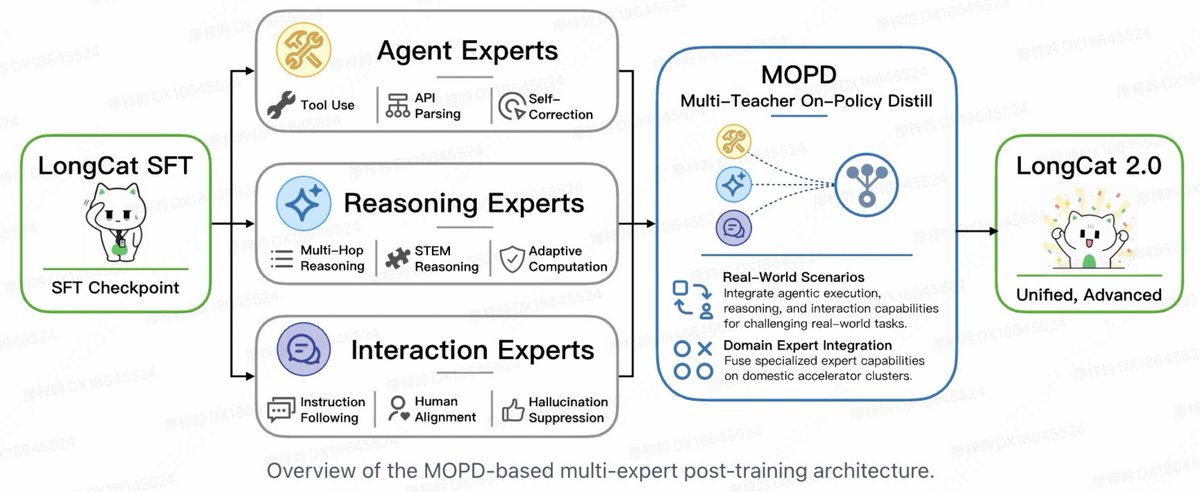
Introducing LongCat-2.0 🐱
1.6T parameters · MoE with ~48B active · 1M context
The full model behind Owl Alpha on @OpenRouter — now available.
Built for agentic coding from the ground up:
◆ LongCat Sparse Attention (LSA) — scales efficiently for 1M-context tokens
◆ Zero-Compute Experts — dynamic activation 33B–56B per token, zero wasted compute
◆ MOPD — three specialized expert groups (Agent / Reasoning / Interaction), gate-routed per task
How it stacks up:
→ Terminal-Bench 2.1: 70.8
→ SWE-bench Pro: 59.5 (GPT-5.5: 58.6)
→ SWE-bench Multilingual: 77.3
→ FORTE: 73.2 · RWSearch: 78.8 · BrowseComp: 79.9
📖 Tech Blog: https://t.co/4KrjyKiDBn
Try it across different scenarios 🧵👇
🚨🇺🇸 Anthropic's powerful Fable 5 model could be back online as soon as tonight.
The Trump administration reportedly plans to lift export restrictions on Fable 5 as early as this evening, restoring access for all general users.
It follows Friday's partial unlocking of Mythos 5, the more powerful model Fable is built from, with extra safeguards against cyberattack misuse.
The whole episode rattled the industry.
The administration's June 12 export controls cut off both models entirely, frustrating users and even European allies eager to use Anthropic's tools to find security holes before adversaries do.
The reversal now defuses weeks of drama.
The bigger fight isn't over.
OpenAI was pressured into limiting its newest model the same week, and executives across the industry are pushing for a clear, predictable process to replace what they see as the White House's reactive, case-by-case gatekeeping.
Washington is still trying to balance frontier-AI security risks against staying ahead of China, and the rules keep shifting under everyone's feet.
Source: Politico / Writer: Daniel
Good morning y'all!
Qwopus-3.6-35B-A3B-MTP-Coder is live! All GGUF's will be populating over the next few hours!
It's a lightning-fast MOE with the coder curriculum recipe. Similar to the 27B coder, it shines with thinking disabled, offering significantly faster wall time for similar, and in some cases superior results to same-sized thinking alternatives! With thinking disabled, it goes toe-to-toe with the new Ornith 35B MoE across a huge eval suite (performed by @no_stp_on_snek), edging it on the coding trajectories and decisively on speed and cost, even though Ornith was run with thinking enabled.
See the model card for the full test results, and shoutout to Tom, @no_stp_on_snek, for thoroughly evaluating the model for us before launch!
With MTP and thinking disabled, along with the MOE speed, it runs so quickly in harnesses like @opencode that it almost feels instant @ 253 tps on my 5090.
No 8k tokens of thinking before a coherent output is actioned. This is especially useful in long contexts, where the base models will progressively start thinking for tens of thousands of tokens before replying.
Compared to the base models with thinking off, the coder curriculum really advances the no-think frontier. Especially in terms of how creative it can be. Run temp hot as usual, 0.85-1, and make sure your harness isn't overriding the temp setting of your server at runtime.
If you want to use it to its full ability, I would recommend giving it very thorough prompts. I have been using it in opencode, and I have been blown away by the results it generates autonomously with chunky prompts. Please see links to the demo's Aether Dominion (RTS Game), and a slide deck presentation the model made about itself that turned out beautifully, links in comments below!
I am getting results on this incredibly fast local model (with thinking disabled) that I couldn't get in some thinking frontier models over a year ago.
Open source is accelerating fast, and in light of recent events, there's never been a better time to get your local AI workflows tightened up. This MOE would be a great one to play with, and it's also a great one if you don't have much VRAM because it can run fast offloaded partially to system memory!
All of that said, please give it a run with thinking off and build something you'd like to see. We'd love to see your results and any feedback on specific use cases in the comments below!
Also, thanks so much for 5k followers, you all make up such an enjoyable and knowledgeable open source community, and I am so blessed to be able to collaborate and discuss this research with all of you. I can't express how grateful I am for every comment. As always, I will try to reply to them all!
If we ever get monetized on X, I will put every penny into buying more hardware for our lab!
Have a blessed day, my friends, looking forward to your thoughts!
https://t.co/0WkjglsaWS
Anthropic CEO:
“open source is kind of a distraction you still can’t really see what’s happening inside the model, so it’s not truly “free.”
People should be paying a lot more attention to what Anthropic is doing.
Lot of mental backflips here by Dario Amodei to dismiss open source AI:
- You can literally see what's happening inside the model. The weights are available (if you can make sense of them).
- Fully open source models like Nemotron make the entire training dataset and recipe available (which Anthropic never does).
- The same mechanistic interpretability techniques Anthropic uses to investigate the inner workings of its models are applicable to open-weight models, and the entire scientific community can work on them as opposed to the one lab that has access to the weights.
- Anyone can fine-tune the model (given they have resources)
- You might need to host them in the cloud, but you're in full control and you don't have to worry about Anthropic or OpenAI or some other AI lab monitoring your usage to create a competitor product.
- And last but not least, since the model is being served transparently, you don't need to worry about the hosting service to nerf the model at peak demand, ban your account because it didn't like your prompts, or route you to another model because what you're requesting is too dangerous. You're in full control.
I don't think that the fable or Gpt - 5.6 are or more capable to do magic as they frame. However, the government wants it to be slowed down. So as a tool it is useful enough for the industry and dump enough to not replace you or replace them. Let's see how China responds.
🚨 BREAKING: U.S. government will decide who gets access to GPT-5.6
OpenAI will release GPT-5.6 only in a limited preview to a small group of partners.
Sam Altman told staff the government would be "approving access customer by customer."
Commerce Sec Lutnick personally called Altman warning: don't launch without approvals from other agencies.
A de facto licensing regime.
ITS HAPPENING
Aloha! 🌺 Meet Ornith-1.0, a family of open-source LLMs specialized for agentic coding.
Ornith-1.0 spans the full parameter sizes including 9B Dense, 31B Dense, 35B MoE, and 397B MoE. It achieves state-of-the-art performance among open-source models of comparable size on coding benchmarks including:
✅Terminal-Bench 2.1(77.5)
✅SWE-Bench(82.4 on verified, 62.2 on pro, 78.9 on Multilingual)
✅NL2Repo(48.2)
✅SWE Atlas(41.2 on QnA, 42.6 RF, 39.1 TW)
✅ClawEval(77.1)
Post-trained on top of gemma4 and qwen3.5, Ornith-1.0 employs a novel self-improving training strategy in which reinforcement learning is used to generate not only solution rollouts, but also the task-specific scaffolds that drive those rollouts. By jointly optimizing the scaffold and the resulting solution, the model generate higher-quality solutions in agentic coding.😎
All models are released under the MIT license, enabling full commercial and research use.
📖Tech Blog: https://t.co/qT9N2HYWFn
🤗Huggingface: https://t.co/PRrwqjeBtM