Asst Professor @FSU_EOAS studying clouds, aerosols, & climate. Views my own & not representative of employers past, present, future, in nearby multiverses, etc.
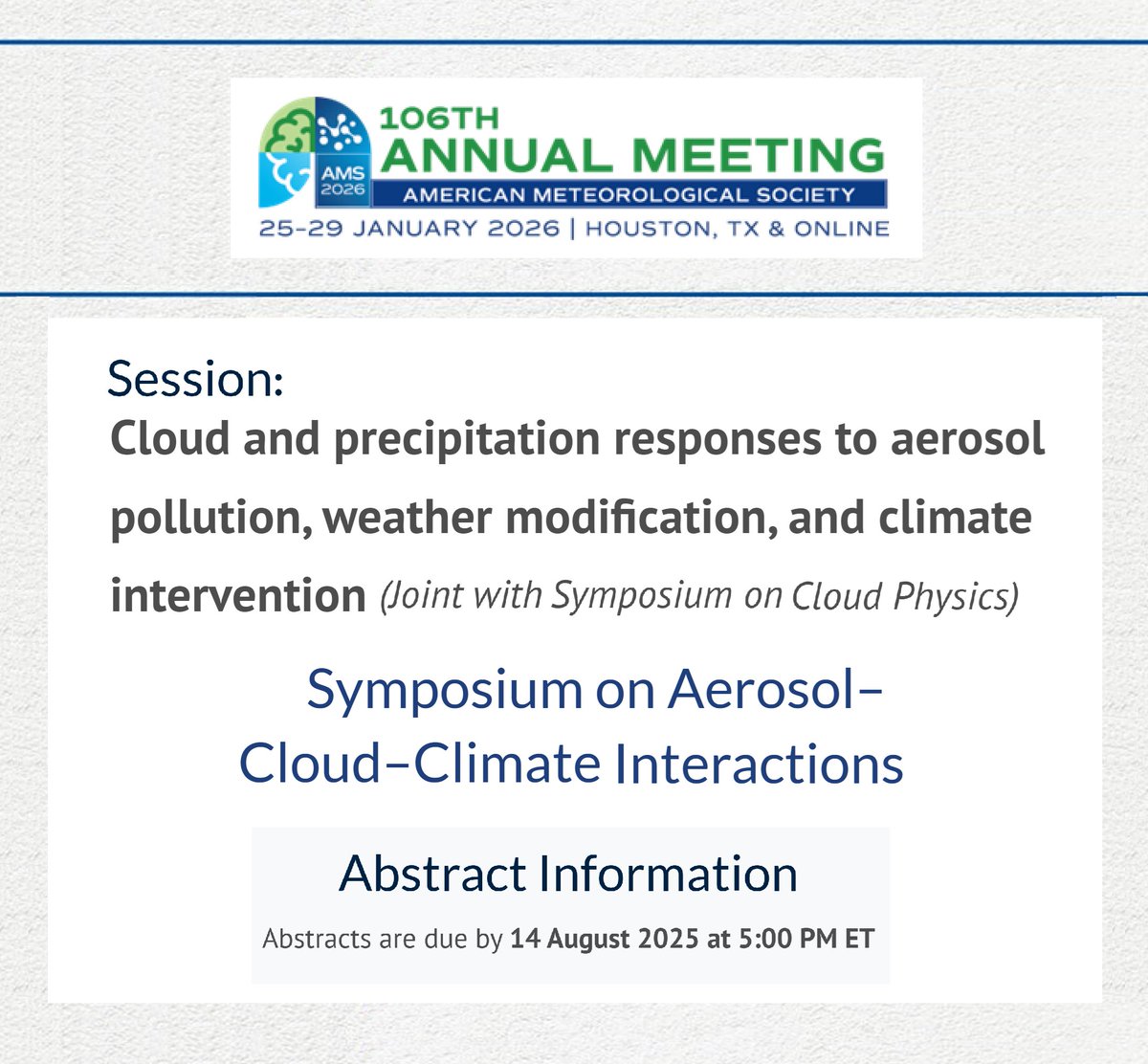
Please consider submitting an abstract to our #AMS2026 session on cloud & precipitation responses to aerosol pollution..., organized by Troy Zaremba and me, as part of aerosol-cloud-climate symposium at #AMS106 in Houston, Jan 26.
#cloud#aerosol#DiscoverDRI@ametsoc@zmann3000
Congratulations to #FSU Presidential Scholar and meteorology sophomore Matthew Azuara, winner of the Ernest F. Hollings Undergraduate Scholarship from @NOAA! Recognized for his research on the impact of wildfires on air quality, he will take part in a 10-week internship at a NOAA facility next summer.
Matthew conducted his work under the guidance of @FSU_EOAS associate professor Christopher Holmes through the Undergraduate Research Opportunity Program. Learn more about his project: https://t.co/EKBf8Rjl3v
@FSU_CRE@ONF_FSU
Our latest Climate Reflections podcast episode dives into Marine Cloud Brightening.
🎥 : @ScCloudMD shares how studying the cooling effects of ships' pollution led to this potential #ClimateIntervention
🎙️ Listen on your favorite podcast platform: https://t.co/63WpqWPTIo
#firstalertwx this Florida law & jet contrails are two very different "things". As long as jets fly & weather conditions are *right*, we will see contrails @ActionNewsJax@WOKVNews
FACT VS FICTION: we sat down with a meteorologist on FL’s upcoming ban on weather modification, which @GovRonDeSantis announced today he will sign into law.
@MikeFirstAlert also weighed in on the chemtrail vs contrail debate.
@ActionNewsJax
https://t.co/xhWpe3RZmu
Very excited I get to contribute to the great @SRM360_org project! There's a real need for quality information on sunlight reflection methods that is clear, balanced, accessible. @peteirvine and his team are off to a great start addressing that gap
New op-ed from @AnnaBershteyn and @ScCloudMD explores the urgent need to continue first-of-its-kind aerosol research that could help forecast climate and inform life-saving tools for extreme heat. Read more in CNN.
@LeonSimons8 Note that SST differences are 1) accounted for in the kriging algorithm and 2) not easily tied to anomalies in cloud microphysics. So we're really looking for an aerosol effect in terms my Figure 4
@LeonSimons8 To explain the change in the background "NoShip" effective radius/Nd as due to IMO 2020, it would have to be true that the uniform change in aerosol from long-range transport is ~3x greater than the change from aerosol emitted in the corridor itself. I find that implausible
@LeonSimons8 True it didn't account for SST warming from changing the background (but would see a perturbation in the environment within the lane). Background perturbation from long-range transport would have to be >>> the corridor perturbation for the "false IMO effect" to be real though
SilverLining is grateful to have supported, alongside @GAYO and @OperaatioArktis, the Sámi Parliament of Finland (@Saamelaiskaraja)’s side event on Indigenous voices on climate intervention research during @UN4Indigenous at @FinlandUN. 1/3 ↓
Dr. Sarah Doherty, atmospheric scientist & Director of @UW Marine Cloud Brightening Program, gave a phenomenal talk at #TED2024 on the imp. of research on how aerosols & clouds impact our climate system & a groundbreaking new effort to study it. Stay tuned – releases May 9! 1/3↓
Very excited to be participating in this event in a few days! Many thanks to the Sámi Parliament of Finland @Saamelaiskaraja, @SilverLiningNGO, @OperaatioArktis, and Green Africa Youth Organization for organizing and for the invitation to speak about #climateintervention research
SilverLining, alongside @GAYO & @OperaatioArktis is honored to support Sámi Parliament of Finland (@Saamelaiskaraja)’s side event on indigenous voices on climate intervention research during the Permanent Forum on Indigenous Issues (@UN4Indigenous) at @FinlandUN this week. 1/4↓
3/ This event speaks to the urgent need to center Indigenous knowledge, perspectives, & rights in global efforts to address climate change. It seeks to highlight the importance of integrating Indigenous perspectives, knowledge, & participation into climate intervention research.
2/ At the front lines of climate impacts, Indigenous Peoples hold invaluable traditional knowledge and practices arising from their relationships with nature That can contribute significantly to efforts seeking to address global warming– including climate intervention research.