From crypto news headlines to real life! Captured these financial titans shaking hands in Singapore. Subtle moves in the crypto world! #ThanksCrypto 💯
#Singapore 🇸🇬
The facts as we know them:
1. @Binance is reentering the Philippines thru Blockshoals, which was granted sandbox access by the @SEC_Philippines .
2. Blockshoals' owners are currently also involved in various Romualdez-owned businesses.
3. Both Binance and Romualdez have been associated with alleged money laundering activities in the past here in the Philippines, as recently as Nov 2025. (See ICI investigation into the flood control funds and how they were exiting the country.)
Does it mean Romualdez is actually behind Blockshoals? Not necessarily, but if we put all those facts together ... surely this is something worth looking into more deeply?
PS. The Binance website reportedly became accessible again here in the Philippines earlier today (although not on my Converge home connection) ... what a rollercoaster of a day it must have been for the local team!
Good news so far!
Rollback na ang presyo ng mga produktong petrolyo, base sa kalakalan sa world market mula April 6 hanggang 8, 2026.
Dalawang trading days pa ang hihintayin para matiyak na maisasakatuparan ito. #PricePatrol
@FinanceLancelot Kinda good read, looks like we are already at the saturation stage of our current technology, national budget and focus of superpowers right now is on war and defense, so war is inevitable. People will fall to apathy and result to civil unrest i guess.
Personal Announcement No. 3: I’m joining Talino Fintech Foundry as their Chief Strategy Officer
Here’s my last personal announcement for the quarter, a bit later than I was expecting to make it. As of today, I’ll be working with the US/PH startup Talino. I'll be focusing on rethinking the payments pipeline between the US and the Philippines with stablecoins, blockchain, AI, and tons of existing licenses, partners, and clients.
In many ways, the work that I’ll be doing at Talino feels like the culmination of the last 18 years of my tech career.
In 2008, back when many of you were in grade school, I did a pitch at one of the earliest examples of a startup pitching competition in the country to a panel of prominent Pinoy investors. One of them was Winston Damarillo @TalinoWD , and over the next couple of years, I ended up building a handful of archetypal social media and ecommerce web apps under his tutelage.
By 2014 I had ventured off on my own, discovering Bitcoin and eventually founding BloomSolutions. Bloom’s first product was a Bitcoin-powered remittance pipeline connecting OFWs in Korea and Hong Kong back with their families here in the Philippines.
We struggled to make it work for many reasons – local crypto trading volume was too small or too volatile, there were no regulatory frameworks to work with, and we didn’t have the kind of reach that would allow our ideas to scale quickly.
Heck, it was so long ago that we barely even had Instapay back then. @gcashofficial was just an app that Globe employees used in their cafeteria.
In short, we were way too early.
Most of my learnings from that era are collected in this book I wrote called “Reinventing Remittances with Bitcoin.” I recently dug it up, and many of the concepts still hold true to this day … with the biggest difference being that founders now no longer have to worry about jail time when working with crypto. (A big plus, IMHO!)
By 2020, Bloom had shifted its focus to retail exchange software, and as the pandemic hit, we doubled down on our domestic-only focus.
In parallel with all of that and unbeknownst to me, Winston and his team had formed a fintech venture in the US focusing on the (much larger) remittance pipeline there using traditional payment rails and collaborating with licensed incumbents. That product was called BayaniGlobalPay, and it was built by Talino Labs.
It’s now 2026, and the #GENIUS act in the US has permanently changed the way the industry thinks about stablecoins. We have strong liquidity and compressible margins on both ends of the remittance corridor, we have regulatory frameworks that we can follow, we have traditional institutions genuinely interested in what we're offering, and we have AI accelerating everything.
I think it’s time to revisit all of my old assumptions about what’s possible with cross-border payments, and Talino is how I plan to do that. ❤️🇵🇭
UAE Water Truth 💧🇦🇪
Everyone is asking if the UAE has enough water. Here’s the reality 👇
The UAE has 26 billion liters stored in Liwa. That alone can supply water for 90 days. Dubai also has underground reserves that add another 90 days of supply.
Food is covered too, with 6 months of reserves already secured. Financially, the UAE holds assets equal to 184% of GDP.
#UAE #Dubai #MiddleEast
Digital assets are entering a new phase. What once ran in parallel to existing financial systems is increasingly being applied to solve practical, real-world needs — often behind the scenes – from cross-border remittances to B2B money transfers. This creates new opportunities to add value in how money moves globally.
Today, we introduced the Mastercard Crypto Partner Program — a global initiative that brings together more than 85 crypto-native companies, payments providers, and financial institutions. Together, we're creating a forum for meaningful dialogue and collaboration as this space continues to mature.
If you want adventure go to Indonesia 🇮🇩
If you travel for nightlife go to Thailand 🇹🇭
If you travel for history go to China 🇨🇳
If you like eating go to Vietnam 🇻🇳
If you have money go to Singapore 🇸🇬
If you're broke, go to sleep.
My monthly cost of living in Vietnam 🇻🇳
🏠 Aparment: $450
🍲 Food: $345
🚗 Transportation: $0
🛜 Data/mobile: $12
💧 Bottled water: $17
👕 Laundry: $6
Total = $830/mo
P.S. This is my first month in Vietnam. I have spent a total of 1 month and five days here now.
We need more power:
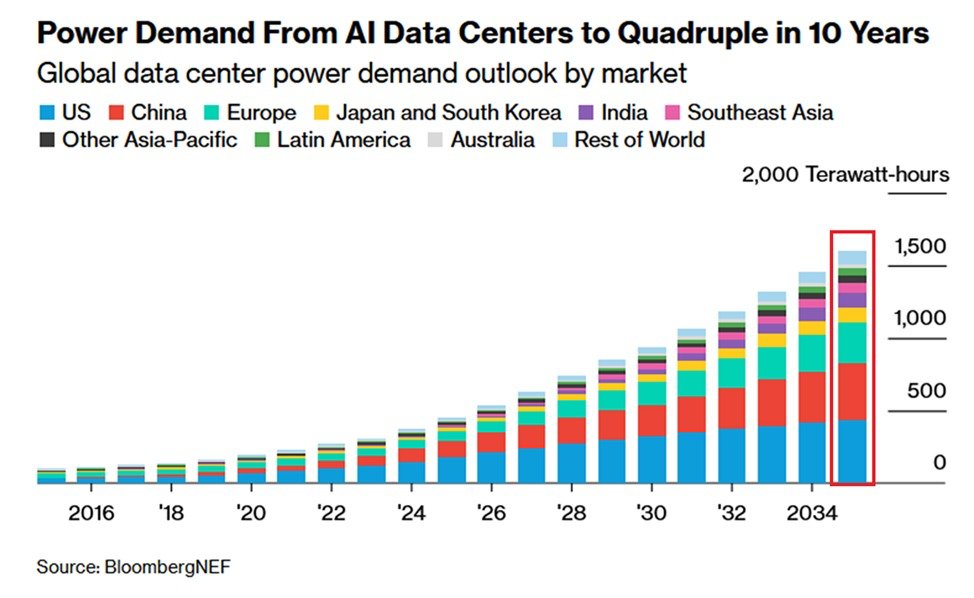
Global data center power demand is now expected to rise to a record 1,596 terawatt-hours by 2035.
That would mark a +255% increase from 2025 levels.
The US is set to remain the leader in consumption with a +144% surge in demand over this period, to 430 terawatt-hours.
China's demand is projected to rise +255%, to 397 terawatt-hours, while European demand is expected to surge +303%, to 274 terawatt-hours.
New data centers coming online between now and 2030 will need more than 600 terawatt-hours of electricity.
This is enough to power ~60 million homes.
AI growth will be contingent on generating more power.
We need more power:
Global data center power demand is now expected to rise to a record 1,596 terawatt-hours by 2035.
That would mark a +255% increase from 2025 levels.
The US is set to remain the leader in consumption with a +144% surge in demand over this period, to 430 terawatt-hours.
China's demand is projected to rise +255%, to 397 terawatt-hours, while European demand is expected to surge +303%, to 274 terawatt-hours.
New data centers coming online between now and 2030 will need more than 600 terawatt-hours of electricity.
This is enough to power ~60 million homes.
AI growth will be contingent on generating more power.